Psychology and pedagogy of writing : a résumé of the researches and experiments bearing on the history and pedagogy of writing / by Mary E. Thompson.
- Thompson, Mary Elizabeth, 1873-
- Date:
- 1911
Licence: Public Domain Mark
Credit: Psychology and pedagogy of writing : a résumé of the researches and experiments bearing on the history and pedagogy of writing / by Mary E. Thompson. Source: Wellcome Collection.
Provider: This material has been provided by the Francis A. Countway Library of Medicine, through the Medical Heritage Library. The original may be consulted at the Francis A. Countway Library of Medicine, Harvard Medical School.
131/137 (page 127)
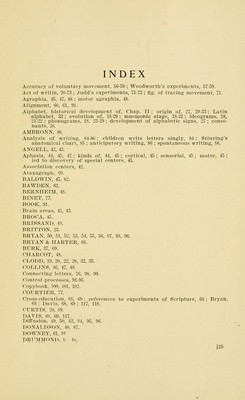
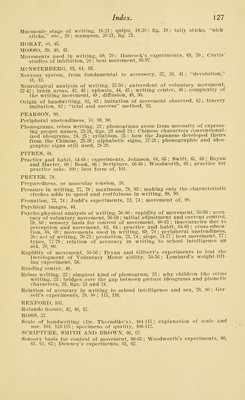
![Muemouic stage of wiitiiiir, lS-21: quipu, 18-20; fig. 19; tally sticks, nick sticks,' etc., 20 ; wampuiu, 20-21, fig. 21. MORAT, 44, 45. MOSSO, 3i), 40, 41. Movements used in writing. 69. 70; Hancock's experiments, 69, 70; Curtis' studies of inhibition, 70 ; best movement, 95-97. MlXSTERBERG, 63, 64, 93. Nervous svstem, from fundamental to accessory, 37, 38, 41; devolution, 41, 42. ' Neurological analvsis of writing. 37-5<] : antecedent of voluntary movement. 37-42; brain areasi 42. 43; aphasia, 44, 45; writing center, 46; complexity of the writing movement, 49 ; diffusion, 49, 50. Origin of handwriting. 82, 83; imitation of movement observed, 82; tracery imitation. 82 ; trial and success method, 82. TEAR SON, 80. Peripheral unsteadiness, 70, 89, 90. Phonograms, rebus writing, 23 ; phonograms arose from necessity of express- ing proper names. 23-24, figs. 23 and 24 ; Chinese characters conventional- ized ideograms 24, 25 : svilabism. 25 ; how the .Japanese developed theirs from the'^Chinese, 25-26 ;'alphabetic signs, 27-28; phonographic and ideo- graphic signs still used, 28-29. PITRES, 48. Practice and habit, 64-68 ; experiments, .Johnson. 64, 65 ; Swift. 65, 66 ; Bryan and Harter. 66 ; Book, 66 ; Scripture, 66-68 ; Woodworth, 68 ; practice for practice sake, 100 ; best form of, 101. PREYER, 78. Preparedness, or muscular tension, 38. Pressui-e in writing, 77, 78 ; maximum, 78, 93 ; making only the characteristic strokes adds to speed and restfulness in writing, 98, 99. I'ronation, 73, 74 ; Judd's experiments, 73, 74; movement of, 98. I'sj'chical images, 44. J'svcho-phvsical analvsis of writing. 50-80; rapidity of movement, 50-56 ; accu- racy of voluntary movement, 56-59 ; initial adjustment and current conti'ol, 59. (JO ; sensorv basis for control of movement. 60-63 ; inaccuracies duo to perception and movement, 63, 64 ; practice and habit, 64-68 ; cross-educa- tion. 68. 69 ; movements used in wn-iting, 69, 70 ; peripheral unsteadiness. 70; act of writing. 70-73 ; pronation, 73. 74 ; slope, 74-77 ; best movement. 77 ; types. 77-79; relation of accuracy in writing to school intelligence an sex, 79, 80. Rapiditv of movement. 50-56 ; Brvan and Gilbert's experiments to test the JJevelopmeut of Voluntary Motor ability, 50-56; Lombard's weight-lift- ing experiment, 56. Reading center, 46. Rebus writing. 23 ; simplest kind of phonogram. 23 ; why children like rebus writing. 23 ; bridges over the gap between picture ideograms and phonetic characters, 2.3, figs. 23 and 24. Relation of accuracy in writinir to school intelligence and sex, 79, 80 ; Ger- sell's experiments, 79. 80 ; urj, 116. RE.XFORI*. lO.*]. Rolando fissure, 42, 46, 47. PtOSS, 37. Scale of handwiiliiig (hr. Tln-nidike's), 104-115; explan.ition of scab' and use, 101. lllMir, : six'ciiiK'ns of (|Ualify. 106-112. SCRIPTURE, S.Mrifr AND P.ROWN, 66. 67. Sensory basis for control of movement, 60-63; Woodworth's ex[)eriiiu'n1s. 60, 61, 02, 03; Downey's exp^'riiiienls. 61, 62.](https://iiif.wellcomecollection.org/image/b21167254_0131.jp2/full/800%2C/0/default.jpg)