Derivatives of glyoxaline-or 4(or 5)-formaldehyde and glyoxaline-4(or 5)-carboxylic acid : a new synthesis of histidine / Frank Lee Pyman.
- Pyman, Frank Lee.
- Date:
- [1916?]
Licence: In copyright
Credit: Derivatives of glyoxaline-or 4(or 5)-formaldehyde and glyoxaline-4(or 5)-carboxylic acid : a new synthesis of histidine / Frank Lee Pyman. Source: Wellcome Collection.
15/16 page 202
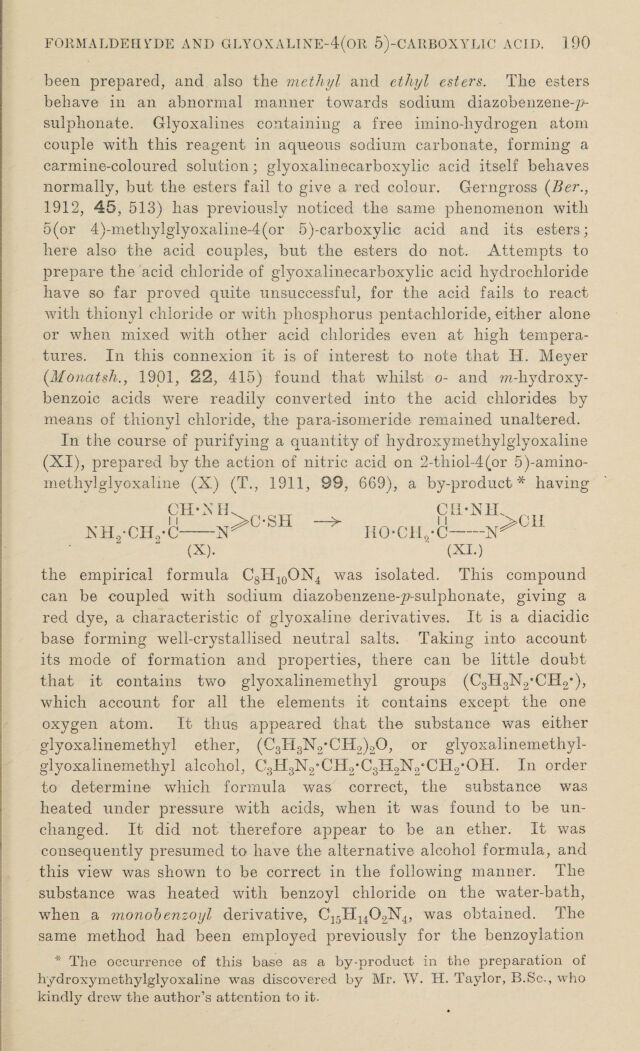
![(T., 1912, 101, 541), except that the acid solution was precipitated by the addition of sodium carbonate, when the benzoate separated as an oil which soon crystallised. The crystals melted at 67—68° (corr.), and the same melting point was recorded after the substance had been crystallised from water, when it separated in needles containing water of crystallisation: Found, H20 = 8‘7. C15H1402N4,1 JH20 requires H20 — 8'7 per cent. After crystallisation from ethyl acetate, the substance is obtained anhydrous in the form of warts melting at 120—121° (corr.): Found, C = 63'9 ; H = 5*0; N = 20‘0. C15H1402N4 (282T) requires C = 63'8; H = 5*0; N = 19*9 per cent. The substance is sparingly soluble in cold, but fairly readily so in hot water; readily soluble in alcohol or chloroform, but sparingly so in ether. It dissolves readily in dilute hydrochloric acid. The Wellcome Chemical Research Laboratories, London, E.C. [Received, February 14th, 1916.] PRINTED IN GREAT BRITAIN BY R. CLAY AND SONS, LTD., BRUNSWICK STREET, STAMFORD STREET, S.E., AND BUNGAY, SUFFOLK.](https://iiif.wellcomecollection.org/image/b30621537_0015.jp2/full/800%2C/0/default.jpg)