On the ultimate secreting structure, and on the laws of its function / by John Goodsir.
- John Goodsir
- Date:
- 1842
Licence: Public Domain Mark
Credit: On the ultimate secreting structure, and on the laws of its function / by John Goodsir. Source: Wellcome Collection.
Provider: This material has been provided by The Royal College of Surgeons of England. The original may be consulted at The Royal College of Surgeons of England.
3/18 page 295
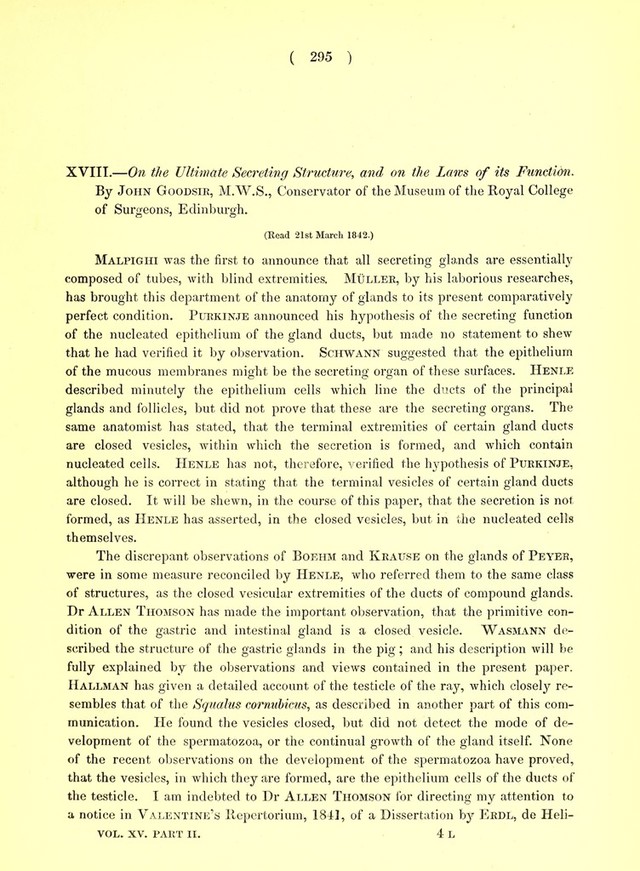
![XVIII.—On the Ultimate Secreting Structure, and on the Laws of its Function. By John Goodsir, M.W.S., Conservator of the Museum of the Boyal College of Surgeons, Edinburgh. (Read 21st March 1842.) Malpighi was the first to announce that all secreting glands are essentially composed of tubes, with blind extremities. Muller, by his laborious researches, has brought this department of the anatomy of glands to its present comparatively perfect condition. Purkinje announced his hypothesis of the secreting function of the nucleated epithelium of the gland ducts, but made no statement to shew that he had verified it by observation. Schwann suggested that the epithelium of the mucous membranes might be the secreting organ of these surfaces. IIenle described minutely the epithelium cells which line the ducts of the principal glands and follicles, but did not prove that these are the secreting organs. The same anatomist has stated, that the terminal extremities of certain gland ducts are closed vesicles, within which the secretion is formed, and which contain nucleated cells. IIenle has not, therefore, verified the hypothesis of Purkinje, although he is correct in stating that the terminal vesicles of certain gland ducts are closed. It will be shewn, in the course of this paper, that the secretion is not formed, as IIenle has asserted, in the closed vesicles, but in the nucleated cells themselves. The discrepant observations of Boehm and Krause on the glands of Peybr, were in some measure reconciled by IIenle, who referred them to the same class of structures, as the closed vesicular extremities of the ducts of compound glands. Dr Allen Thomson has made the important observation, that the primitive con- dition of the gastric and intestinal gland is a closed vesicle. Wasmann de- scribed the structure of the gastric glands in the pig; and his description will be fully explained by the observations and views contained in the present paper. Hallman has given a detailed account of the testicle of the raj?, which closely re- sembles that of the Squalus cornubicus, as described in another part of this com- munication. lie found the vesicles closed, but did not detect the mode of de- velopment of the spermatozoa, or the continual growth of the gland itself. None of the recent observations on the development of the spermatozoa have proved, that the vesicles, in which they are formed, are the epithelium cells of the ducts of the testicle. I am indebted to Dr Allen Thomson for directing my attention to a notice in Valentine’s Repertorium, 184], of a Dissertation by Erdl, de Heli- VOL. XV. PART II. 4 L](https://iiif.wellcomecollection.org/image/b2229756x_0005.jp2/full/800%2C/0/default.jpg)