A case of toxic amblyopia : with autopsy and microscopical examination of the specimens / by G. E. de Schweinitz.
- George Edmund de Schweinitz
- Date:
- [1897]
Licence: Public Domain Mark
Credit: A case of toxic amblyopia : with autopsy and microscopical examination of the specimens / by G. E. de Schweinitz. Source: Wellcome Collection.
Provider: This material has been provided by UCL Library Services. The original may be consulted at UCL (University College London)
2/12 page 2
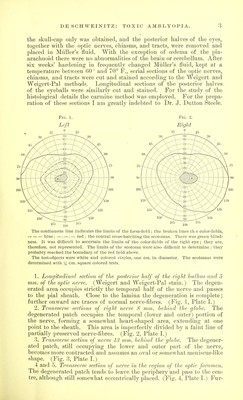
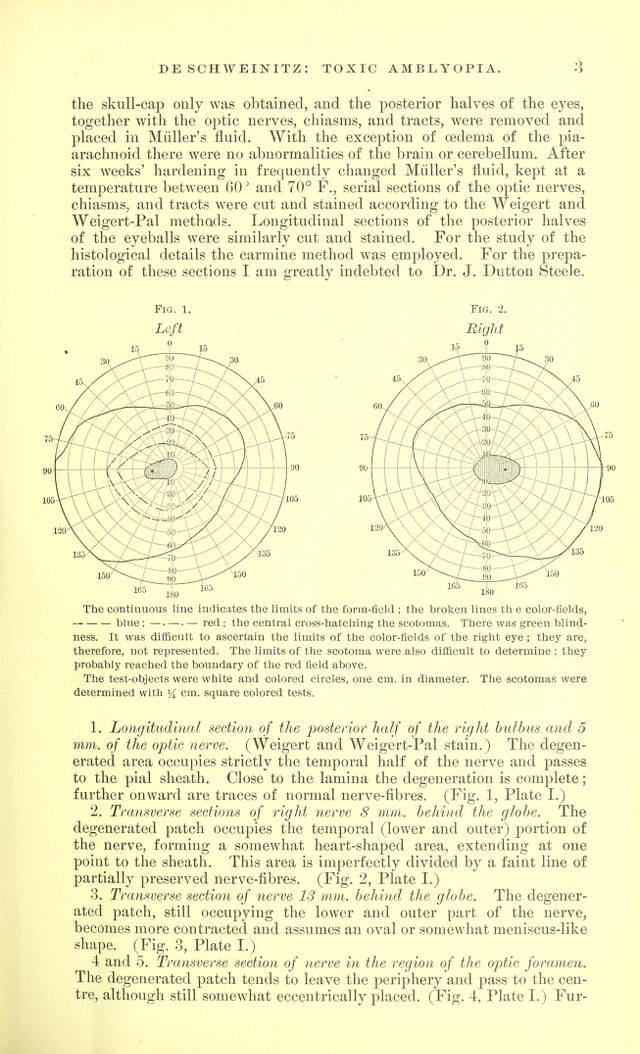
![the patient had been for many years a reasonably healthy man. He had been an inmate of the hospital for thirteen years, during the last nine of Avhich he had been employed as a messenger in the Training School. According to the rules of the institution, once in two months he was given leave of absence lasting twenty-four hours. He always returned on time, and although it is probable he was not an abstainer during these holiday hours, he was never known to be intoxicated. While within the walls of the hospital it was not possible for him to obtain liquor. Previous to his entrance into the hospital he kept a saloon, and no doubt drank liquor, but there is no history of alcoholic excesses. For a number of years he had smoked excessively ; indeed, he was seldom without a pipe in his mouth. He drank tea freely. There was no history of venereal disease and no signs of its influence. For a year before his death there was distinct evidence of physical failure. He suffered much from headache, and the urine was known to contain albumin. The vision of each eye had been poor for some months before he reported for treatment, and he was driven to seek advice because of his inability to read the newspaper. Examination. The patient was a tall, well-preserved, and, at that time, an apparently healthy man. His radial and temporal arteries were rather hard, and the pulse showed high tension. The urine was not examined on this date, but subsequently—i. e., about eighteen months later—it was found to contain albumin and casts. Sugar was not present. Eyes. V. of R. E. equalled 5/60, and was unimprov^ed by a glass. The ophthalmoscope revealed H. of 2 D., a vertically oval, rather pallid disk, the temporal side being paler than the general surface. The ves- sels were of normal size ; there were no retinal or choroidal lesions. The nucleus of the crystalline lens was hazy. The peripheral form-field was normal, but there was a central scotoma for red and green. The pupil- reactions were normal. V. of L. E. equalled 5/40, unimproved by a glass, and ophthalmoscop- ically the same conditions were present as those on the right side. The form-field was normal and there was a central color-scotoma, somewhat smaller than on the right side. The lens was hazy; the pupil normal. The patient was advised to discontinue the use of tobacco, and was ordered strychnine. It is probable that he tried to follow this advice, but with indifferent success, and practically he did not stop the use of tobacco until his final illness. His eyes were examined from time to time, and the conditions already described remained unaltered. The fields of vision in the early fall of 1896 are represented in the accompanying diagrams, viz.: O. D. a normal form-field, contracted blue and red fields, loss of the perception of green, and a large central scotoma extending somewhat beyond the limits usually seen in the earlier stages of intoxication-amblyopia, and probably reaching the limit of the red field above; O. S. a normal form-field, moderate contraction of the blue and red fields, green blindness, and a typical central scotoma, 20 degrees outward, 7 degrees upward, 6 degrees downward, and about 5 degrees inward. (Figs. 1 and 2.) On December 7, 1896, the patient was taken suddenly ill and rapidly developed ])neumonia, with unx3mic symptoms. The urine contained albumin and granular and hyaline casts. Stupor supervened, and death occurred on the third day. The autopsy was made sixteen hours after death. Permission to open](https://iiif.wellcomecollection.org/image/b21648578_0004.jp2/full/800%2C/0/default.jpg)