Heredity in relation to eugenics / by Charles Benedict Davenport.
- Charles Benedict Davenport
- Date:
- [1911]
Licence: In copyright
Credit: Heredity in relation to eugenics / by Charles Benedict Davenport. Source: Wellcome Collection.
Provider: This material has been provided by The University of Glasgow Library. The original may be consulted at The University of Glasgow Library.
64/324 page 44
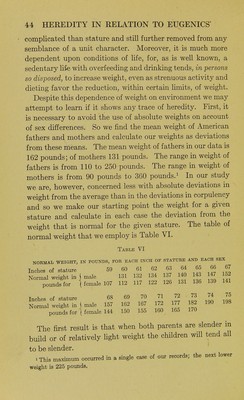
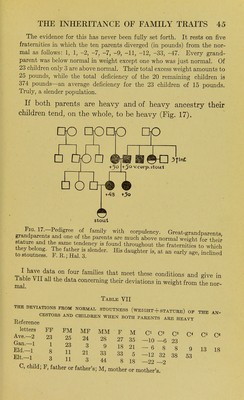
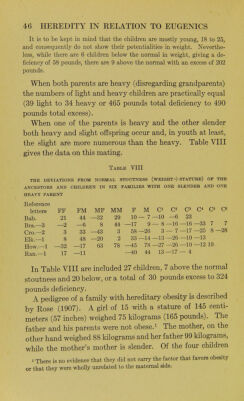
![complicated than stature and still further removed from any semblance of a unit character. Moreover, it is much more dependent upon conditions of life, for, as is well known, a sedentary life with overfeeding and drinking tends, in persons so disposed, to increase weight, even as strenuous activity and dieting favor the reduction, within certain limits, of weight. Despite this dependence of weight on environment we may attempt to learn if it shows any trace of heredity. First, it is necessary to avoid the use of absolute weights on account of sex differences. So we find the mean weight of T^erican fathers and mothers and calculate our weights as deviations from these means. The mean weight of fathers in our data is 162 pounds; of mothers 131 pounds. The range in weight of fathers is from 110 to 250 pounds. The range in weight of mothers is from 90 pounds to 360 pounds.^ In our study we are, however, concerned less with absolute deviations in weight from the average than in the deviations in corpulency and so we make our starting point the weight for a given stature and calculate in each case the deviation from the weight that is normal for the given stature. The table of normal weight that we employ is Table VI. Table VI NORMAL WEIGHT, IN POUNDS, FOR EACH INCH OF STATURE AND EACH SEX Inches of stature 59 60 61 62 63 64 65 66 67 Normal weight in j male 131 132 134 37 40 43 47 52 pounds for j female 107 112 117 122 126 131 136 139 141 Inches of stature 68 69 70 71 72 73 74 75 Normal weight in i male 157 162 167 172 177 82 190 198 pounds for] female 144 150 155 160 165 170 The first result is that when both parents are slender in build or of relatively light weight the children will tend all to be slender. iThia maximum occurred in a single case of our records; the next lower weight is 225 poimds,](https://iiif.wellcomecollection.org/image/b21462719_0064.jp2/full/800%2C/0/default.jpg)