Heredity in relation to eugenics / by Charles Benedict Davenport.
- Charles Benedict Davenport
- Date:
- [1911]
Licence: In copyright
Credit: Heredity in relation to eugenics / by Charles Benedict Davenport. Source: Wellcome Collection.
Provider: This material has been provided by The University of Glasgow Library. The original may be consulted at The University of Glasgow Library.
77/324 page 57
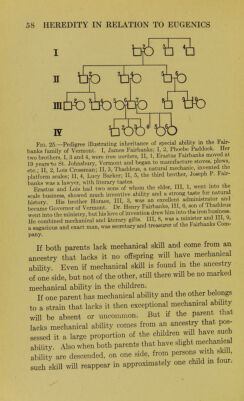
![with, him if he were not always right. There was also Ehsha M. Pomeroy of Wallingford a tinner by trade. He invented the razor strop and profited much by its success. [C. H. S. Davis, 1870, History of Wallingford.] In the sixth generation we find Benjamin Pomeroy a successful lawyer entrusted with important public offices. ''But he was conscious of powers for which his law practice gave him no scope. He had a taste for mechanical execution, and as a pastime between his professional duties under- took the construction of difficult pubhc works—the more difficult the better he liked them. The chief of the United States Topographical Engineers was a friend of Mr. Pom- eroy and repeatedly consulted him in emergencies wherein his extraordinary capacity was made useful to the govern- ment. By him were constructed on the Atlantic coast beacons and various structures in circumstances that had baffled previous attempts. The value to this country of the mechanical trait in this one germ plasm can hardly be estimated. Especially is it to be noted that, despite con- stant out-marriages, it goes its course unreduced and im- modified through the generations. The Fairbanks family of St. Johnsbury, Vermont, illus- trates the inheritance of inventiveness combined with execu- tive abihty, specialized in the iron trade. The inventor of the platform scales belonged to a family not merely of iron workers but to one with imagination such as made other members hterary men (Fig. 25). The Family Records give rather definite information as to the method of inheritance of mechanical skill. When both parents have good or exceptional mechanical skill all of their children will have it also. Out of 413 children of such matings (including both sexes) all but 7 show some mechanical ability, and 118 of them ability of an exceptional order. Indeed, most persons of exceptional skill come from this mating](https://iiif.wellcomecollection.org/image/b21462719_0077.jp2/full/800%2C/0/default.jpg)