Dr. W.W.E. Fletcher's report to the Local Government Board on the urban districts of Longton and Fenton, in the county of Staffordshire, in reference to long-sustained and highly-fatal prevalence of diphtheria therein / [Wilfred W.E. Fletcher].
- Fletcher, Wilfred W. E.
- Date:
- 1898
Licence: Public Domain Mark
Credit: Dr. W.W.E. Fletcher's report to the Local Government Board on the urban districts of Longton and Fenton, in the county of Staffordshire, in reference to long-sustained and highly-fatal prevalence of diphtheria therein / [Wilfred W.E. Fletcher]. Source: Wellcome Collection.
5/38 page 5
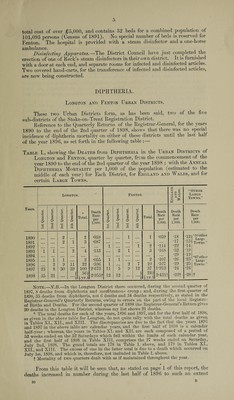
![total cost of over £5,000, and contains 32 beds for a combined population of 101,093 persons (Census of 1891). No special number of beds is reserved for Fenton. The hospital is provided with a steam disinfector and a one-horse ambulance. Disinfecting Apparatus.—The District Council have just completed the erection of one of Keck’s steam disinfectors in their own district. It is furnished with a door at each end, and separate rooms for infected and disinfected articles. Two covered hand-carts, for the transference of infected and disinfected articles, are now being constructed. DIPHTHERIA. Longton and Fenton Urban Districts. These two Urban Districts form, as has been said, two of the five sub-districts of the Stoke-on-Trent Registration District. Reference to the Quarterly Returns of the Registrar-General, for the years 1890 to the end of the 2nd quarter of 1898, shows that there was no special incidence of diphtheria mortality on either of these districts until the last half of the year 1896, as set forth in the following table :— Table I., showing the Deaths from Diphtheria in the Urban Districts of Longton and Fenton, quarter by quarter, from the commencement of the year 1890 to the end of the 2nd quarter of the year 1898 ; with the Annual Diphtheria Mortality per 1,000 of the population (estimated to the middle of each year) for Each District, for England and Wales, and for certain Large Towns. Years. Longton. Fenton. England AND Wales. “Other Large Towns.” rH a> -p c3 P <y -P go A -P rH c3 P o> a •A <D -p rH P P C? *h CO A <v -P c3 P C? rP 4-3 * Total. Death Rate per 1,000. Jh -P rH P P o> -p XJ1 r-H Jh O -P rH P P o> ’P P 'M <D U P P <y P ?H « A V P P P C? -P Total. Death Rate per 1.000. Death Rate per 1,000. Death Rate per 1,000. 1890 1891 1892 1893 1894 1895 1896 1897 1898 *i 23 35 i 1 2 8 21 2 2 1 9 30 1 2 i'i 39 J ”1 2 3 '4 2 22 100 56 { ^yr.( •059 •087 T13 •055 •596 2-673 2*953t • • • 1 i 1 11 12 2 1 *5 12 1 i ’2 9 1 7 12 -I 1 2 3 2 hJ 10 37 24] lyr.i •059 •114 T68 •107 •527 1- 913 2- 4311 T8 •17 •22 •32 •29 •26 •29 •24 •22f T2j“o0 other .tof Lar£e -to | Towns.” ■14 •19 T9 ,^5 “67other >■ Large 25 Towns.” •24 •28, t Note.—N.B.—In the Longton District there occurred, during the second quarter of 1897, 8 deaths from diphtheria and membranous croup ; and, during the first quarter of 1898, 35 deaths from diphtheria, not 6 deaths and 34 deaths respectively, as stated in the Registrar-General’s Quarterly Returns, owing to errors on the part of the local Registrar of Births and Deaths. For the second quarter of 1898 the Registrar-General’s Return gives 20 deaths in the Longton District, whereas my list shows 21 deaths. * The total deaths for each of the years, 1896 and 1897, and for the first half of 1898, as given in the above table for Longton, do not quite tally with the total deaths as given in Tables XI., XII., and XIII. The discrepancies are due to the fact that the years 1896 and 1897 in the above table are calendar years, and the first half of 1898 is a calendar half-year ; whereas, the years in Tables XI. and XII. are each composed of a period of 52 weeks ended on the 52 Saturdays which fell within the limits of each calendar year, and the first half of 1898 in Table XIII. comprises the 27 weeks ended on Saturday, July 2nd, 1898. The grand totals are 178 in Table I. above, and 179 in Tables XI., XII., and XIII. The excess of one in the latter total is due to a death which occurred on July51st, 1898, and which is, therefore, not included in Table I. above. f Mortality of two quarters dealt with as if maintained throughout the year. # From this table it wdll be seen that, as stated on page 1 of this report, the deaths increased in number during the last half of 1896 to such an extent B so](https://iiif.wellcomecollection.org/image/b30557768_0005.jp2/full/800%2C/0/default.jpg)