An experimental study of bone growth and the spinal bone transplant / Fred H. Albee.
- Fred H. Albee
- Date:
- 1913
Licence: In copyright
Credit: An experimental study of bone growth and the spinal bone transplant / Fred H. Albee. Source: Wellcome Collection.
Provider: This material has been provided by The Royal College of Surgeons of England. The original may be consulted at The Royal College of Surgeons of England.
7/16 page 7
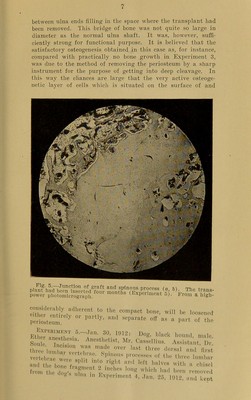
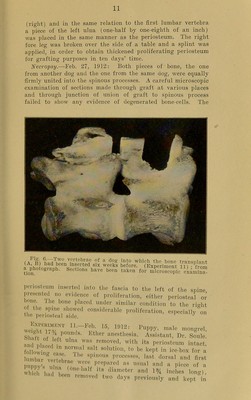
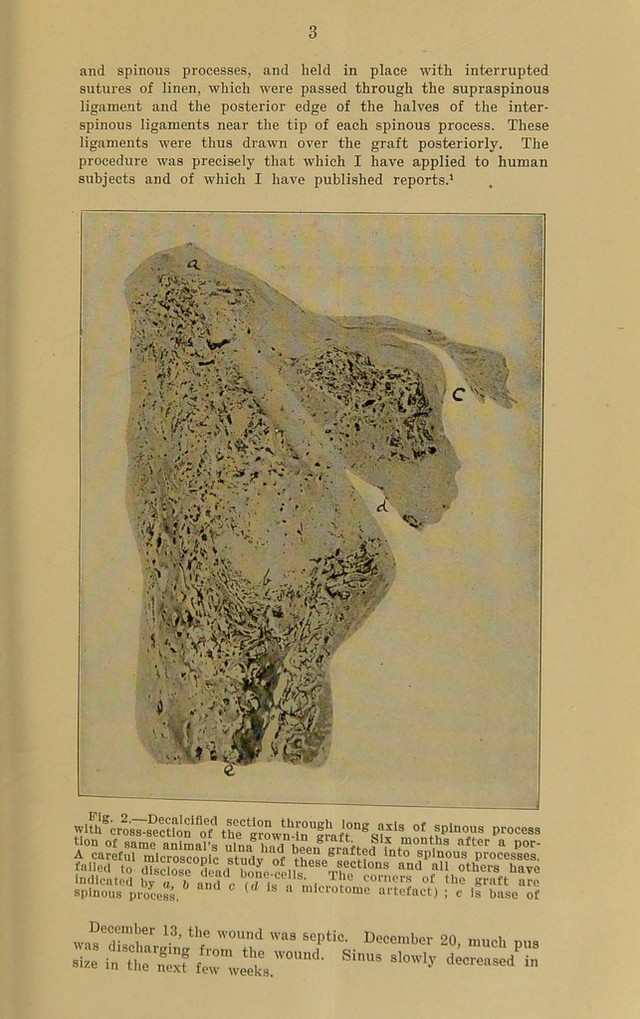
![between ulna ends filling in the space where the transplant had been removed. This bridge of bone was not quite so large in diameter as the normal ulna shaft. It was, however, suffi- ciently strong for functional purpose. It is believed that the satisfactory osteogenesis obtained in this case as, for instance, compared with practically no bone growth in Experiment 3, was due to the method of removing the periosteum by a sharp instrument for the purpose of getting into deep cleaA'age. In this way the chances are large that the very active osteoge- netic layer of cells which is situated on the surface of and nlw^hnh 'Tunction of graft and spinous, process (a b) The trans- rom a high- considerably adherent to the compact bone, will be loosened periosteum.1' y °'' PaVt,y’ ^ 86parate °ff as a of the EtherP?«1MfrT-5‘“fan' 3°’ 1012 = Do- blade hound, male Soule T® ieSla- Anesthfist> Mr- Cassellius. Assistant, Dr! 0VCr hl&t tl,ree dorsal first vertebrap » . Sp,no,,s Presses of the three lumbar and theboneBiSSf- I”' ,Gff.ha,VeS Witl> a c»i«l from the do«’s „]no :. ™ 1 '.°H 0n® ll?h had been removed ° a m Experiment 4, Jan. 25, 1012, and kent](https://iiif.wellcomecollection.org/image/b22443654_0009.jp2/full/800%2C/0/default.jpg)