Handbook of American Indians north of Mexico / edited by Frederick Webb Hodge.
- Date:
- 1907-1910
Licence: In copyright
Credit: Handbook of American Indians north of Mexico / edited by Frederick Webb Hodge. Source: Wellcome Collection.
21/1000 page 3
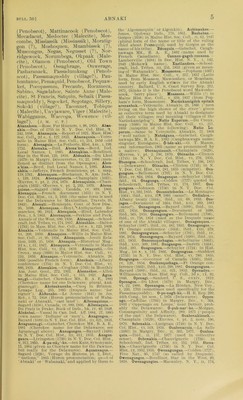
![Htockhridges, and Muni^ee about (ireen bay, Wis. By the ruritanw they were generally called Tarrateens, a term appar- ently obtained from the southern Xew England tribes; and though that is the general conclusion of modern autlowities, there is some doubt as to the aboriginal origin of this term. In later times, after tlie main body of the Abnaki had re- moved to Canada, the name was applieil more especially to the Penobscot tribe. The Irocpiois called them Owenunga, which seems to be merely a modification of Abnaki, or Abiuupii, tlie name aitplied by the French and u.<ed by most modern writers. The form Openango has been used more especially to designate the easstern tribes. Maurault (Hist, des .\ben., 2,18()6) says: “Some English au- thors have called these savages Waba- noaks, ‘those of the east’; this is the reason they arecalled ‘Abenakis’ by some among us. This name was given them because they were towai'd the east with reference to the Xarragansetts.’’ Ethnic relations. — In his tentative ar- rangement Itrinton (Ijen. beg., II, JSS5) brings into one group the Xascapee, Mic- mac, Malecite, Etchimin, and Abnaki, but this is num‘ of a geographic than a linguistic grouping. \'etromile (Abnaki.s, 20, 1800), following other authors, says that we should “(Miibrace under thisterm all the tribes of the Algic [Algompiian] family, who occupy or have occupie<l the !•:. or N. K. shore of Xorth America; thus, all tlu‘ Indians of the seashori‘S, from Virginia to Xova Scotia, were Aljnaki.’’ -Maurault gives the following as tlu' prin- cipal tribes of the .\bnaki confederacy: Kanibesinnoaks (Xorridgewock in part; see Kenneber and .\orri(l(jenvrlc); Pat- suikets (Sokoki in part); Sokouakiaks (Sokoki); Xurhantsuaks( Xorridgewock); I’entagoets (Penobscot); Etemankiaks ( Etchimin); Ouarastegouiaks(iMalecite), the name -Abnaki being applied in the restricted sen.se tt) the Indians of Kenne- bec r. All the.setribes spoke substantially the same language, the chief dialectal differences being between the Etchimin and the other tril)es of the group. The Etchimin, who formcfl a subgroup of the Abnaki confederacy, included the Passa- nuKjuoddy and Malecite. Linguistically the -Vbnaki do not appear to b(> mon* closely related to the Micmac than to the Delaware group, and Dr William .Jones finds the -Abnaki closely related to the central -Algonquian languages. In cus- toms and beliefs they are more* nearly related to the Alicmac, and their ethnic relations appear to be with the tribes n. of the St Lawrence. Histonj.—The history of the .Abnaki may be said to begin with Verrazano’s visit in 1.024. The mythical accounts of Xorumbega (q. v.) of the early writers and navigators finally dwindled to a village of a few bark-covered huts under the name Agguncia, situated near the mouth of Penob.scot r., in the country of the Abnaki. Jn 1(304 C’hamj)lain ascended the Penobscot to the vicinity of the pres- ent Bangor, and met the “lord” of No- rumbega, doubtle.ss an Abnaki chief. Emm that time the .Abnaki formed an important factor in the hi.story of the region now embraced in the.stateof -Miane. From the time of their discovery until their ]>artial withdrawal to Canada they occujjied the general region from the St .Johns to the Saco; but the earliest ICnglish accounts indicate that about 160.O-20 tbe s. w. |>art of the coast of .Maine was occu- pied by other Indians, who.se chief seat was near Penuupiid, and who were at war with the -\bnaki, or Tarrateen, as tlu* English termed them, who were more to th(‘ -\; but these other tribes w(>re finally coiuiuered by the Abnaki and probably GROUP OF ABNAKI (PASSAMAQUODDy) absorbed by them. M’ho the.«e Indians were is unknown. The Abnaki formed an early attachimmt for the French, chiefly through the influence of their Tuissionaries, and carried on an almost constant war with the English until the fall of the French power in .America. The accounts of tlu‘se struggU's <luring the settlement of .Maine an> familiar episodes in -American historv- ,\s the whites encroached on them the .\bnaki gradually withdrew to Canmla and settled chiefly at Becancour and Sillery, the latter luMiig afterward abandoned by them for St Fraiu-is, near Pierreville, (^m'bt'c. Th(> Penobscot, Pa.ssamacjuoddy, and Malecite. however, remained in their ancient honu's, and in 1749 tin* Penob,>Jcot, as the leading tribe, made peace with the English, accepting tixed bounds. Since that period the different tribes have gradual])' dwindled into insigniticance. The descendants of thos<> who emigrated](https://iiif.wellcomecollection.org/image/b24881739_0021.jp2/full/800%2C/0/default.jpg)
 No text description is available for this image
 No text description is available for this image
 No text description is available for this image