Handbook of American Indians north of Mexico / edited by Frederick Webb Hodge.
- Date:
- 1907-1910
Licence: In copyright
Credit: Handbook of American Indians north of Mexico / edited by Frederick Webb Hodge. Source: Wellcome Collection.
33/1000 page 15
Licence: In copyright
Credit: Handbook of American Indians north of Mexico / edited by Frederick Webb Hodge. Source: Wellcome Collection.
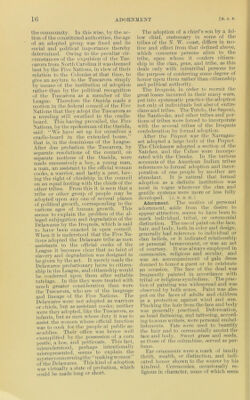
![A. E. 309, 1890; Cushiiiic, ibid., 300). Houses constnieted of adobes are very conifortal)le, l)eing warm in winter and cool in summer. For this reason, and owing to the availal)ility and cheapness of the material, adol)e forms an impor- tant factor in the domestic economy of botli white and Indian iniiabitants of tin* S. \V. (c. w. H.) Adoeette {ado ‘tree,’ e-ti ‘great,’ tr j)er- sonal sutHx: ‘Big Tree’). A Kiowa chief, l)orn about 1845. in conseciuence of Custer’s vigorous campaign on the Washita in the fall of 1808 the Kiowa and confederated tribes had been com- j)elled to come in upon tbeir reservation, in what is now s. w. Oklahoma, but still kept up frecpKMit raids into Te.xas not- withstanding the establishment of Ft ADOEETTE (kIOWa) Bill in their midst. In iUay, 1871, a large party of warriors led by Satanta (proiH>rlyBet-t‘ain-te, White Bear), (|.v., and accompanied by Satank (properly Set-iingya, Sitting Bear), (j. v., ami Big Tree, attacked a wagon train, killing 7 men and taking 41 mules. For their part in this deed, which they opeidy avowed, the three chiefs named were arrested at F't Sill to stand trial in T(‘xa«. Setiingya made n'sistance and was killed by the guard. The otlu'r two were confined in the Texas jienitentiary until Oct., 1873, when they were released on promise of good behavior of their tribe. Satanta was subsequently rearrested and committed suicide in prison. Dur- ing the latter j>art of the outbreak of 1874-75 Big Tree, with other chiefs be- lieved to be secretly hostile, were con- fined as prisoners at Ft Sill. Since that time the tribe has remained at peace. Big Tree is still living upon his allotment on the former reservation and is now a professed Christian. See Mooney, Cal- endar Mist. Kiowa Inds., 17th lie)). B. A. K., 1898. Adoption. An almost universal j)oliti- cal and social institution which originally dealt only with ))ersons but later witl'i families, clans or gentes, bands, and tribes. It had its beginnings far back in the history of ))rimitive society and, after ))assing through many forms and losiiui much ceremonial garb, ajijx'ars to-day in the civilized institution of naturalization. In the ])rimitive mind the fundamental motive underlying adoption was to defeat the evil ))ur)Kjse of death to remove a mendjer of the kinshi)) grou{) by actually re))lacing in person the lost or dead mem- ber. In primitive i)hiloso)>hy, birth and death ai'e the results of magic }>ower; birth increases and death decreases the oreiiila (cp v.) of the clan or family of the grou)) affected. In ord(>r to))reserve that magic ))Ower intact, society, by the exer- cise of con.structiveere)/dcf, resuscitates the dead in the jicrson of another in whom is embodied the blood and ))erson of the dead. As the diminution of the number of the kindred was regarded as having been caused by magic |X)wer—by the of some hostile agency—so the j)revention or re))aration of that loss must be accom- l)lished by a like )>ower, manifested in ritualistic liturgy and ceremonial. From the view j)t)int of the ))rimitive ndndado))- tion serves to change, by a liction of law, the ))ersonality as well as the jiolitical status of the adoipted person. For ex- am])le, there were (;a|)tureil two white )>ersons (sisters) by the Seneca, and in- stead of both being a(lo))ted into one clan, one was adopted by the Deer and the other bv the Heron clan, and thus the blood of the two sisters was changed by the rite of ado|)tion in such wise that their children could intermarry. Fur- thermore, to satisfy the underlying con- cej)t of the rite, the adojited ))erson must be brought into one of the strains of kinshi)) in order to define the standing of .sucli person in the community, and the kinshi)) name which the ))erson re- ceives declares his relation to all other ))crsons in the family grou)); that is to say, should theado))te<l ))crson be named son rather than uncle by the ado))ter, his status in the community would differ ac- cordingly. From the )>olitical a<lo))tion of the Tuscarora by the Five. Nations, about 1726, it is evident that tribes, fam- ilies, clans, and grou))s of ))co))le could be adoj)ted like ))ersons. ,\ fictitious age might be conferred u))on the ))erson ado))t('d, since age largtdy governed the rights, duties, and position of ]>ersons in](https://iiif.wellcomecollection.org/image/b24881739_0033.jp2/full/800%2C/0/default.jpg)