Handbook of American Indians north of Mexico / edited by Frederick Webb Hodge.
- Date:
- 1907-1910
Licence: In copyright
Credit: Handbook of American Indians north of Mexico / edited by Frederick Webb Hodge. Source: Wellcome Collection.
961/1000 (page 943)
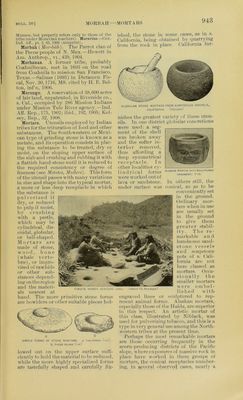
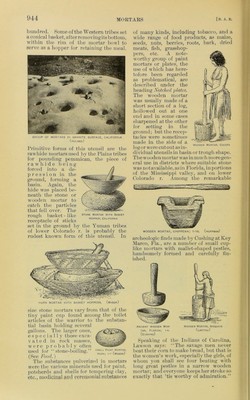
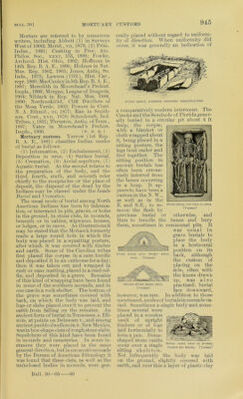
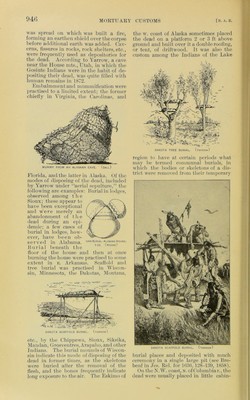
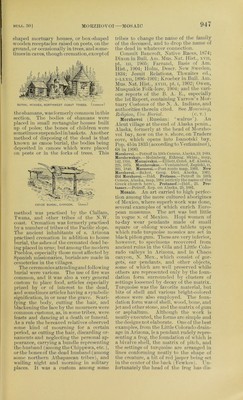
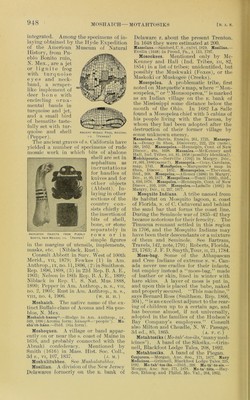
![a h SIMPLE FORMS OF STONE MORTARS. d CALIFORNIA (l-s); ft, Rhode Island (i-s) lowed out oil the upper .«urfaee sufli- ciently to hold the material to he redueed, while the more highly specializ(‘d forms are tastefully shaped and carefully lin> YOKUTS WOMEN Gf.INDING SEEU. VSANTA FE RAtLROAo) Miinsoc, but properly refers only to those of the tribe under Moravian teachers). Moravins.—Can. Ind. Alt., pt. 2, 65, 1906 (misprint). Morbah (Mor-hiUi). The Parrot clan of the Pecos people of N. Mex. — Hewett iu Am. Authrop., vi.,439, 1904. Morbanas. A former tribe, jirobably Coahuiltecan, met iu 1693 ou tbe road from Coahuila to mission Han Francisco, Texas.—Salinas (1693) in Dictamen Fis- cal, Nov. 30,1716, MS. cited by II. F. Bol- ton, inf’ll, 1906. Morongo. A reservation of 38,600 acres of fair land, unpatented, in Riverside co., s. Cal., occuiiied by 286 MBsion Indians under Mission Tide River agtmcv. —Ind. Aff. Rep., 175, 1902; ibid., 192, 1905; Kel- sey, Rep., 32, 1906. Mortars. Utensils emjiloyed by Indian tribes for the trituration of food and other substances. The Southwestern or Mexi- can type of grinding stone is known as a metate, and its operation consists in ]>lac- iug the substance to be treated, dry or moist, on the sloping upper surfaiio of the slab and crushing and rubbing it with a Hattish hand-stone until it is reduced to the required consistency or degree of lineness (see Metatcs, Mullers). This form of the utensil passes with many variations in size and shaiie into the typical mortar, a more or less deep rece{)tacle in which the substance is pulverized if dry, or reduced to juilp if moist, by crushing with a pestle, which may be cylindrical, dis- coidal, globular, or bell-shaped. Alortars are made of stone, wood, bone (whale verte- bne), nr impro- vised of rawhi(h“ or other sub- stances depi'iid- ing on the region and the materi- als nearest at hand. The more primitive stone forms are bowlders or other suitable pieces bol- ished, the stone in some cases, as in s. California, being obtained by (luarrving from the rock in place. California fur- GLOBULAR STONE MORTARS FROM AURIFEROUS GRAVELS, CALIFORNIA. (holmes) nishes the greatest variety ol these uten- sils. In one district globular concretions were used: a seg- ment of the shell was broken away and the softer in- terior removed, thus affording a dee}) symmetrical reci'ptacle. I n other localities cv- lindrical forms were worked out ol lava or sandstone. In others still, the under surface was conical, so as to be conveniently set in the grouml. Ordinary mor- tars when in use are usually set in the ground to give them greater .stabil- ity. The re- markable and bandsome .sand- stone vessels and soapstone jiots of s. (Mli- fornia are not here classed as mortars. Occa- sionally the smaller mortars were embel- lished with engraved lines or sculptured to reji- resent animal forms. Alaskan mortars, especially tho.se of the Ilaida, aresuiierior in this resjiect. An artistic mortar of this class, illustrated by Niblack, was used for jiulverizing tobacco, and Ibis is a typ(> iu very general use among the North- western tribes at tbe present time. I’erhajis the most remarkabU' mortars are those occurring frccpiently in the acorn-producing districts of the Pacific slope, whereexposur(‘s of massive rock in place have worked in them groups ot mortars, the conical receiitacles number- ing, in !»pyeral observec^ cases, nearly a](https://iiif.wellcomecollection.org/image/b24881739_0961.jp2/full/800%2C/0/default.jpg)