Handbook of American Indians north of Mexico / edited by Frederick Webb Hodge.
- Date:
- 1907-1910
Licence: In copyright
Credit: Handbook of American Indians north of Mexico / edited by Frederick Webb Hodge. Source: Wellcome Collection.
963/1000 (page 945)
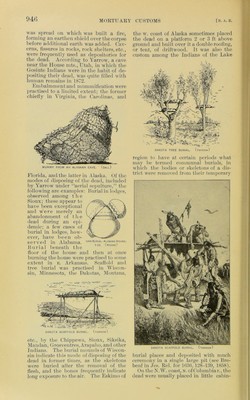
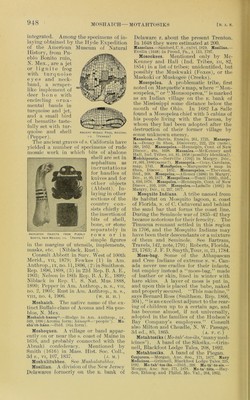
![Mortare are referred to by imnierous writers, including Abbott (1) in Surveys West of 100th Merid., vii, 1879, (2) Prim. Indus., 1881; Cusbiug in Proc. Am. Philos. Soc., XXXV, 158, 1890; Fowke, Archicol. Hist. (3hio, 1902; Hoffman in 14th Rep. E. A. R, 1890; Holmes in Nat. Mus. Rep. 1902, 1908; Jones, Anticj. So. Inds., 1878; Lawson (1701), Hist. Car., repr. 1800; MacCauleyinoth Rej). B. A. R, 1887; jMereditb in Moorehead’s Prebist. Impls., 1900; jNIorgan, I.eague of Irocpiois, 1904; Niblack in Rep. Nat. Mus. 1888, 1890; NordenskiOOl, Cliff Dwellers of the ^lesa Verde, 1898; Powers iu Cont. N. A. Fthnol., Ill, 1877; Rau in Smith- son. Cont., .\.\ii, 1870; Schoolcraft, Jnd. Tribes, i, 1851; Thruston, Auti(|. of Tenn., 1897; Yates in Mooreiu'ad’s Prebist. Impls., 1900. (w. 11. II.) Mortuary customs. Yarrow (1st Rep. B. A. E., 1881) classifies Indian modes of burial as follows: (1) Inhumation, (2) Embalmment, (8) Depo.dtion in urns, (4) Surface burial. (5) Cremation, (0) Aerial sepulturi', (7) Aquatic burial. As the second relates to the preparation of the body, and the third, fourth, sixth, and seventh refer chietly to the receptacles or the jilace of deiiosit, the disposal of the dead by the Indians may be classed under the heads Burial and Vremaliou. Tlie usual mode of burial among North American Indians has been by inhuma- tion, or interment in ])its, graves, or holes in the ground, iu stone cists, in mounds, beneath or in cabins, wigwams, houses, or lodges, or in caves. As illustrations it may be stated that the IMohawk formerly made a large round hole in which the body was jdaced in a squatting posture, after which it was covered with timber and earth. Some of the Carolina tribes first ])laced the corjise in a cane hurdle and deposited itiu an outhouse for a day; then it was taken out and wrapped in rush or cane matting, placed in a reed cof- fin, and deposited in a grave. Remains of this kind of wrajiiiing have been found in some of the southern mounds, and in one case in a rock shelter. The bottom of the grave was sometimes covered with bark, on which the body was laid, and logs or slabs placed over it to iirevent the earth from falling on the remains. An ancient form of burial in Tennessee, s. Illi- nois, at points on Delaware r.,and among ancient pueblo dwellers in n. New Mexico, was in box-shape cists of rough stone slabs. Sepulchers of this kind have been found in mounds and cemeteries. In .«ome in- stances they were placed in the same general direction, but in excavationsmade by the Bureau of American Ethnology it was found that these cists, as well as the uninclosed bodies in mounds, were gen- erally ])laced without regard to uniforni- ity of direction. When uniformity did occur, it was generally an indication of STONE GRAVE, SHOVING ORDINARY CONSTRUCTION a comparatively modern interment. Creeks and the Seminole of Florida g ally buried deep; the with a blanket or cloth wrapped about it, being placed in a sitting posture, the legs bent under and tied together. The sitting imsition in ancient burials has often been errone- ously inferred from the bones occurring in a heap. It ap- [learsto have been a custom in the N. W., as well as in the E. and S. E., to re- move the desh by previous burial then to bundle them, sometimes The gener- 111 a circular pit about 4 ft corpse. STONE Grave, top view ; Illinois, (thomas) GRAVE WITH Offset Arch; IOWA, (thomas) ARCHED STONE GRAVE; OHIO. (ThOMAs) or otherwise, and the bones and bury in communal pits. It was usual in grave burials to {dace the body in a horizontal position on its back, although the custom of placing on the side, often with the knees drawn up, was also practised; burial face ilownward, however, was rare. In addition to those mentioned, modesof Vmrialsin mounds va- ried. Sometimes a single body and some- times several were placed in a wooden vault of upright timbers or of logs laid horizontally to formajien. Dome- shajied stone vaults occur ovt'r a single sitting skeleton. Not infreiiuently the body was laid on the ground, slightly covered with earth, and over this a layer of jilastic clay Burial under heap of Stones; Hudson bay Eskimo, (turner) Bull. 30—05 00](https://iiif.wellcomecollection.org/image/b24881739_0963.jp2/full/800%2C/0/default.jpg)