Handbook of American Indians north of Mexico / edited by Frederick Webb Hodge.
- Date:
- 1907-1910
Licence: In copyright
Credit: Handbook of American Indians north of Mexico / edited by Frederick Webb Hodge. Source: Wellcome Collection.
965/1000 (page 947)
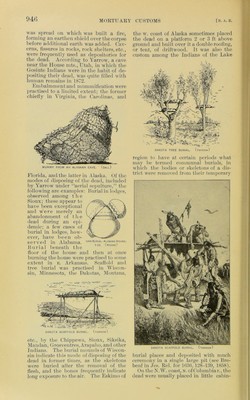
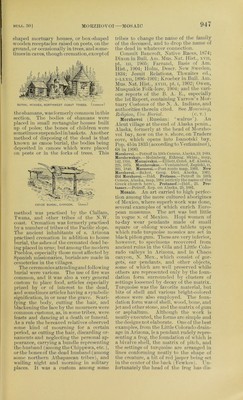
![shaped mortuary houses, or box-shaped Avooden receptacles raised on posts, on the ground, or occasionally in trees, and some- tiniesin caves, though cremation,exceptof BURIAL HOUSES, NORTHWEST COAST TRIBES. (vARROw) theshamans, was formerly common in this section. The bodies of shamans were placc'd in small rectangular houses built up of poles; the bones of children were sometimes suspended in haskeb:. Another method of disposing of the dead is that known as canoe burial, the bodies being deposited in canoes which were placed on j)Osts or in the forks of trees. This CANOE BURIAL, CHINOOK. (swAn) method was practised by tlie Clallam, Twana, and other tribes of the N.W. coast. Cremation was formerly practised by a number of tril)esof the Pacific slope. The ancient inhabitants of s. Arizona practised cremation in addition to house burial, the ashes of the cremated dead be- ing placed in urns; hut among the modern Pueblos, especially those most affected by Spanish missionaries, burials are made in cemeteries in the villages. The ceremonies attendingand following burial were various. The use of fire was common, and it was also a very general custom to place food, articles esjiecially prizeil by or of interest to the dead, and sometimes articles having a symbolic signification, in or near the grave. Scari- fying the body, cutting the hair, and blackening the face by the mourners were common customs, as, in some tribes, were feasts and dancing at a death or funeral. As a rule the bereaved relatives observed some kind of mourinng for a certain period, as cutting the hair, discarding or- naments and neglecting the j)ersonal ap- pearance, carrying a bundle rei)re.senting the husband (among the Chippewa, etc.), or the bones of the dead husband (among some northern Athapascan tribes), and wailing night and morning in solitary places. It w{is a custom among some tribes to change the name of the family of the deceased, and to drop the name of the dead in whatever connection. Consult Bancroft, Native Eaces, 1874; Dixon in Bull. Am. Mus. Nat. Hist., xvii, pt. Ill, 1905; Farrand, Basis of Am. Hist., 1904; Holm, Descr. New Sweden, 1834; Jesuit Relations, Thwaites ed., i-LXXii, 1896-1901; Kroeber in Bull. Am. Mus. Nat. Hist., xviii, pt. i, 1902; Owen, Musquakie Folk-lore, 1904; and the vari- ous reports of the B. A. K., esjiecially the 1st Report, containing Yarrow’s Mor- tuary Costonis of the N. A. Indians, and authorities therein cited. See Mounihuj, Religion, Urn Jhirial. Morzhovoi (Russian: ‘walrus'). An xVleut village at tlieend of Alaska jienin., Alaska, formerly at the head of Morzho- voi hay, now on the x. shore, on Traders cove, which ojiens into Isanotski hay. Po]). 45in 1833(accordingto Veiriaminol), 68 in 1890. Morshevoi.—PetrotT in 10th Census,-\liiskn,19, lS8t. Morshewskoje.—Holmberg, Elhnog. Skizz., nini), 142,1S55. Morzaivskoi.—Elliott,Cond. All. Alaska, 225, 1S75. Morzhevskoe.—Veiiianiinof, Zaj>iski,ii, 203, 1840. Morzovoi.—Post route nuiii, 1903. New Morzhovoi.—Baker, Geog. Diet. Alaska, 1902. Old Morzhovoi.—Ibid. Protasso.—PetrotT in 10th Census, Alaska, map, 1881 (strictly the name of the Greek church here). Protassof,—Ibid., 23. Pro- tassov,—PetrofT, Rep. on .-Maska, 25, 1881. Mosaic. An art carried to high perfec- tion among the more cultured aborigines of iMexico, where superb work was done, several examples of which enrich Furo- pean museums. The art was hut little in vogue x. of Mexico. Hopi women of to-day wear ])endants made of small square or oblong wooden tablets ujxm which rude timpioise mosaics are set in black pinon gum. These are very inferior, liowever, to specimens ret'overed from ancient ruins in the Cila and Little Colo- rado valleys in Arizona, and in Chaco canyon, N. Mex., which consi.«t of gor- gets, ear jiendants, and other objects, some of which are well jireserved while others are rt'presented only by the foun- dation form surrounded l>y clusters of settings loosened by decay of the matrix. Tunjuoise was the favorite material, hut bits of shell and various bright-colored stones were also employed. The foun- dation form wasof shell, wood, bone, and jetand otherstone, andthematrix of gum or asi)haltum. Although the work is neatly executed, the forms are siiu))le and the designs not elaborate. Oneof the best examples, from the Little (blorado drain- age in Arizona, is a pmidant rudely repre- senting a frog, the foundation of which is a bivalve shell, the matrix of ]»itch, and the settings of tunpioise are arranged in lines conforming neatly to the shape of the creature, a bit of red jasper being set in the center of the back ( Fewkes). Fn- fortunately the head of the frog has dis-](https://iiif.wellcomecollection.org/image/b24881739_0965.jp2/full/800%2C/0/default.jpg)