Handbook of American Indians north of Mexico / edited by Frederick Webb Hodge.
- Date:
- 1907-1910
Licence: In copyright
Credit: Handbook of American Indians north of Mexico / edited by Frederick Webb Hodge. Source: Wellcome Collection.
966/1000 (page 948)
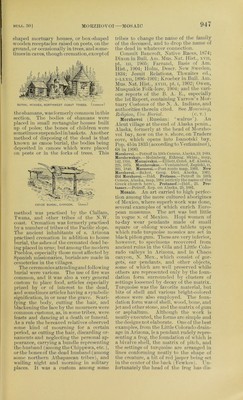
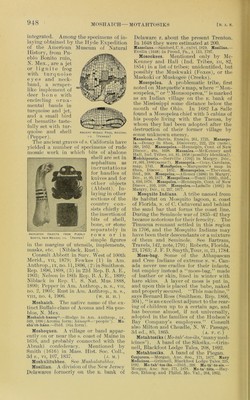
![MOSH AICH— MOTAHTOSTKS [ B. A. E. integrated. Among the specimens of in- laying obtained by the Hyde Ex2)edition of the American History, from Pu- eblo Bonito ruin, N. ]Mex., are a jet or lignite fi-og with tun] noise eyes and neck- band, a scraj)cr- like implement of deer bone with encircling orna- mental bands in tuniuoise and jet, and a small bird of hematite taste- fully set with tur- quoise and shell (Pepper). The ancient graves of s. California have yielded a number of si)ecimens of rude mosaic work in which hits of ahalone shell are set in asjdialtum as incrustations for bandies of knives and for other objects (A])hott). In- laying in other sections of the country con- sists chiefly of the insertion of hits of shell, hojie, or stone separately in rows or in simple figures in the margins of utensils, implements, masks, etc. (Nihlack, Rust). Consult Abbott in .Surv. West of 100th Merid., vii, 1879; Fewkes (1) in Am. Anthrop., i.\-, no. 11,1896, (2)inSmithson. Rep. 1896, 1898, (3) in 22d Rep. B. A. K., 1903; Nelson in 18tb Rep. B. A. K., 1899; Nihlack in Hej). U. S. Nat. IMus. 1888, 1890; I’epper in Am. Anthnq)., n. s., vii, no. 2, 190.6; Rust iu Am. Anthro])., n. s., VIII, no. 4, 1906. (w. ii. n.) Moshaich. The native name of the ex- tinct Buffalo clans of Acoma and Sia ^me- blos, N. Mex. Moshaich-hanoq«i'.—Hodfro in .\m. .VnOiro))., i.\. 349, 1S90 (Acoma form; /ciMor;<4i = ‘people’). Mu- shii'ch-hano.—ll)i(l. (Sia form). Moshoquen. A village or band appar- ently on or near the s. coast of IMaine in 1616, and {irobalily connected with the Ahnaki confederacy. Mentioned by Smith (1616) in Mass. Hist. Soc. Coll., 3d s., VI, 107, 1837. (.i. m.) Moshulitubbee. See Mushnlatuh!tee. Mosilian. A division of the New ,Ier.«i>y Delawares formerly on the ic. bank of Delaware r. about the present Trenton. In 1648 they were estimated at 200. Masselans.—sfmford.U. S., cxlvi, 1819. Mosilian.— Evelin (1648) iu Proud, Pa., i, 113, 1797. Mosookees. Mentioned only bj' Mc- Kenney and Hall (Ind. Tribes, iii, 82, 1854) in a li.st of tribes; iinidentifled, but pos.sibly the Muskwaki (Foxes), or the Maskoki or Muskogee (Creeks). Mosopelea. A problematic tribe, flrst noted on JMarquette’s map, where “IMon- soujielea,” or “ Monsonperea,” is marked as an Indian village on the e. hank of the Mississi])jii some distance below the mouth of the Ohio. In 1682 La Salle found a Mosopelea chief with 5 cabins of his jieople living with the Taeiusa, by whom they had been adojited after the destruction of their former village by some unknown enemy. Mansoleas.—Harcia, Eusayo, 261, 1723. Mansope- la.—Duuay in Shea, Di.scovery, 222, 224 (note), 268, 18.')2. Mansopelea.—Heuiicpin, Gout, of New Discov., 48a, 1698. Mausalea.—McKeuuey and Hall, Iiid. Tribes, iii, 81,1858 (po.s.sibly identical). Medchipouria.—Iberville (1702) in Margry, I)C*c., IV,601,1380(same'?). Monsopela.—Coxe,Carolana, map, 1741. MonsSpelea.—Marquette’s map in Shea, Discov., 1352. Monsoupelea.—Tbevenot, ibid., 268. Mosopelea.—Allonez (1680) in Margry, De(\, 11,95,1877. Mosopelleas.—Tonti (1683), ibid., 1,610,1876. Mosopolca.—Hennepin, Gout, of New Discov., 310, 1698. Mosopolea.—Labile (1682) in Margry, Dec., ii,237, 1877. Mosquito Indians. A tribe named from its habitat on 5h)squito lagoon, e. coast of Florida, n. of C. Canaveral and behind the sand bar that forms the coast line. During the Seminole war of 1835-42 they became notorious for their ferocity. The Timucua remnant settled in this region in 1706, and the IMoscpiito Indians may have been their descendants or a mixture of them and Seminole. See Bartram, Travels, 142, note, 1791; Roberts, Florida, 23,1763; J. F. D. Smyth,Tour, ii, 21, 1784. Moss-bag. Some of the Athapascan and Cree Indians of extreme n. w. Can- ada never use cradles for their infants, but employ instead a “mo.«s-bag,” made, of leather or skin, lim'd in winter with hare skins. A layer of mo.«s is jmt in, and upon this is jiiaced the babe, naked and proiierlysecured. “This machine,” says Bernard Ro.^is (Smithson. Re]>. 1866, 304), “is an excellent adjunct to the rear- ing of children up to a certain age, and has become almost, if not universally, adojited in the families of the Hudson’s Bay Conqianv’s employees.” Consult also Milton and Cheadle, N. W. Passage, 3(1 ed., 85, 1865. (a. e. c. ) Motahtosiks (Mo-tal/-tos-iks, ‘ many med- icines’). .V band of the Siksika.—Crin- nell, Blackfoot Lodge Tales, 208, 1892. Motahtosiks. A band of the Piegan. Conjurers.—Morgan, .\nc. Soc., 171, 1877. Many Medicines.—(Jrinncll, Hlackfoot Lodge Talcs, 225, 1892. Mo-tah'-tos-iks.—Ibid..209. Mo-ti'-to-sis.— Morgan, Anc. .Soc. 171, 1378. Mo-ta'-tots.—Hay- den, Etbnog. and Philol. Mo. Val., 264,186‘2, Museum of Natural Ancient mosaic Frog, Arizona; 1-2. (fewkes) 1 INCRUSTED Objects from pueblo Bonito, NEW MEXICO; i-4. (pepper)](https://iiif.wellcomecollection.org/image/b24881739_0966.jp2/full/800%2C/0/default.jpg)