Handbook of American Indians north of Mexico / edited by Frederick Webb Hodge.
- Date:
- 1907-1910
Licence: In copyright
Credit: Handbook of American Indians north of Mexico / edited by Frederick Webb Hodge. Source: Wellcome Collection.
968/1000 (page 950)
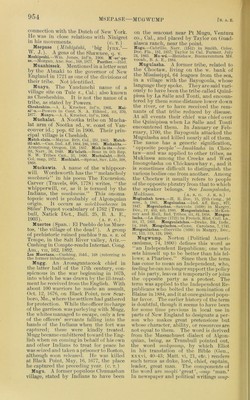
![MOUNDS AND MOUND-BUILDERS r B. A. E. vailed in the arrangement of mounds in groups, but some exceptions occur, as, in tlie effigy-mound region, the small conical mounds are sometimes arranged in regu- lar lines, somewhat evenly s[>aced and occasionally connected by low embank- ments; anti in Calhoun co.. 111., and n. e. Minnesota they were fretjuently built in rows. Although a few mounds have been observed on the Pacilic sloj)e, n. of Mexico, they are limited chiefly to the Mississi])pi liasin and the Gulf states, the areas of greatt'st abundance being along the banks of the IMississippi from La Crosse, W'is., to Natchez, Miss., theceiv tral and s. sections of Ohio and the adjoin- ing ]<ortion of Indiana, and s. ^^dsconsin. The E. side of Florida is well dotted with shell-heaps. Inclosures include some of the most important and interesting monuments of the United States. In form they arc* circular, sijuare, ob- long, octagonal, or irregular. Those w h i c b apju’oach rc'gularity in tigure are either circadar, sciuare, or octag- onal, and with few exceptions are tound m Ohio and ith moat AND ENCmC- the adjoining por- 7.!^ tions ot Indiana, Kentucky, and West Virginia. These works vary in size from an area of less than an acre to that of more OBLONG iNCLOSURE WtTH MOAT; WEST VIRGINIA; LENGTH 287 FT. (thomas) than 100 acres. Some are exceedingly interesting because of the near ajiproach they make to true gcx'imetrical figures. The diameters of the circle in one or two instances vary less than lO ft in 1,000 ft, and the corners of the scpiare in one or two other examjiles vary less than one degree from 00°. In s. E. jNlissonri and in one or two other sections the inclosures have scat- tered through them small earthen circles marking the sites of circular dwellings. There are indications that some at least of the Ohio inclosures contained similar circles which were obliterated by cultiva- tion. Another important class of ancient monuments are the refuse or shell heajis found along tidewater and at a few points on the banks of inland streams and lakes, and the mound-like hcajis which cover the ruined jiueblo dwell- ings of the S. W. Many hundreds of the mounds and many of the refuse heai)s have been opened and their contents ex- amined. Although one or two artifacts, esjiecially certain coi>i)er plates with stamped figures, have been discovered which aie difiicult to account for, the contents otherwise jiresent nothing incon- sistent with the conclusion that they are the works of the Indians who inhai)ited these regions ])iior to the advent of the whites. It has been contended tliat many of the artifacts found in the mounds indi- cate a higher degree of culture than that reached by the later Indians of the mound area. After excluding those derived from the whites or otherwise introduced, this is found to be a mistake, a.« it ap|)ears from the evidence that the historic In- dians could and did make articles similar in type and equal in finish to those of the mounds. Some of thearticles found show contact with Europeans, and hence indi- cate that the mounds in which they were discovered are comjiaratively modern. Notwithstanding the.se facts and many others tending to f he same conclusion, it was maintained by the majority of writ- ers on American archeology, until verv recently, that the builders t)f the mounds of the Mi.*<sissipia basin and the (hilf states were a specific people of higher culture than the Indians found inhabiting this re- gion; that they were overrun by incoming Indian hordes and finally became extinct, leaving the monuments as the only evi- dence of their former existence. Other writers suj)pose that they were Mexicans (.Vztec) who were driven s. into Mexico, while others concluded that they were driven into the Gulf states and were the ancestors of the tribes inhabiting that section. The more careful exploration of the mounds in recent years, and the more thorough study of the data bearing on the subject, have shown these opinions to be erroneous. The articlesfound in the mounds and the character of the various monuments indicate a culture stage much](https://iiif.wellcomecollection.org/image/b24881739_0968.jp2/full/800%2C/0/default.jpg)