Handbook of American Indians north of Mexico / edited by Frederick Webb Hodge.
- Date:
- 1907-1910
Licence: In copyright
Credit: Handbook of American Indians north of Mexico / edited by Frederick Webb Hodge. Source: Wellcome Collection.
978/1000 (page 960)
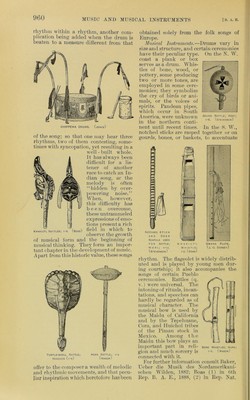
![rhythui within a rhythm, another com- plication being added when tlie drum is beaten to a measure different from that CHIPPEWA DRUMS. (jENKs) of the song; so that one may hear three rliythms, two of them contesting, some- times with syncopation, yet resulting in a well-built whole. It has always been difficult for a lis- tener of another race to catch an In- dian song, as the melody is often “hidden by over- ] lowering noise.” When, however, this difficulty has been overcome, these untrammeled expressions of emo- tions ]»resenta rich field in which to observe the growth of musical form and the beginning of musical thinking. They form an impor- tant chapter in the development of music. Apart from this historic value, these songs Kwakiutl Rattles; i-s. (boas) offer to the composer a wealth of melodic and rhythmic movements, and that pecu- liar inspiration which heretofore has been obtained solely from the folk songs of Europe. .^hisical InstrummU.—Drums vary in size and structure, and certain ceremonies have their jieculiar type. On the N. W. coast a plank or box serves as a drum. AVhis- tles of bone, wood, or jiottery, some producing two or more tones, ai-e em])loyed in some cere- monies; they symbolize the cry of birds or ani- mals, or the voices of spirits. Pandean pipes, which occur in South America, were unknown in the northern conti- nent until recent times. In the S. AV., notched sticks an' rasped together or on gourds, bones, or baskets, to accentuate NOTCHED STICK AND DEER Scapula used FOR RATTLE; H 0 PI ; I-I2. (stevenson) OMAHA Flute. (j. O. Dorsey) Kwakiutl w H istle; 1-8. (boas) rhythm. The fiageolet is widely distrib- uted and is jilayed by young men dur- ing courtship; it also accompanies the songs of certain Pueblo ceremonies. Rattles (q. V.) were universal. The intoning of rituals, incan- tations, and sjieeches can hardly be regarded as of musical character. The musical bow is used by the Maidu of California and by the Tejiehuane, Cora, and Iluichol tribes of the Piman stock in Mexico. Among the Alaidu this bow jilays an imjiortant part in reli- gion and much sorcery is connected with it. For further information consult P>aker, Ueber die Musik des Nordamei’ikani- schen Wihlen, 1882; Boas (1) in tith Kep. B, A. E., 1888, (2) in Kep. Nat, BONE WHISTLES; HuPA; 1-5. (mason)](https://iiif.wellcomecollection.org/image/b24881739_0978.jp2/full/800%2C/0/default.jpg)