On stethometry : being an account of a new and more exact method of measuring & examining the chest, with some of its results in physiology and practical medicine also an appendix on the chemical and microscopical examination of respired air / by Arthur Ransome.
- Arthur Ransome
- Date:
- 1876
Licence: Public Domain Mark
Credit: On stethometry : being an account of a new and more exact method of measuring & examining the chest, with some of its results in physiology and practical medicine also an appendix on the chemical and microscopical examination of respired air / by Arthur Ransome. Source: Wellcome Collection.
65/228 page 49
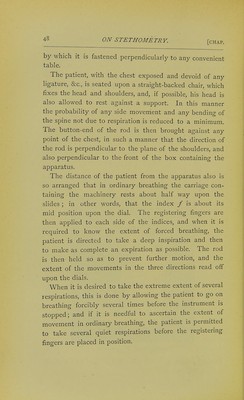
![111.] SOURCES OF ERROR. The only appreciable error in the indications, arising from the construction of the instrument, is to be found in the influence of the radial movements upon the forward motion. This is, however, very easily calculated, and depends upon the length of the lever. Mathematically stated, the distance through which the button moves for- wards is registered as less than it really is, by the versed sine of the angle formed by the rod in its angular motion. The longer the rod or arm, therefore, the less the error from this source. In my instrument it amounts to -021 or an inch for every lOO degrees of upward or outward motion. There are several sources of fallacy to be regarded in applying, the instrument, and corresponding precautions to be taken. In the first place, the mode of breathing, espe- cially when it is forced, may be unnatural and irregular from nervousness, officiousness, or anxiety ; the ribs may be even kept entirely fixed, and the breathing abdominal. It is necessary, therefore, to urge the patient to breathe easily and naturally, and, when a deep inspiration is needed, to ask him to breathe quietly and deeply; and sometimes a little time has to be given, and the attention has to be drawn away from the instrument. It is hardly necessary to state that those observations in which the breathing has not been natural were rejected as worthless. It is also desirable that the muscles of the arms should not be allowed to take part in the process of breathing, as they generally introduce some irregularity in the move- ments. In all cases, therefore, the patient is directed to rest the tips only of the fingers upon the edge of the table; this arrangement also steadies the body of the patient. E](https://iiif.wellcomecollection.org/image/b20412101_0065.jp2/full/800%2C/0/default.jpg)