The Celt, the Roman, and the Saxon : a history of the early inhabitants of Britain, down to the conversion of the Anglo-Saxons to Christianity, illustrated by the ancient remains brought to light by recent research / by Thomas Wright ; with numerous engravings on wood.
- Thomas Wright
- Date:
- 1902
Licence: In copyright
Credit: The Celt, the Roman, and the Saxon : a history of the early inhabitants of Britain, down to the conversion of the Anglo-Saxons to Christianity, illustrated by the ancient remains brought to light by recent research / by Thomas Wright ; with numerous engravings on wood. Source: Wellcome Collection.
457/588 page 435
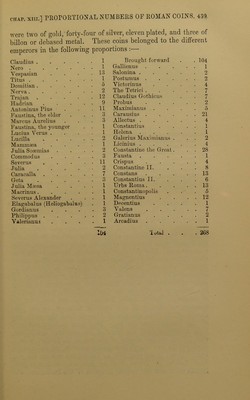
![CHAP. XIII.] COINS RELATING TO BRITAIN. one another, notch over notch, in the same order as when moulded. ’ It has been a question rather learnedly and warmly discussed, whether these workshops were those ot private forgers, or whether they were establishments under the direction of the imperial government. The latter supposition seems to be au- thorized by the fact that they are found in large towns, and ap- parently, in some instances, in public buildings. The moulds found at Polden Hill, in Somersetshire, were of Severus and his wife Julia, of Caracalla, Geta, Macrinus, Elagabalus, Alex- ander Severus, Maximinus, Maximus, Plautilla, Julia Paula, and Julia Mammsea. These, compared with other circum- stances, seem to show that the forgeries were carried on after the reign of Severus, and that it was probably one scheme of the fiscal administration to raise money by the issue of debased coin, which, to protect the reigning emperor from odium, was cast from moulds of the coins of previous emperors. Of course, it does not follow necsssarily that some of the moulds which have been found in other places may not have belonged to private forgers, who thus enriched themselves by defrauding the public. Mr Akerman has published a useful volume under the title of ‘ Coins of the Romans relating to Britain.’ The series ot Roman coins which come under this denomination have a peculiar interest connected with the history of our island. From the moment when Claudius set his foot on our shores, there was a regular series of imperial coins commemorative of victories in Britain by the emperors or by their military com- manders. Those of Claudius, bearing on the reverse a triumphal arch with the inscription de brittan (over the Britons), are well known. The expedition of the emperor Hadrian was commemorated by a coin in large brass, struck in the year 121, on the reverse of which is the inscription, adventvs ayg britanniae (the advent of the Augustus to Britain). The same emperor commemorated his exploits bv another coin, bearing on the reverse a figure of a female seated on a rock, holding a spear on her arm, with a shield resting by her side, and the inscription Britannia. There are several different coins of Hadrian with this device, from which they are usually known as the Britannia types, and similar coins were struck under Antoninus Pius ; but in the latter the figure is more frequently a male than a female. It is from these Roman coins that the figure of Britannia was taken lor our](https://iiif.wellcomecollection.org/image/b24870808_0459.jp2/full/800%2C/0/default.jpg)
 No text description is available for this image
 No text description is available for this image
 No text description is available for this image