A text-book of medicine : for students and practitioners / by Adolf Strümpell ; translated by permission from the 2nd and 3rd German editions by Herman F. Vickery and Philip Coombs Knapp ; with editorial notes by Frederick C. Shattuck.
- Date:
- 1887
Licence: Public Domain Mark
Credit: A text-book of medicine : for students and practitioners / by Adolf Strümpell ; translated by permission from the 2nd and 3rd German editions by Herman F. Vickery and Philip Coombs Knapp ; with editorial notes by Frederick C. Shattuck. Source: Wellcome Collection.
Provider: This material has been provided by the Royal College of Physicians of Edinburgh. The original may be consulted at the Royal College of Physicians of Edinburgh.
33/1022
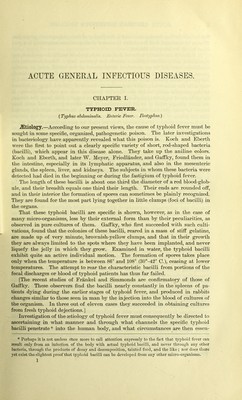
![ACUTE GENERAL INFECTIOUS DISEASES. CHAPTER I. TYPHOID FEVER. (Typhus abdominalis. Enteric Fever. Ileotyphus.) iEtiology.—According to our present views, the cause of typhoid fever must be sought in some specific, organized, pathogenetic poison. The later investigations in bacteriology have apparently revealed what this poison is. Koch and Eberth were the first, to point out a clearly specific variety of short, rod-shaped bacteria (bacilli), which appear in this disease alone. They take up the aniline colors. Koch and Eberth, and later W. Meyer, Friedlander, and Gaffky, found them in the intestine, especially in its lymphatic apparatus, and also in the mesenteric glands, the spleen, liver, and kidneys. The subjects in whom these bacteria were detected had died in the beginning or during the fastigium of typhoid fever. The length of these bacilli is about one third the diameter of a red blood-glob- ule, and their breadth equals one third their length. Their ends are rounded off, and in their interior the formation of spores can sometimes be plainly recognized. They are found for the most part lying together in little clumps (foci of bacilli) in the organs. That these typhoid bacilli are specific is shown, however, as in the case of many micro-organisms, less by their external form than by their peculiarities, as observed in pure cultures of them. Gaffky, who first succeeded with such culti- vations, found that the colonies of these bacilli, reared in a mass of stiff gelatine, are made up of very minute, brownish-yellow clumps, and that in their growth they are always limited to the spots where they have been implanted, and never liquefy the jelly in which they grow. Examined in water, the typhoid bacilli exhibit quite an active individual motion. The formation of spores takes place only when the temperature is between 86° and 108° (30°-42° C.), ceasing at lower temperatures. The attempt to rear the characteristic bacilli from portions of the fecal discharges or blood of typhoid patients has thus far failed. [The recent studies of Frankel and Simmonds are confirmatory of those of Gaffky. These observers find the bacilli nearly constantly in the spleens of pa- tients dying during the earlier stages of typhoid fever, and produced in rabbits changes similar to those seen in man by the injection into the blood of cultures of the organism. In three out of eleven cases they succeeded in obtaining cultures from fresh typhoid dejections.] Investigation of the aetiology of typhoid fever must consequently be directed to ascertaining in what manner and through what channels the specific typhoid bacilli penetrate * into the human body, and what circumstances are then essen- * Perhaps it is not useless Once more to call attention expressly to the fact that typhoid fever can result only from an infection of the body with actual typhoid bacilli, and never through any other bacteria, through the products of decay and decomposition, tainted food, and the like ; nor does there yet exist the slightest proof that typhoid bacilli can be developed from any other micro-organisms.](https://iiif.wellcomecollection.org/image/b21981565_0033.jp2/full/800%2C/0/default.jpg)