A text-book of medicine : for students and practitioners / by Adolf Strümpell ; translated by permission from the 2nd and 3rd German editions by Herman F. Vickery and Philip Coombs Knapp ; with editorial notes by Frederick C. Shattuck.
- Date:
- 1887
Licence: Public Domain Mark
Credit: A text-book of medicine : for students and practitioners / by Adolf Strümpell ; translated by permission from the 2nd and 3rd German editions by Herman F. Vickery and Philip Coombs Knapp ; with editorial notes by Frederick C. Shattuck. Source: Wellcome Collection.
Provider: This material has been provided by the Royal College of Physicians of Edinburgh. The original may be consulted at the Royal College of Physicians of Edinburgh.
63/1022 page 31
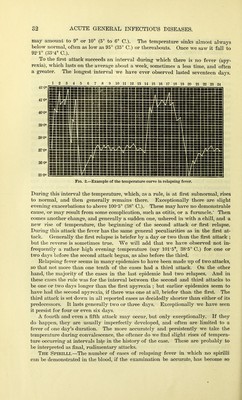
![brought the disease with him and passed through it in the Massachusetts General Hospital.] Clinical History.—The stage of incubation lasts about five to eight days. It is only exceptionally that some slight prodromal symptoms present themselves just before the outbreak of the disease proper. As a rule, it begins suddenly, with a more or less pronounced chill and intense constitutional symptoms. There are violent headache, great languor, anorexia, and especially marked pains in the loins and extremities. The temperature rises rapidly, reaching generally 103° (41° C.) or higher as early as the first or second day. The skin is hot and dry, and usually quickly assumes a very characteristic dirty-yellowish color. Here, in Leipsic, we have often seen herpes labialis, which seems, however, to have been rarer in epidemics elsewhere. The tongue becomes dry and thickly coated. Some- times there is vomiting. The bowels are constipated, or there is a slight diarrhoea. The spleen becomes rapidly enlarged, being, as a rule, even larger than in typhoid or typhus. The liver is slightly enlarged. The chest presents the signs of a bron- chitis, generally moderate, but in exceptional instances severe. The pulse is much quickened. It is seldom that there are severe cerebral symptoms beyond a certain apathy and stupor. We have seen delirium tremens sometimes, in drunkards. A very characteristic symptom, already mentioned, is the marked hyperaesthesia of the muscles, especially in the calves. After these symptoms, accompanied by persistent and generally very high fever, have lasted five days to a week, there is a critical decline of temperature, with profuse sweating. The patient now improves so rapidly and decidedly that he thinks himself completely cured, and generally gives little credence to the physician’s prophecy of a relapse. In rare but well-attested cases there has been really but one attack. The rule is that, after about a week, a second attack occurs, often a third after that, and, infrequently, even a fourth and fifth. In each of these, the above-mentioned symptoms are repeated more or less completely and violently. As the only certain and constant sign of the recurring attacks (the so-called relapses) is a fresh rise of temperature, it will be well to consider their peculiarities at the same time that we describe the course of the fever. During the intervals of normal temperature the other objective symptoms of disease are usually absent, except an evident splenic tumor, and, not infrequently, the pecul- iar pale-yellow hue. Course of the Fever (see Fig. 2).—The beginning of the fever in the first attack is, as we have said, almost always sudden, so that it may even in a few hours reach a considerable height. The fever lasts, as a rule, five to seven days, but not infrequently as short a time as three or four days, or as long as ten or twelve days. During this time it may keep a tolerably uniform height, but oftener there are considerable remissions, which may even come to deserve the name of pseudo-crises. In such cases the temperature sinks in the morning to normal or even lower, so that we might believe the fever ended ; but in the even- ing the temperature rises again to its former height. These pseudo-crises are most frequent toward the end of the attack, but do occur sometimes in the very first days. The absolute height of the fever is, as a rule, very considerable. Tempera- tures between 105‘5° and 106'5° (41° and 41'5° C.) are very often observed, and in themselves are not especially ominous in relapsing fever. The highest tempera- ture we have observed was 107’9° (42‘2° C.). Sometimes the temperature is more moderate (between 102° and 104°, 39° and 40° C.). The fever almost always ends at the close of the attack by crisis, only rarely by a rapid, gradual decline. The crisis is often preceded by an especially great rise the evening before (pertur- batio critica); so that the subsequent fall of temperature is very considerable. It generally occurs at night, and is accompanied by profuse perspiration. The fall](https://iiif.wellcomecollection.org/image/b21981565_0063.jp2/full/800%2C/0/default.jpg)