A treatise on the small-pox and measles / by Abú Becr Mohammed ibn Zacaríyá ar-Rází (commonly called Rhazes) ; translated from the original Arabic by William Alexander Greenhill.
- Razi, Abu Bakr Muhammad ibn Zakariya, 865?-925?, 865?-925?
- Date:
- 1848
Licence: Public Domain Mark
Credit: A treatise on the small-pox and measles / by Abú Becr Mohammed ibn Zacaríyá ar-Rází (commonly called Rhazes) ; translated from the original Arabic by William Alexander Greenhill. Source: Wellcome Collection.
Provider: This material has been provided by King’s College London. The original may be consulted at King’s College London.
81/268 page 69
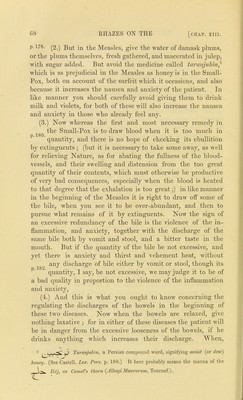
![therefore, the bowels are relaxed, give the patient barley gruel to drink, instead of barley water; and, if it be necessary, boil with the barlej'^ gruel the parched meal of pomegranate seeds; and if, notwithstanding, the looseness still continues, then mix in his diink gum^ Arabic and tabasheer, in this manner:— p. 184. [Form. 17.] Take of Gum Arabic, two drachms, Tabasheer, one drachm; Pound them as small as cuhl, and sprinkle the powder into four ounces of barley gruel, and give it to the patient to drink, if his bowels be much relaxed. And give him also to drink, about an horn before the barley gruel, some of this medicine which I am going to describe; and then give him barley gruel. The following is the description of it:— [form. 18.] Take of Red Roses ground fine, Tabasheer, Broad-leaved Dock Seed, Sumach, Barberries, of each equal parts. Gum Arabic, Lemnian Earth, Poppy Rinds, Pomegi-anate Flowers, of each half the quantity ; Give the patient to drink three drachms of these in one ounce of the inspis- sated juice of green and acid quinces. p. 186. (5.) But if the looseness still continues, and the patient is weakened by it, let him drink sour butter-milk,^ from which the butter has been carefully removed, with the best sort of biscuits, and a little gum Arabic. Lastly, there often comes on a dysentery,^ and when this is the case the mode of treatment ' The word Samag, gum, when used without any distinguishing epithet, signifies gum Arabic. See Ibn Baitar, vol. ii. p. 133. The Greek Translator has Trpoa^tpe to pain (i.e. Raib), Tovrkari to I’xtopibSte TOO b^vvov ydXaKTog. See above. Note (®) p. 39. The word Sahj, means excoriation of the intestines and dysentery. The exact passage referred to by Rhazes is not quite clear. It is possible that it may be Almam. ix. 72 (71), but this does not seem likely, as that chapter is headed Chalfah, not ventris. Sahj, which is rendered in the Latin version Fluxus](https://iiif.wellcomecollection.org/image/b21301943_0081.jp2/full/800%2C/0/default.jpg)