A report of surgical cases treated in the Army of the United States from 1865 to 1871 / War Department, Surgeon General's Office.
- Date:
- 1871
Licence: Public Domain Mark
Credit: A report of surgical cases treated in the Army of the United States from 1865 to 1871 / War Department, Surgeon General's Office. Source: Wellcome Collection.
Provider: This material has been provided by the Royal College of Physicians of Edinburgh. The original may be consulted at the Royal College of Physicians of Edinburgh.
31/318 page 23
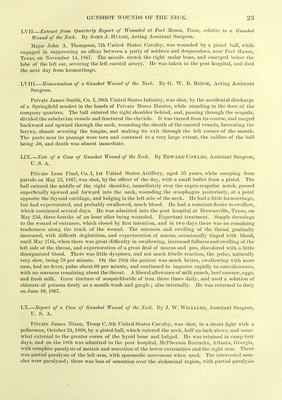
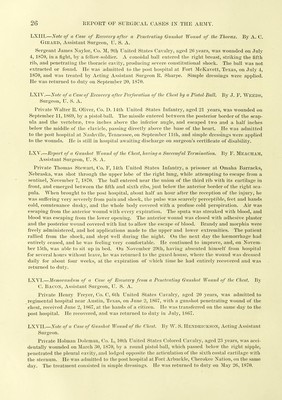
![XiYIT. Extract from Quarterly Eeport of Wounded at Fort Mason, Texas, relative to a Gunshot Wound of the Neclc. By John J. Hulse, Acting Assistant Surgeon, Major John A. Thompson, 7th United States Cavalry, was wounded by a pistol ball, while engaged in suppressing an aiFray between a party of soldiers and desperadoes, near Fort Mason, Texas, on November 14, 18G7. The missile struck the right malar bone, and emerged below the lobe of the left ear, severing the left carotid artery. He was taken to the post hospital, and died the next day from haemorrhage. LVIII.—Memorandum of a Gunshot Woimd of the Neclc. By G. W. B. Minor, Acting Assistant Surgeon. Private James Smith, Co. I, 38th United States Infantry, was shot, by the accidental discharge of a Springfield musket in the hands of Private Moses Hunter, while standing in the door of the companj' quarters. The ball entered the right shoulder behind, and, iiassing through the scapula, divided the subclavian vessels and fractured the clavicle. It was turned from its course, and ranged backward and upward through the neck, wounding the sheath of the carotid vessels, lacerating the larynx, almost severing the tongue, and making its exit through the left corner of the mouth. The parts near its passage were torn and contused to a very large extent, the calibre of the ball being .50, and death was almost immediate. LIX.—Note of a Case of Gunshot Wound of the Neclc. By Edward Cowles, Assistant Surgeon, U. S. A. Private Leon Pinel, Co. I, 1st United States Artillery, aged 35 years, while escaping from patrols on May 23, 1867, was shot, by the officer of the day, with a small bullet from a pistol. The ball entered the middle of the right shoulder, immediately over the supra-scapular notch, passed superficially upward and forward into the neck, wounding the oesophagus posteriorly, at a point opposite the thyroid cartilage, and lodging in the left side of the neck. He had a little haemorrhage, but had expectorated, and probably swallowed, much blood. He had a constant desire to swallow, which continned several days. He was admitted into the post hospital at Brownsville, Texas, on May 23d, three-fourths of an hour after being wounded. Expectant treatment. Simple dressings to the wound of entrance, which closed by first intention, and in two days there was no remaining tenderness along the track of the wound. The soreness and swelling of the throat gradually increased, with difficult deglutition, and expectoration of mucus, occasionally tinged with blood, until May 27th, when there was great difficulty in swallowing, increased fullness and swelling of the left side of the throat, and expectoration of a great deal of mucus and pus, discolored with a little disorganized blood. There was little dyspnoea, and not much febrile reaction, the pulse, naturally very slow, being 70 per minute. On the 28th the patient was much better, swallowing with more ease, had no fever, pulse about 60 per minute, and continued to improve rapidly to convalescence, with no soreness remaining about the throat. A liberal allowance of milk-punch, beef-essence, eggs, and fresh milk. Gave tincture of sesquichloride of iron three times daily, and used a solution of chlorate of i^otassa freely as a mouth-wash and gargle; also internally. He was returned to duty on June 10, 1867, LX,—Report of a Case of Gunshot Wound of the Neclc. By J, W. Williams, Assistant Sui-geoi], U. S. A. Private James Nixon, Troop C, 5th United States Cavalry, was shot, in a street fight with a policeman, October 21,1868, by a pistol-ball, which entered the neck, half an inch above, and some- what external to the greater cornu of the hyoid bone and lodged. He was retained in camp four days, and on the 18th was admitted to the post hospital, McPherson Barracks, Atlanta, Georgia, with complete paralysis of motion and sensation of the lower extremities and the right arm. There was partial paralysis of the left arm, with spasmodic movement when nsed. The intercostal mus- cles were paralyzed; there was loss of sensation over the abdominal region, with partial paralysis](https://iiif.wellcomecollection.org/image/b21970695_0031.jp2/full/800%2C/0/default.jpg)