An inquiry into the nature and treatment of diabetes, calculus, and other affections of the urinary organs : with remarks on the importance of attending to the state of the urine in organic diseases of the kidney and bladder: and some practical rules for determining the nature of the disease from the sensible and chemical properties of that secretion / by William Prout.
- William Prout
- Date:
- 1826
Licence: Public Domain Mark
Credit: An inquiry into the nature and treatment of diabetes, calculus, and other affections of the urinary organs : with remarks on the importance of attending to the state of the urine in organic diseases of the kidney and bladder: and some practical rules for determining the nature of the disease from the sensible and chemical properties of that secretion / by William Prout. Source: Wellcome Collection.
Provider: This material has been provided by the Woodruff Health Sciences Center Library at Emory University, through the Medical Heritage Library. The original may be consulted at the Woodruff Health Sciences Center Library, Emory University.
21/328
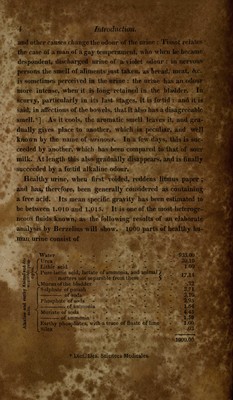
![and other causes change the odour of the urine : Tissot relator? the case of a man of a gay temperament, who when he became despondent, discharged urine of a violet odour : in nervous persons the smell of aliments just taken, as oread, meat, &c. is sometimes perceived in the urine : the urine has an odour more intense, when it is long retained in the bladder. In scurvy, particularly in its last stages, it is fcetid : and it is said, in affections of the bowels, that it also has a disagreeable smell.*] As it cools, the aromatic smell leaves it, and gra- dually gives place to another, which is peculiar, and well known by the name of urinous. In a few days, this is suc- ceeded by another, which has been compared to that of sour milk. At length this also gradually disappears, and is finally succeeded by a foetid alkaline odour. Healthy urine, when first voided, reddens litmus paper; and has, therefore, been generally considered as containing a free acid. Its mean specific gravity lias been estimated to be between 1.010 and 1.015. It is one of the most heteroge- neous fluids known, as the following results of an elaborate analysis by Berzelius will show. 1000 parts of healthy hu- man urine consist of ■a E. 3£ 933.00 30.10 1.00 17.14 .32 3.71 3.16 2.95 1.64 4.45 — of ammonia 1.50 Earthy phosphates, with a trace of fluate of lime - 1.00 LSilex - , 03 1000.00 Water _-„_-.-- fUrea - j Lithic acid ^i Pure lactic acid, lactate of ammonia, and animal 3 matters not separable from these - y LMucusoflhe bladder f Sulphate of potash ------ of soda ------ Phosphate of soda J -- of ammonia \ Muriate of soda * Diet. Des. Sciences Medicates.](https://iiif.wellcomecollection.org/image/b21036718_0021.jp2/full/800%2C/0/default.jpg)