An inquiry into the nature and treatment of diabetes, calculus, and other affections of the urinary organs : with remarks on the importance of attending to the state of the urine in organic diseases of the kidney and bladder: and some practical rules for determining the nature of the disease from the sensible and chemical properties of that secretion / by William Prout.
- William Prout
- Date:
- 1826
Licence: Public Domain Mark
Credit: An inquiry into the nature and treatment of diabetes, calculus, and other affections of the urinary organs : with remarks on the importance of attending to the state of the urine in organic diseases of the kidney and bladder: and some practical rules for determining the nature of the disease from the sensible and chemical properties of that secretion / by William Prout. Source: Wellcome Collection.
Provider: This material has been provided by the Woodruff Health Sciences Center Library at Emory University, through the Medical Heritage Library. The original may be consulted at the Woodruff Health Sciences Center Library, Emory University.
24/328
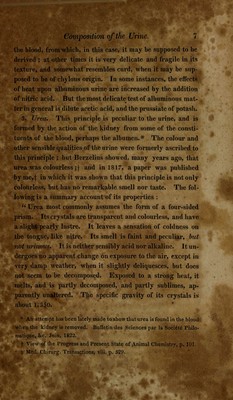
![.'. i Composition of the Urine. 7 the blood, from which, in this case, it may he supposed to he derived ; at other times it is very delicate and fragile in its texture, and somewhat resemhles curd, when it may be sup- posed to be of chylous origin. In some instances, the effects of heat upon albuminous urine are increased by the addition of nitric acid. But the most delicate test of albuminous mat- ter in general is dilute acetic acid, and the prussiate of potash. 3. Urea. This principle is peculiar to the urine, and is formed by the action of the kidney from some of the consti- tuents of the blood, perhaps the albumen.* The colour and other sensible qualities of the urine were formerly ascribed to this principle ; but Berzelius showed, many years ago, that urea was colourless;] and in 1817, a paper was published by me,:}: in which it was shown that this principle is not only colourless, but has no remarkable smell nor taste. The fol- lowing is a summary account of its properties : Urea most commonly assumes the form of a four-sided prism. Its crystals are transparent and colourless, and have a slight pearly lustre. It leaves a sensation of coldness on the tongue, like nitre. Its smell is faint and peculiar, but not urinous. It is neither sensibly acid nor alkaline. It un- dergoes no apparent change on exposure to the air, except in very damp weather, when it slightly deliquesces, but does not seem to be decomposed. Exposed to a strong heat, it melts, and is partly decomposed, and partly sublimes, ap- parently unaltered. The specific gravity of its crystals is about 1.350. * An attempt has been lately made to show that urea is found in the blood when the kidney is removed. Bulletin des Sciences par la Soci^te Philo- matique, 8tc. Juin, 1822. f View of the Progress and Present State of Animal Chemistry, p. 101. t Med. Chirurg. Transactions, viii. p. 529.](https://iiif.wellcomecollection.org/image/b21036718_0024.jp2/full/800%2C/0/default.jpg)