Abstract of report on the origin and spread of typhoid fever in U. S. military camps during the Spanish War of 1898 / by Walter Reed, Victor C. Vaughan and Edward O. Shakespeare.
- Walter Reed
- Date:
- 1900
Licence: In copyright
Credit: Abstract of report on the origin and spread of typhoid fever in U. S. military camps during the Spanish War of 1898 / by Walter Reed, Victor C. Vaughan and Edward O. Shakespeare. Source: Wellcome Collection.
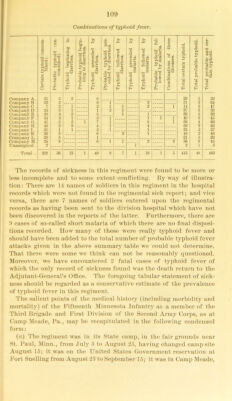
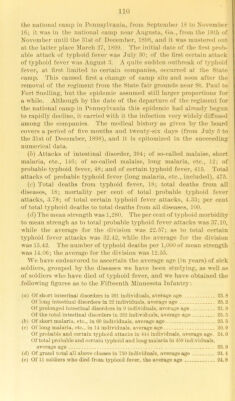
129/270 page 107
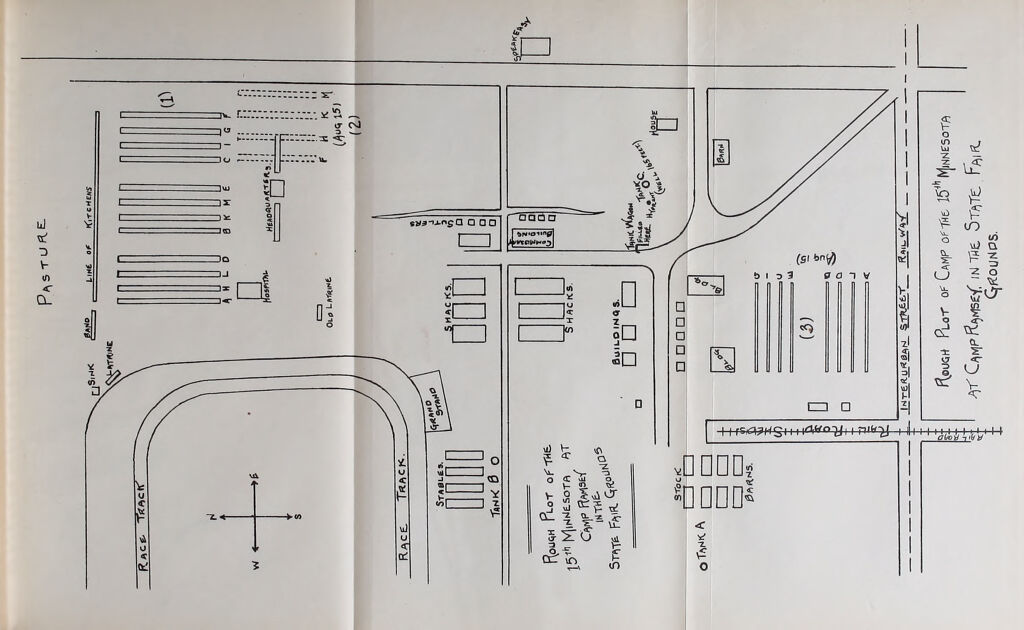
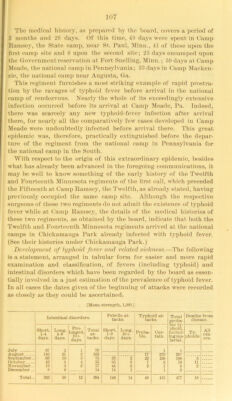
![The medical history, as prepared by the board, covers a period of 5 months and 26 days. Of this time, 49 days were spent in Camp Ramsey, the State camp, near St. Paul, Minn., 41 of these upon the first camp site and 8 upon the second site; 23 days encamped upon the Government reservation at Fort Snelling, Minn.; 59 days at Camp Meade, the national camp in I^ennsylvania; 33 days in Camp Macken- zie, the national camp near Augusta, Ga. This regiment furnishes a most striking example of rapid prostra- tion by the ravages of typhoid fever before arrival in the national camp of rendezvous. Nearl3' the whole of its exceedingly extensive infection occurred before its arrival at Camp Meade, Pa. Indeed, there was scarcely any new typhoid-fever infection after arrival there, for nearly all the comparatively few cases developed in Camp Meade were undoubtedlj^ infected before arrival there. This great epidemic was, therefore, practically extinguished before the depar- ture of the regiment from the national camp in Pennsylvania for the national camp in the South. With respect to the origin of this extraordinary epidemic, besides what has already been advanced in the foregoing communications, it may be well to know something of the early history of the Twelfth and Fourteenth Minnesota regiments of the first call, which iDreceded the Fifteenth at Camp Ramsey, the Twelfth, as already stated, having previously occupied the same camp site. Although the respective surgeons of these two regiments do not admit the existence of typhoid fever while at Camp Ramsey, the details of the medical histories of the.se two regiments, as obtained by the board, indicate that both the Twelfth and Fourteenth Minnesota regiments arrived at the national camps in Chickamauga Park alreadj'^ infected with typhoid fever. (See their histories under Chickamauga Park.) Development of typhoid fever and related sickness.—The following is a statement, an-anged in tabular form for easier and more rapid examination and classification, of fevers (including typhoid) and intestinal disorders which have been regarded by the board as essen- tially involved in a just estimation of the prevalence of typhoid fever. In all cases the dates given of the beginning of attacks were recorded as closely as they could be ascertained. [Mean strength, 1,280.] Intestinal disorders. Febrile at- tacks. Typhoid at- tacks. Total proba- ble ty- phoid, includ- ing ma- larial. Deaths from disease. Short, 1-1 days. Long, 5-9 days. Pro- longed, 10-f days. Total at- tack.s. Short, 1-9 days. Lung, lOH- days. Proba- ble. Cer- tain. Ty- phoids. All oth- ers. July 67 O 1 70 1 1 August 110 31 2 163 17 270 287 September.. 63 10 3 75 23 2 23 136 160 6 October i:i H 4 <t5 0 7 6 1» 11 November. 12 3 2 17 44 5 2 1 8 2 December .. 8 6 11 14 1 1 2 Total.. .332 50 12 :194 146 14 48 415 477 18](https://iiif.wellcomecollection.org/image/b28063223_0129.jp2/full/800%2C/0/default.jpg)