Abstract of report on the origin and spread of typhoid fever in U. S. military camps during the Spanish War of 1898 / by Walter Reed, Victor C. Vaughan and Edward O. Shakespeare.
- Walter Reed
- Date:
- 1900
Licence: In copyright
Credit: Abstract of report on the origin and spread of typhoid fever in U. S. military camps during the Spanish War of 1898 / by Walter Reed, Victor C. Vaughan and Edward O. Shakespeare. Source: Wellcome Collection.
148/270 page 124
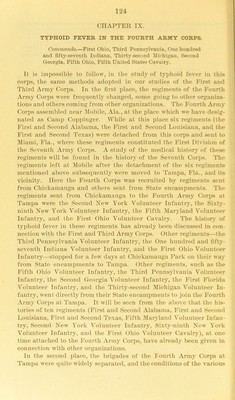
![CHAPTER IX. TYPHOID FEVER IN THE FOURTH ARMY CORPS. Commands.—First Ohio, Third Pennsylvania, One hundred and fifty-seventh Indiana, Thirty-second Michigan, Second Georgia, Fifth Ohio, Fifth United States Cavalry. It is impossible to follow, in the study of typhoid fever in this corps, the same methods adopted in our studies of the First and Third Army Corps. In the first place, the regiments of the Fourth Arm3^ Corps were frequentlj’ changed, some going to other organiza- tions and others coming from other organizations. The Fourth Armj' Corps assembled near Mobile, Ala., at the place which we have desig- nated as Camp Coppinger. While at this place six regiments (the First and Second Alabama, the First and Second Louisiana, and the First and Second Texas) were detached from this corps and sent to Miami, Fla., where these regiments constituted the First Division of the Seventh Armj^ Corps. A studj’ of the medical historj’ of these regiments will be found in the histoiy of the Seventh Corps. The regiments left at Mobile after the detachment of the six regiments mentioned above subsequentlj^ were moved to Tampa, Fla., and its vicinity. Here the Fourth Corps was recruited by regiments sent from Chickamauga and others sent from State encampments. The regiments sent from Chickamauga to the Fourth Army Corps at Tampa were the Second New York Volunteer Infantiy, the Sixty- ninth New York Volunteer Infantry, the Fifth Marjdand Volunteer Infantry, and the First Ohio Volunteer Cavalry. The histor.v of typhoid fever in these i-egiments has alreadj’- been discussed in con- nection with the First and Third Armj^ Corj)s. Other regiments—the Third Pennsylvania Volunteer Infantry, the One hundred and fifty- seventh Indiana Volunteer Infantry, and the First Ohio Volunteer Infantry—stopped for a few days at Chickamauga Park on their wa.v from State encampments to Tampa. Other regiments, such as the Fifth Ohio Volunteer Infantry, the Third Pennsj'lvania Volunteer- Infantry, the Second Georgia Volunteer Infantry, the First Florida Volunteer Infantrjq and the Thirty-second Michigan Volunteer In- fantry, went directl}'^ from their State encampments to join the Fourth Armj^ Corps at Tampa. It will be seen from the above that the his- tories of ten regiments (First and Second Alabama, First and Second Loirisiana, First and Second Texas, Fifth Maryland Volunteer Infan- try, Second New York Volunteer Infantry, Sixty-ninth New York Volunteer Infantry, and the First Ohio Volunteer Cavalry), at one time attached to the Fourth Arny^ Corps, have alreadA’^ been given in connection with other organizations. In tlie second ])lace, the brigades of (he Fourth Arinj- Corps at Tampa were quite widely- separated, and the conditions of the various](https://iiif.wellcomecollection.org/image/b28063223_0148.jp2/full/800%2C/0/default.jpg)