Abstract of report on the origin and spread of typhoid fever in U. S. military camps during the Spanish War of 1898 / by Walter Reed, Victor C. Vaughan and Edward O. Shakespeare.
- Walter Reed
- Date:
- 1900
Licence: In copyright
Credit: Abstract of report on the origin and spread of typhoid fever in U. S. military camps during the Spanish War of 1898 / by Walter Reed, Victor C. Vaughan and Edward O. Shakespeare. Source: Wellcome Collection.
168/270 page 142
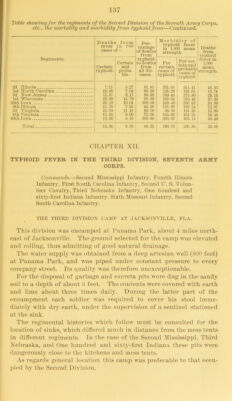
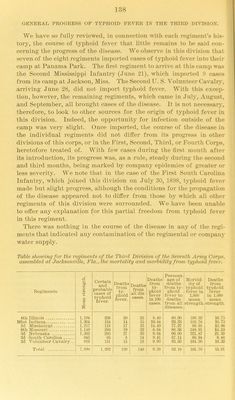
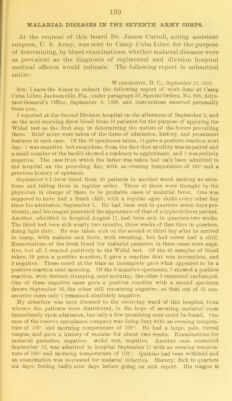
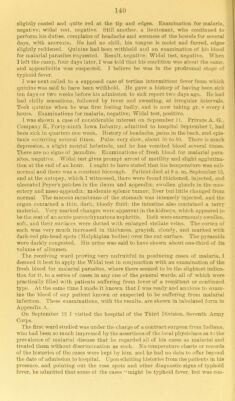
![had no chill, but has felt badly for two days before going on sick report. Took quinine gr. vi to-day at 1 j). m. E.xamination for malarial parasite, negative; Widal test, negative. 3. R. W, Com])any F, First Texas. Has been sick a day and a half. Has had only fever; no chill and no sweating. Has not taken any quinine. Examination for malarial parasite, negative; Widal test, positive. It is remarkable that 1 case in 3 gave a positive reaction so early in the disease, and it recalls 3 similar supposed cases of malaria which were all the cases of fever I could find at the camp of the Twelfth Pennsylvania Infantry at Camp Alger. They were all sick in quarters only, and were believed to be convalescent from mild attacks of malarial fevers. I transcribe v’erbatim from my notes made at the time. Cajip Alger, August 24, 1898. 1. W. A. Gr., Company E, Twelfth Pennsylvania. Chilly sensations followed by fever is the only history. Examination for malarial parasites, made at once, negative. August 35, 1898, Widal test, positive; good reaction, “3. H. C.R., Company E, Twelfth Pennsylvania. Has had a number of frank chills, followed by fever and sweating. This was the history given by the man himself, who said he had had regular ague shakes. Examination for malarial parasites, made at once, negative. August 35, 1898, Widal test, positive reaction, typical. “3. H. W. S., Company E, Twelfth Pennsylvania. Gives a history of chilly sensations followed bj’ malaise and a mild fever. Examination for malarial iiara- sites, made at once, negative. August 25, 1898, Widal test, negative.” It is worthy of note that in a camp of a whole regiment the 3 cases came from the same company. To return to camp Cuba Libre. Having been told by the chief surgeon of the Third Division hospital that a considerable number of cases of malarial fever had been reported by the medical officers of the Second U. S. Volunteer Cavalry, I made a special trip to the camp of that regiment, September 14, for the purpose of examin- ing any cases of malaria that could be found. 1 saw the junior medical officer, who stated that he had sent a patient to hospital an hour previously who, he was certain, was a case of malarial fever, and to whom quinine had not been adminis- tered. Besides this patient the caj)tain (medical officer) .showed me another patient diagnosed malarial fever, and these were all that he had of that class of cases. 1. E.J., Troop H, Second Volunteer Cavalry, just admitted to hospital. Has been feeling badly for two weeks. Gives a history of pains in back and limbs, diarrhea, soreness of bowels. His tongue is coated, and the edges are bright red. Roseola is present. Widal test, negative. 2. N.E.D., Troop L, Second Volunteer Cavalry, admitted to hospital Septem- ber 13; to quarters September 10. History of headache, insomnia. Tongue coated and with bright-red edges. Examination for malarial parasites, negative; Widal test, negative. Failure to obtain a positive reaction with the tjq>hoid bacillus early in the dis- ease is no evidence that the patient is not suffeiing from tjqjhoid fever. On the other hand, a failure to find any of the parasites of malaria, with the absence of pigmented leucocytes, is positive evidence that the patient is not suffering from malarial infection at the time the examination is made. The uniformity of the results obtained in this work has been a revelation to me. and I am more than ever impressed with the great value of the Widal test in clearing up the diagnosis in doubtful and especiallj’^ in atypical cases of typhoid fever, provided, of course, the test be not applied too early in the course of the disease. I have been impressed also by the fact that cases, apparently those of malarial fever, and in which I](https://iiif.wellcomecollection.org/image/b28063223_0168.jp2/full/800%2C/0/default.jpg)