Lexicon medicum; or medical dictionary; containing an explanation and comparative, botany, chemistry, materia medica, midwifery, pharmacy, physiology, practice of physic, surgery, and the various branches of natural philosopy, connected with medicine / Selected, arranged and compiled, from the best authors, by Robert Hooper.
- Robert Hooper
- Date:
- 1839
Licence: Public Domain Mark
Credit: Lexicon medicum; or medical dictionary; containing an explanation and comparative, botany, chemistry, materia medica, midwifery, pharmacy, physiology, practice of physic, surgery, and the various branches of natural philosopy, connected with medicine / Selected, arranged and compiled, from the best authors, by Robert Hooper. Source: Wellcome Collection.
62/1428 (page 48)
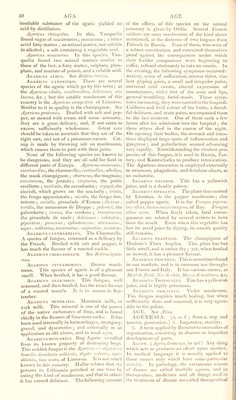
![•18 AFF a disposing affinity, which was considered as a sort of prospective affinity for the compound about to be formed ; thus, zinc has so small an affinity for oxygen, that it decomposes water at common temperatures with extreme slowness; but if sulphuric acid be added, the zinc takes oxygen from the water with great rapidity, and the oxide combines with the acid ; here the acid exerts a disposing affinity. This doctrine of disposing affinities involves the absurdity, that a substance can exert an affinity for a certain compound before that compound exists. The cases of chemical action referred to are now explained in a different manner. See Attraction. Affinity, divellent. See Affinity quiescent. Affinity, double. Double elective attraction. When two bodies, each consisting of two con¬ stituent parts, come into contact, and are de¬ composed, so that their constituents become reciprocally united, and produce two new com¬ pound bodies, the decomposition is said to take place by double affinity: thus, if we add a solution of nitrate of potash to one of sulphate of am¬ monia, the salts change ingredients and sul¬ phate of potash and nitrate of ammonia are formed. Affinity, elementary. See Affinity, resulting. Affinity, intermediate. When two substances which have no disposition to unite, combine by the agency of a third substance, the combination is said to be effected by an intermediate affinity: thus, oil and water, which will not even mix without the intervention of a third body, are readily combined, by means of an alkali, into the homogeneous substance called soap. Affinity, quiescent. Kirvvan employs the term quiescent affinity to designate that by which the principles of each compound adhere to each other ; and divellent affinity, to distinguish that by which the principles of one body unite and change order with those of the others : thus, sul¬ phate of potash is not decomposed by nitric acid or by lime, when either of these principles is separately presented ; but if the nitric acid be combined with lime, this nitrate of lime will decompose the sulphate of potash. In the last case, the affinity of the sulphuric acid for the alkali is weakened by its affinity for the lime. This acid, therefore, is subject to two affinities : the one which binds it to the alkali, called quiescent; and the other which attracts it towards the lime called divellent affinity. Affinity, reciprocal. When a compound of two bodies is decomposed by a third, the sepa¬ rated body is in some instances capable of de¬ composing the new compound, if brought to act on it in large quantity ; nitrate of potash, for example, is readily decomposed by sulphuric acid, which unites with the potash and disen¬ gages the nitric acid ; but if the sulphate of potash thus formed, be subjected to the action of nitric acid in large quantity, it will detach a portion of the potash lrom the sulphuric acid, and form with it nitrate of potash. Such a case is called one of reciprocal affinity. Affinity, resulting. The affinity exerted by a compound, arising from the modified affinities of its constituents, were called by Berthollet resulting affinities, in contradistinction to those AFF of the constituents themselves, which he named elementary. Affinity, simple. Single elective attraction. If a body, consisting of two component parts, be decomposed on the approach of a third, which has a greater affinity for one of those component parts than they have for each other, then the decomposition is said to be effected by simple affinity : for instance, if acetic acid be added to a compound of carbonic acid and ammonia, the union which existed between these two bodies will cease; the acetic acid combines with the ammonia, and the carbonic acid is disengaged. When two bodies only enter into chemical union, the affinity which unites them, is also termed simple or single affinity : thus, sulphur and oxygen combine by simple affinity to form sulphurous acid. Affinity, vital. The power which regu¬ lates the formation of the various solids and fluids from the common circulating fluids, has been called vital affinity. A'ffion. An Arabic name of opium. AFFLA'TUS. [us, its. m. ; from afflare, to blow upon.) 1. A vapour or blast. 2. Applied by some to a species of erysipelas, which attacks suddenly, as if produced by some I unwholesome wind blowing on the part. Affrodina. An alchemical name of copper. I Afragar. Verdigris. AFFUSION. [Affusio; from affuiulo, to t pour upon.) The affusion of cold water, in the treatment of fever, was brought into general notice by the late Dr. Currie, of Liverpool, and appears, in his hands, to have been attended with an astonishing uniformity of success. The re¬ medy consists merely in placing the patient in a bathing-tub, or other convenient vessel, and pouring a pailful of cold water upon his body ; after which he is wiped dry, and again put i to bed. Dr. Currie’s experience led him to the following general conclusions with re- S] sped to the external application of cold water in fevers. First. That it is the low contagious fever in | which the cold affusion is to be employed ; the jl first symptoms of which are a dull headach, with I restlessness and shivering ; pains in the back, | and all over the body ; the tongue foul, with I prostration of strength ; the headach becoming p more acute ; the heat of the body, by the ther- | mometer, 102° to 10.1 °, or more ; general rest- I lessness, increasing to delirium, particularly in the night. Secondly. That it is in the early stage iff the | disease we must employ the remedy ; and gene- | rally in the state off the greatest heat and exacerb- | at ion. Thirdly. That affusion, not immersion, is to be | employed. Since the first publication of Dr. Currie’s | work, the practice of affusion has been exten- | sively tried, and its efficacy has been established | in some stages of the disease^ in which the B author had originally proscribed the practice of : it. One of the cautionary injunctions which I had been given for the allusion ot cold water in 8 fever, was, never to employ it in cases where the I ! patient had a sense iff chilliness upon him, even | >](https://iiif.wellcomecollection.org/image/b29304945_0062.jp2/full/800%2C/0/default.jpg)