Maternity services. Volume II, Minutes of evidence.
- Great Britain. Parliament. House of Commons. Health Committee
- Date:
- 1992
Licence: Open Government Licence
Credit: Maternity services. Volume II, Minutes of evidence. Source: Wellcome Collection.
12/320 (page 344)
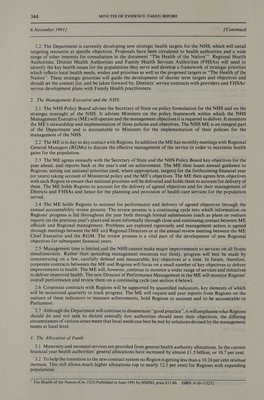
![6 November 1991] [Continued 1.2 The Department is currently developing new strategic health targets for the NHS, which will entail targeting resources at specific objectives. Proposals have been circulated to health authorities and a wide range of other interests for consultation in the document “The Health of the Nation’’'. Regional Health Authorities, District Health Authorities and Family Health Services Authorities (FHSAs) will need to identify the key health issues for the populations they serve and develop a framework of strategic priorities which reflects local health needs, wishes and priorities as well as the proposed targets in ““The Health of the Nation’. These strategic priorities will guide the development of shorter term targets and objectives and should set the context for, and be taken forward by, Districts’ service contracts with providers and FHSAs’ service development plans with Family Health practitioners. 2. The Management Executive and the NHS 2.1 The NHS Policy Board advises the Secretary of State on policy formulation for the NHS and on the strategic oversight of the NHS. It advises Ministers on the policy framework within which the NHS Management Executive (ME) will operate and the management objectives it is required to deliver. It monitors the ME’s stewardship and implementation of those policies and objectives. The NHS ME is an integral part of the Department and is accountable to Ministers for the implementation of their policies for the management of the NHS. 2.2 The ME isin day to day contact with Regions. In addition the ME has monthly meetings with Regional General Managers (RGMs) to discuss the effective management of the service in order to maximise health gains for the population. 2.3 The ME agrees annually with the Secretary of State and the NHS Policy Board key objectives for the year ahead, and reports back at the year’s end on achievement. The ME then issues annual guidance to Regions, setting out nationa! priorities (and, where appropriate, targets) for the forthcoming financial year (or years) taking account of Ministerial policy and the ME’s objectives. The ME then agrees firm objectives with each Region to ensure that national priorities will be delivered and holds them to account for delivery of these. The ME holds Regions to account for the delivery of agreed objectives and for their management of Districts and FHSAs and hence for the planning and provision of health care services for the population served. 2.4 The ME holds Regions to account for performance and delivery of agreed objectives through the annual accountability review process. The review process is a continuing cycle into which information on Regions’ progress is fed throughout the year both through formal submissions (such as plans or outturn reports on the previous year’s plan) and more informally through close and continuing contact between ME officials and Regional management. Problems are explored rigorously and management action is agreed through meetings between the ME and Regional Directors or at the annual review meeting between the ME Chief Executive and the RGM. The review process is a vital part of the development of new Regional objectives for subsequent financial years. 2.5 Management time is limited and the NHS cannot make major improvements to services on all fronts simultaneously. Rather than spreading management resources too thinly, progress will best be made by concentrating on a few, carefully defined and measurable, key objectives at a time. In future, therefore, corporate contracts betweeen the ME and Regions will focus on a small number of key objectives to deliver improvements to health. The ME will, however, continue to monitor a wider range of services and initiatives to deliver improved health. The new Director of Performance Management in the ME will monitor Regions’ overall performance and review them on a continuing cycle (see section 4 below). 2.6 Corporate contracts with Regions will be supported by quantified indicators, key elements of which will be monitored quarterly to track progress. The ME will require end year reports from Regions on the outturn of these indicators to measure achievements, hold Regions to account and to be accountable to Parliament. 2.7 Although the Department will continue to disseminate “good practice”’, it will emphasise what Regions should do and not seek to dictate centrally how authorities should meet their objectives; the differing circumstances of various areas mean that local needs can best be met by solutions devised by the management teams at local level. 3. The Allocation of Funds 3.1 Maternity and neonatal services are provided from general health authority allocations. In the current financial year health authorities’ general allocations have increased by almost £1.5 billion, or 10.7 per cent. 3.2 To help the transition to the new contract system no Region is getting less than a 10.24 per cent revenue increase. This still allows much higher allocations (up to nearly 12.5 per cent) for Regions with expanding populations. ' The Health of the Nation (Cm 1523) Published in June 1991 by HMSO, price £11.80. ISBN 0-10-115232.](https://iiif.wellcomecollection.org/image/b32222907_0012.jp2/full/800%2C/0/default.jpg)