Maternity services. Volume II, Minutes of evidence.
- Great Britain. Parliament. House of Commons. Health Committee
- Date:
- 1992
Licence: Open Government Licence
Credit: Maternity services. Volume II, Minutes of evidence. Source: Wellcome Collection.
28/320 (page 360)
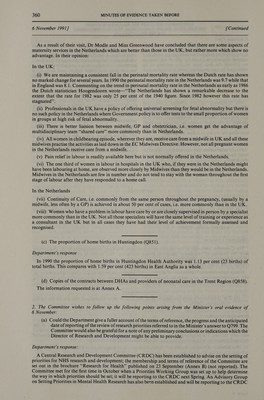
![6 November 1991] [Continued As a result of their visit, Dr Modle and Miss Greenwood have concluded that there are some aspects of maternity services in the Netherlands which are better than those in the UK, but rather more which show no advantage. In their opinion: In the UK: (i) We are maintaining a consistent fall in the perinatal mortality rate whereas the Dutch rate has shown no marked change for several years. In 1990 the perinatal mortality rate in the Netherlands was 9.7 while that in England was 8.1. Commenting on the trend in perinatal mortality rate in the Netherlands as early as 1986 the Dutch statistician Hoogendoorn wrote—“The Netherlands has shown a remarkable decrease to the extent that the rate for 1982 was only 25 per cent of the 1940 figure. Since 1982 however this rate has stagnated”’. (ii) Professionals in the UK have a policy of offering universal screening for fetal abnormality but there is no such policy in the Netherlands where Government policy is to offer tests to the small proportion of women in groups at high risk of fetal abnormality. (iii) There is better liaision between midwife, GP and obstetrician, i.e. women get the advantage of multidisciplinary team “‘shared care” more commonly than in Netherlands. (iv) All women in childbearing episode, wherever they are, receive care from a midwife in UK and all these midwives practise the activities as laid down in the EC Midwives Directive. However, not all pregnant women in the Netherlands receive care from a midwife. (v) Pain relief in labour is readily available here but is not normally offered in the Netherlands. (vi) The one third of women in labour in hospitals in the UK who, if they were in the Netherlands might have been labouring at home, are observed more closely by Midwives than they would be in the Netherlands. Midwives in the Netherlands are few in number and do not tend to stay with the woman throughout the first stage of labour after they have responded to a home call. In the Netherlands (vii) Continuity of Care, i.e. commonly from the same person throughout the pregnancy, (usually by a midwife, less often by a GP) is achieved in about 50 per cent of cases, i.e. more commonly than in the UK. (viii) Women who have a problem in labour have care by or are closely supervised in person by a specialist more commonly than in the UK. Not all those specialists will have the same level of training or experience as a consultant in the UK but in all cases they have had their level of achievement formally assessed and recognised. (c) The proportion of home births in Huntingdon (Q851). Department's response In 1990 the proportion of home births in Huntingdon Health Authority was 1.13 per cent (23 births) of total births. This compares with 1.59 per cent (423 births) in East Anglia as a whole. (d) Copies of the contracts between DHAs and providers of neonatal care in the Trent Region (Q858). The information requested is at Annex A. 2. The Committee wishes to follow up the following points arising from the Minister's oral evidence of 6 November: (a) Could the Department give a fuller account of the terms of reference, the progress and the anticipated date of reporting of the review of research priorities referred to in the Minister’s answer to Q799. The Committee would also be grateful for a note of any preliminary conclusions or indications which the Director of Research and Development might be able to provide. Department’s response: A Central Research and Development Committee (CRDC) has been established to advise on the setting of priorities for NHS research and development; the membership and terms of reference of the Committee are set out in the brochure ‘‘Research for Health” published on 23 September (Annex B) (not reported). The Committee met for the first time in October when a Priorities Working Group was set up to help determine the way in which priorities should be set; it will be reporting to the CRDC next Spring. An Advisory Group on Setting Priorities in Mental Health Research has also been established and will be reporting to the CRDC](https://iiif.wellcomecollection.org/image/b32222907_0028.jp2/full/800%2C/0/default.jpg)