Maternity services. Volume II, Minutes of evidence.
- Great Britain. Parliament. House of Commons. Health Committee
- Date:
- 1992
Licence: Open Government Licence
Credit: Maternity services. Volume II, Minutes of evidence. Source: Wellcome Collection.
30/320 (page 362)
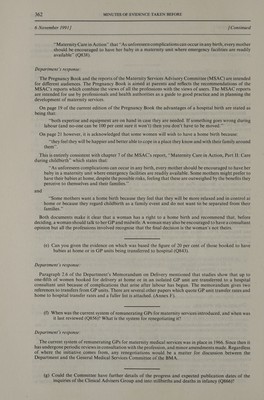
![6 November 1991] [Continued “Maternity Care in Action” that ‘‘As unforeseen complications can occur in any birth, every mother should be encouraged to have her baby in a maternity unit where emergency facilities are readily available” (Q838). Department's response: The Pregnancy Book and the reports of the Maternity Services Advisory Committee (MSAC) are intended for different audiences. The Pregnancy Book is aimed at parents and reflects the recommendations of the MSAC’s reports which combine the views of all the professions with the views of users. The MSAC reports are intended for use by professionals and health authorities as a guide to good practice and in planning the development of maternity services. On page 19 of the current edition of the Pregnancy Book the advantages of a hospital birth are stated as being that: ‘both expertise and equipment are on hand in case they are needed. If something goes wrong during labour (and no-one can be 100 per cent sure it won’t) then you don’t have to be moved.” On page 21 however, it is acknowledged that some women will wish to have a home birth because: ‘they feel they will be happier and better able to cope ina place they know and with their family around them’’. This is entirely consistent with chapter 7 of the MSAC’s report, “‘Maternity Care in Action, Part II: Care during childbirth” which states that: ‘“‘As unforeseen complications can occur in any birth, every mother should be encouraged to have her baby in a maternity unit where emergency facilities are readily available. Some mothers might prefer to have their babies at home, despite the possible risks, feeling that these are outweighed by the benefits they perceive to themselves and their families.” and ‘Some mothers want a home birth because they feel that they will be more relaxed and in control at home or because they regard childbirth as a family event and do not want to be separated from their families.” Both documents make it clear that a woman has a right to a home birth and recommend that, before deciding, a woman should talk to her GP and midwife. A woman may also be encouraged to have a consultant opinion but all the professions involved recognise that the final decision is the woman’s not theirs. (e) Can you given the evidence on which was based the figure of 20 per cent of those booked to have babies at home or in GP units being transferred to hospital (Q843). Department's response: Paragraph 2.6 of the Department’s Memorandum on Delivery mentioned that studies show that up to one-fifth of women booked for delivery at home or in an isolated GP unit are transferred to a hospital consultant unit because of complications that arise after labour has begun. The memorandum gives two references to transfers from GP units. There are several other papers which quote GP unit transfer rates and home to hospital transfer rates and a fuller list is attached. (Annex F). (f) When was the current system of remunerating GPs for maternity services introduced, and when was it last reviewed (Q856)? What is the system for renegotiating it? Department’s response: The current system of remunerating GPs for maternity medical services was in place in 1966. Since then it has undergone periodic reviews in consultation with the profession, and minor amendments made. Regardless of where the initiative comes from, any renegotiations would be a matter for discussion between the Department and the General Medical Services Committee of the BMA. (g) Could the Committee have further details of the progress and expected publication dates of the inquiries of the Clinical Advisers Group and inte stillbirths and deaths in infancy (Q866)?](https://iiif.wellcomecollection.org/image/b32222907_0030.jp2/full/800%2C/0/default.jpg)