Maternity services. Volume II, Minutes of evidence.
- Great Britain. Parliament. House of Commons. Health Committee
- Date:
- 1992
Licence: Open Government Licence
Credit: Maternity services. Volume II, Minutes of evidence. Source: Wellcome Collection.
310/320 (page 642)
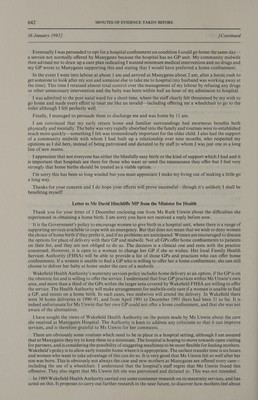
![16 January 1992] [Continued Eventually I was persuaded to opt for a hospital confinement on condition I could go home the same day— a service not normally offered by Manygates because the hospital has no GP unit. My community midwife then advised me to draw up a care plan indicating I wanted minimum medical intervention and no drugs and my GP wrote to Manygates supporting this and stating that I would have preferred a home confinement. In the event I went into labour at about 1 am and arrived at Manygates about 2 am, after a hectic rush to get someone to look after my son and someone else to take me to hospital (my husband was working away at the time). This time I retained almost total control over the management of my labour by refusing any drugs or other unnecessary intervention and the baby was born within half an hour of my admission to hospital. I was admitted to the post natal ward for a short time, where the staff clearly felt threatened by my wish to go home and made every effort to treat me like an invalid—including offering me a wheelchair to go to the toilet although I felt perfectly well. Finally, 1 managed to persuade them to discharge me and was home by 11 am. I am convinced that my early return home and familiar surroundings had enormous benefits both physically and mentally. The baby was very rapidly absorbed into the family and routines were re-established much more quickly—something I felt was tremendously important for the older child. I also had the support of a community midwife with whom I had built up a relationship over nine months, who respected my opinions as I did hers, instead of being patronised and dictated to by staff to whom I was just one in a long line of new mums. I appreciate that not everyone has either the blissfully easy birth or the kind of support which | had and it is important that hospitals are there for those who want or need the reassurance they offer but I feel very strongly that home births should be treated as a viable option. I’m sorry this has been so long winded but you must appreciate I make my living out of making a little go a long way. Thanks for your concern and I do hope your efforts will prove successful—though it’s unlikely I shall be benefiting myself? Letter to Mr David Hinchliffe MP from the Minister for Health Thank you for your letter of 3 December enclosing one from Ms Ruth Unwin about the difficulties she experienced in obtaining a home birth. I am sorry you have not received a reply before now. It is the Government’s policy to encourage women to give birth in a hospital unit, where there is a range of supporting services available to cope with an emergency. But that does not mean that we wish to deny women the choice of home birth if they prefer it, and ifno problems are anticipated. Women are encouraged to discuss the options for place of delivery with their GP and midwife. Not all GPs offer home confinements to patients on their list, and they are not obliged to do so. The decision is a clinical one and rests with the practice concerned. However, it is open to a woman to change her GP if she so wishes. Her local Family Health Services Authority (FHSA) will be able to provide a list of those GPs and practices who can offer home confinements. If a women is unable to find a GP who is willing to offer her a home confinement, she can still choose to deliver her baby at home under the care of a midwife. Wakefield Health Authority’s maternity services policy includes home delivery as an option, if the GP is on the obstetric list and is willing to offer the service. I understand that four GP practices within Ms Unwin’s own area, and more than a third of the GPs within the larger area covered by Wakefield FHSA are willing to offer the service. The Health Authority will make arrangements for midwife-only care if a woman is unable to find a GP, and insists on a home birth. In such cases, two midwives will attend the delivery. In Wakefield there were 36 home deliveries in 1990-91, and from April 1991 to December 1991 there had been 31 so far. It is indeed unfortunate for Ms Unwin that her own GP could not offer a home confinement, and that she was not aware of the alternatives. I have sought the views of Wakefield Health Authority on the points made by Ms Unwin about the care she received at Manygates Hospital. The Authority is keen to address any criticisms so that it can improve services, and is therefore grateful to Ms Unwin for her comments. There are obviously some routines which need to be in place in a hospital setting, although I am assured that at Manygates they try to keep these to a minimum. The hospital is hoping to move towards open visiting for partners, and is considering the possibility of staggering mealtimes to be more flexible for feeding mothers. Wakefield’s policy is to allow early transfer home where it is appropriate. The earliest transfer time is six hours and women who want to take advantage of this can do so. It is very good that Ms Unwin felt so well after her son was born. This is obviously not always the case and new mothers at Manygates are offered every care— including the use of a wheelchair. I understand that the hospital’s staff regret that Ms Unwin found this offensive. They also regret that Ms Unwin felt she was patronised and dictated to. This was not intended. In 1989 Wakefield Health Authority carried out some consumer research on its maternity services, and has acted on this. It proposes to carry out further research in the near future, to discover how mothers feel about](https://iiif.wellcomecollection.org/image/b32222907_0310.jp2/full/800%2C/0/default.jpg)