Maternity services. Volume II, Minutes of evidence.
- Great Britain. Parliament. House of Commons. Health Committee
- Date:
- 1992
Licence: Open Government Licence
Credit: Maternity services. Volume II, Minutes of evidence. Source: Wellcome Collection.
37/320 (page 369)
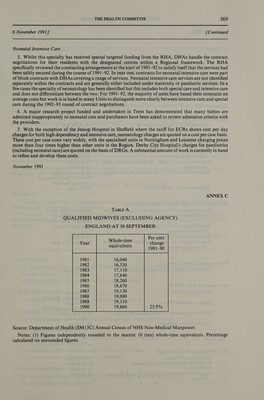
![6 November 1991] [Continued Neonatal Intensive Care 5. Whilst this specialty has received special targeted funding from the RHA, DHAs handle the contract negotiations for their residents with the designated centres within a Regional framework. The RHA specifically reviewed the contracting arrangements at the start of 1991-92 to satisfy itself that the services had been safely secured during the course of 1991-92. In year one, contracts for neonatal intensive care were part of block contracts with DHAs covering a range of services. Neonatal intensive care services are not identified separately within the contracts and are generally either included under maternity or paediatric services. Ina few cases the specialty of neonatology has been identified but this includes both special care and intensive care and does not differentiate between the two. For 1991-92, the majority of units have based their contracts on average costs but work is in hand in many Units to distinguish more clearly between intensive care and special care during the 1992-93 round of contract negotiations. 6. A major research project funded and undertaken in Trent has demonstrated that many babies are admitted inappropriately to neonatal cots and purchasers have been asked to review admission criteria with the providers. 7. With the exception of the Jessop Hospital in Sheffield where the tariff for ECRs shows cost per day charges for both high dependency and intensive care, neonatology charges are quoted on a cost per case basis. These cost per case costs vary widely, with the specialised units in Nottingham and Leicester charging prices more than four times higher than other units in the Region. Derby City Hospital’s charges for paediatrics (including neonatal care) are quoted on the basis of DRGs. A substantial amount of work is currently in hand to refine and develop these costs. November 1991 ANNEX C TABLE A QUALIFIED MIDWIVES (EXCLUDING AGENCY) ENGLAND AT 30 SEPTEMBER Per cent Whole-time change Source: Department of Health (SM13C) Annual Census of NHS Non-Medical Manpower. Notes: (1) Figures independently rounded to the nearest 10 (ten) whole-time equivalents. Percentage calculated on unrounded figures.](https://iiif.wellcomecollection.org/image/b32222907_0037.jp2/full/800%2C/0/default.jpg)