Maternity services. Volume II, Minutes of evidence.
- Great Britain. Parliament. House of Commons. Health Committee
- Date:
- 1992
Licence: Open Government Licence
Credit: Maternity services. Volume II, Minutes of evidence. Source: Wellcome Collection.
40/320 (page 372)
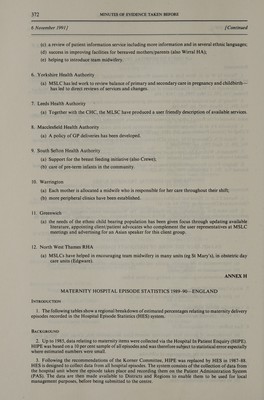
![6 November 1991 ] [Continued (c) a review of patient information service including more information and in several ethnic languages; (d) success in improving facilities for bereaved mothers/parents (also Wirral HA); (e) helping to introduce team midwifery. 6. Yorkshire Health Authority (a) MSLC has led work to review balance of primary and secondary care in pregnancy and childbirth— has led to direct reviews of services and changes. 7. Leeds Health Authority (a) Together with the CHC, the MLSC have produced a user friendly description of available services. 8. Macclesfield Health Authority (a) A policy of GP deliveries has been developed. 9. South Sefton Health Authority (a) Support for the breast feeding initiative (also Crewe); (b) care of pre-term infants in the community. 10. Warrington (a) Each mother is allocated a midwife who is responsible for her care throughout their shift; (b) more peripheral clinics have been established. 11. Greenwich (a) the needs of the ethnic child bearing population has been given focus through updating available literature, appointing client/patient advocates who complement the user representatives at MSLC meetings and advertising for an Asian speaker for this client group. 12. North West Thames RHA (a) MSLCs have helped in encouraging team midwifery in many units (eg St Mary’s), in obstetric day care units (Edgware). ANNEX H MATERNITY HOSPITAL EPISODE STATISTICS 1989-90—ENGLAND INTRODUCTION 1. The following tables show a regional breakdown of estimated percentages relating to maternity delivery episodes recorded in the Hospital Episode Statistics (HES) system. BACKGROUND 2. Up to 1985, data relating to maternity items were collected via the Hospital In Patient Enquiry (HIPE). HIPE was based ona 10 per cent sample of all episodes and was therefore subject to statistical error especially where estimated numbers were small. 3. Following the recommendations of the Korner Committee, HIPE was replaced by HES in 1987-88. HES is designed to collect data from all hospital episodes. The system consists of the collection of data from the hospital unit where the episode takes place and recording them on the Patient Administration System (PAS). The data are then made available to Districts and Regions to enable them to be used for local management purposes, before being submitted to the centre.](https://iiif.wellcomecollection.org/image/b32222907_0040.jp2/full/800%2C/0/default.jpg)