Volume 1
Report of the Committee of Inquiry on Foot-and-Mouth Disease, 1968 / presented to Parliament by the Minister of Agriculture, Fisheries and Food by command of Her Majesty, April 1969.
- Great Britain. Committee of Inquiry on Foot-and-Mouth Disease
- Date:
- 1969
Licence: Public Domain Mark
Credit: Report of the Committee of Inquiry on Foot-and-Mouth Disease, 1968 / presented to Parliament by the Minister of Agriculture, Fisheries and Food by command of Her Majesty, April 1969. Source: Wellcome Collection.
89/142 page 87
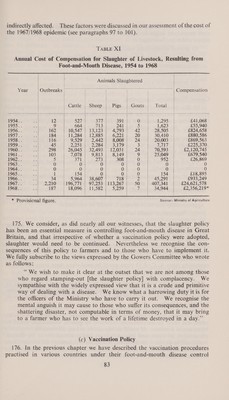
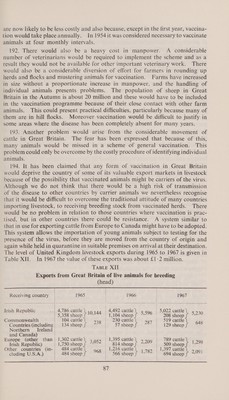
![are now likely to be less costly and also because, except in the first year, vaccina- tion would take place annually. In 1954 it was considered necessary to vaccinate animals at four monthly intervals. 192. There would also be a heavy cost in manpower. A considerable number of veterinarians would be required to implement the scheme and as a result they would not be available for other important veterinary work. There would also be a considerable diversion of effort for farmers in rounding up herds and flocks and mustering animals for vaccination. Farms have increased in size without a proportionate increase in manpower, and the handling of individual animals presents problems. The population of sheep in Great Britain in the Autumn is about 20 million and these would have to be included in the vaccination programme because of their close contact with other farm animals. This could present practical difficulties, particularly because many of them are in hill flocks. Moreover vaccination would be difficult to justify in some areas where the disease has been completely absent for many years. 193. Another problem would arise from the considerable movement of cattle in Great Britain. The fear has been expressed that because of this, many animals would be missed in a scheme of general vaccination. This problem could only be overcome by the costly procedure of ‘identifying individual animals. 194. It has been claimed that any form of vaccination in Great Britain would deprive the country of some of its valuable export markets in livestock because of the possibility that vaccinated animals might be carriers of the virus. Although we do not think that there would be a high risk of transmission of the disease to other countries by carrier animals we nevertheless recognise that it would be difficult to overcome the traditional attitude of many countries importing livestock, to receiving breeding stock from vaccinated herds. There would be no problem in relation to those countries where vaccination is prac- tised, but in other countries there could be resistance. A system similar to that in use for exporting cattle from Europe to Canada might have to be adopted. This system allows the importation of young animals subject to testing for the presence of the virus, before they are moved from the country of origin and again while held in quarantine in suitable premises on arrival at their destination. The level of United Kingdom livestock exports during 1965 to 1967 is given in Table XII. In 1967 the value of these exports was about £1-2 million. TABLE XII Exports from Great Britain of live animals for breeding (head) Receiving country 1965 1966 1967 Irish Republic .| 4,786 cattle | | 4,492 cate) | 5,022 cattle | 5,358 sheep { satan | 1,104 sheep 5,596 | 208 sheep 3200 Commonwealth 104 cattle | 238 230 cattle 287 519 cattle 648 Countries (including 134 sheep f (= 5? sheep 129 sheep Northern Ireland | ee ei ae han | 1,302 le. | 1,395 ] Europe (other than | 1, cattle hi ab, cattle 789 cattle Irish Republic) 1,750 sheep 3,052 | 814 seo 2,209 509 sheep 1,298 Other countries (in- 484 cattle 968 | 1,216 cattle 1.782 1,397 cattle 2.091 cluding U.S.A.) 484 sheep 566 sheep f ~’ 694 sheep ?](https://iiif.wellcomecollection.org/image/b3217696x_0001_0089.jp2/full/800%2C/0/default.jpg)
 No text description is available for this image
 No text description is available for this image
 No text description is available for this image