DNA synthesis in vitro : proceedings of the Second Annual Harry Steenbock Symposium held in Madison, Wisconsin on July 10-12, 1972 / edited by R.D. Wells and R.B. Inman.
- Harry Steenbock Symposium
- Date:
- ©1973, [1974]
Licence: Attribution-NonCommercial 4.0 International (CC BY-NC 4.0)
Credit: DNA synthesis in vitro : proceedings of the Second Annual Harry Steenbock Symposium held in Madison, Wisconsin on July 10-12, 1972 / edited by R.D. Wells and R.B. Inman. Source: Wellcome Collection.
88/512 (page LXXXIV)
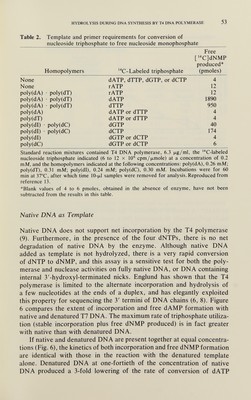
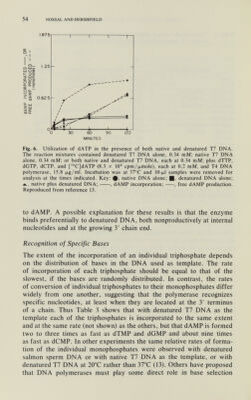
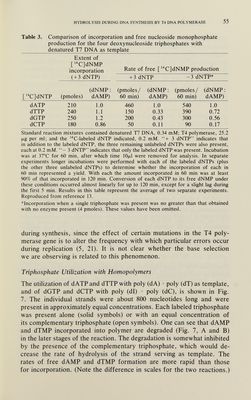
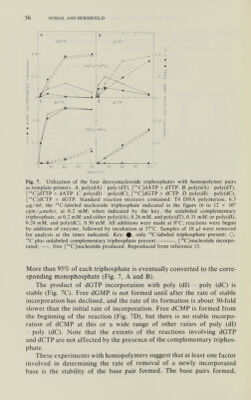
![56 NOSSAL AND HERSHFIELD 04 О 2 О 4 0 2 Fig. 7. Utilization of the four deoxynucleoside triphosphates with homopolymer pairs as template-primers. A. poly(dA) • poly (dT), ['CJdATP ± dTTP. B. poly(dA) • poly(dT), ['CJdTTP ± dATP. C. poly(dl) • poly(dC), ['CJdGTP ± dCTP. D. poly(dl) • poly(dC), ['CjdCTP ± dGTP. Standard reaction mixtures contained: T4 DNA polymerase, 6.3 jjLg/ml; the ''C-labeled nucleoside triphosphate indicated in the figure (6 to 12 x 10^ cpm/jxmole), at 0.2 mM; when indicated by the key, the unlabeled complementary triphosphate, at 0.2 mM; and either poly(dA), 0.26 mM, and poly(dT), 0.31 mM; or poly(dl), 0.24 mM, and poly(dC), 0.30 mM. All additions were made at 0°C; reactions were begun by addition of enzyme, followed by incubation at 37°C. Samples of 10 |х1 were removed for analysis at the times indicated. Key: ф, only 'C-labeled triphosphate present; O, 'C plus unlabeled complementary triphosphate present; , [''C]nucleotide incorpo¬ rated; , free ['С]nucleotide produced. Reproduced from reference 13. More than 95% of each triphosphate is eventually converted to the corre¬ sponding monophosphate (Fig. 7, A and B). The product of dGTP incorporation with poly (dl) • poly (dC) is stable (Fig. 7C). Free dGMP is not formed until after the rate of stable incorporation has declined, and the rate of its formation is about 30-fold slower than the initial rate of incorporation. Free dCMP is formed from the beginning of the reaction (Fig. 7D), but there is no stable incorpo¬ ration of dCMP at this or a wide range of other ratios of poly (dl) • poly (dC). Note that the extents of the reactions involving dGTP and dCTP are not affected by the presence of the complementary triphos¬ phate. These experiments with homopolymers suggest that at least one factor involved in determining the rate of removal of a newly incorporated base is the stability of the base pair formed. The base pairs formed.](https://iiif.wellcomecollection.org/image/b18037288_0089.JP2/full/800%2C/0/default.jpg)