Small-pox in Scotland, as it is, was, and ought to be : with hints for its mitigation by legislative enactment / by Alexander Wood.
- Alexander Wood
- Date:
- 1860
Licence: Public Domain Mark
Credit: Small-pox in Scotland, as it is, was, and ought to be : with hints for its mitigation by legislative enactment / by Alexander Wood. Source: Wellcome Collection.
Provider: This material has been provided by The Royal College of Surgeons of England. The original may be consulted at The Royal College of Surgeons of England.
7/32 page 7
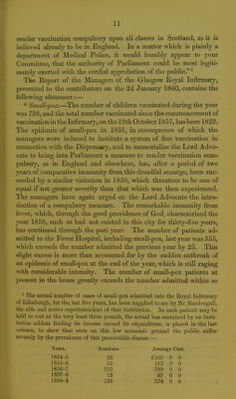
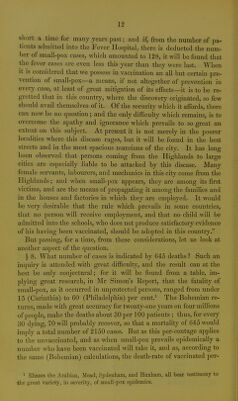
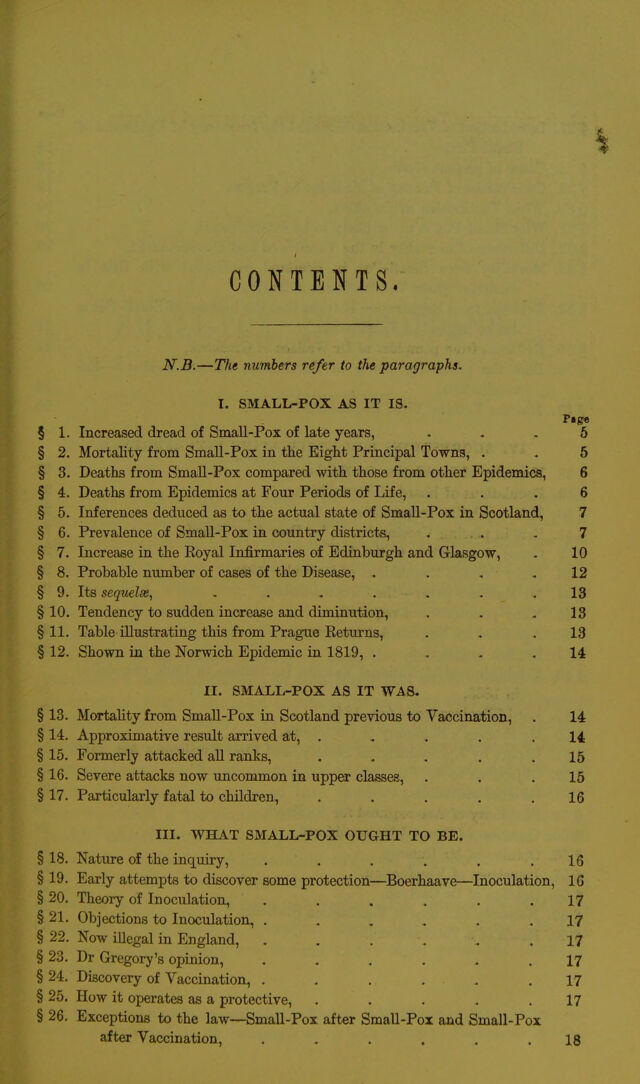
![§ 5. From these tables the following inferences may be safely de- duced : — l5^, That the disease is not steadily increasing year by year; but that it fluctuates in frequency and fatality just as it did before the discovery of vaccination. 2d, That at one time it prevails extensively in one town ; at an- other, it leaves it and ravages another. Thus in 1856 Dundee, and in 1857 Glasgow and Leith, were the towns principally affected by it. ddy That taking the year 1856, when small-pox was epidemically present, out of a total estimated population of 854,066 individuals, 645 died of small-pox. 4:th, That the total mortality from all causes being in that year 22,248, the deaths from small-pox (645) thus constituted 2*8 per cent., which is double the average of London for the last ten years, or of England and Wales for the last seven, and fourteenfold the average of Bohemia and Lombardy. 5th, That a large proportion of that mortality (229 deaths) oc- curred in the town of Dundee, where, in the single month of January, 95 individuals died from small-pox; alluding to which, the Registrar- General observes, The deaths from this single disease constituted not less than 30 per cent, of the total mortality,—a mortality which has been exceeded by no single disease during the last ten years, with the exception of the epidemic typhus in the month of Novem- ber 1847, and the fatal cholera epidemic of 1849, when the deaths from that disease, during the months of July, August, and Septem- ber, numbered respectively 209, 420, 159. Qth, The calculations of Dr Seaton, appended to Mr Simon's Re- ])ort, enables us to view these figures comparatively ; and it appears that, taking the mortality of this town (Dundee) from small-pox for the entire year, it was proportionally more than three times greater than the highest mortality which has taken place in London for the last ten years; viz., that in 1848, when the deaths amounted to 1617, which is above double the annual average of the metro- polis; but had the deaths taken place in the same proportion to population as in Dundee in 1856, they would have amounted to upwards of 5000. § 6. The tables on which the preceding remarks have been founded are limited to the eight principal towns in Scotland, from which alone full returns are published. They do not, therefore, give by any means an accurate idea of the state of matters in the smaller towns and rural districts.](https://iiif.wellcomecollection.org/image/b22323685_0007.jp2/full/800%2C/0/default.jpg)
 No text description is available for this image
 No text description is available for this image
 No text description is available for this image