Volume 2
A dictionary of the English language: in which the words are deduced from their originals, and illustrated in their different significations by examples from the best writers. To which are prefixed, a history of the language, and an English grammar / by Samuel Johnson.
- Samuel Johnson
- Date:
- 1755
Licence: Public Domain Mark
Credit: A dictionary of the English language: in which the words are deduced from their originals, and illustrated in their different significations by examples from the best writers. To which are prefixed, a history of the language, and an English grammar / by Samuel Johnson. Source: Wellcome Collection.
1119/1176
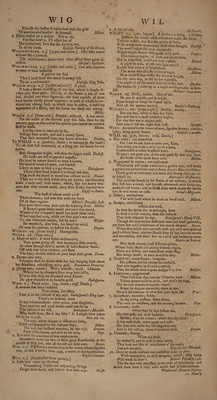
![WHI Perkins’s three counfellors regiftered themfelves fan£luary- knen ; and whether upon pardon obtained, or continuance within the privilege, they were not proceeded with. Bacon. If wc adjoin to the lords, whether they prevail or not we engulph ourfelves into allured danger. Hayward. Then did’ft thou found that order, whether love Or victory thy royal thoughts did move, Each was a noble caufe. Denham. Epiaetus forbids a man, on fuch an occafion, to confult with the oracle whether he fhould do it or no, it bein<* necef- farytobedoiK-. Decay if Piet,. whether by health or ficknefs, life or death, mercy is ftill contriving and carrying on the fpiritual good of all who love . South’s Sermons. I ms afhltance is only offered to men, and not forced upon them, whether they will or no. Tillotfon. When our foreign trade exceeds our exportation of commo¬ dities, our money muff go to pay our debts, whether melted or not. Locke. Whether it be that the richeft of thefe difeoveries fall not into the pope s hands, or for fome other reafon, the prince of Farnefe will keep this feat from being turned up, ’till one of his own family is in the chair. Addifon cn Italy. Whe' ther. pronoun. Which of two. Whither when they came, they fell at words JFbether of them fhould be the lord of lords. Huhberd's Tale. Whether of them twain did the will of his father ? Mat. xxi. Whether is more beneficial, that we fhould have the fame yearly quantity of heat diftributed equally, or a greater fhare in Summer, and in Winter a lefs ? Bentley. Let them take whether they will: if they deduce all animals . from fingle pairs, even to make the fecond of a pair, is to write after a copy. Bentley. Whe,t stone, n.f. [whet and (lone.] Stone on which any thing is whetted, or rubbed to make it fharp. The minds of the afflicted do never think they have fully conceived the weight or meafure of their own woe: they ufe their affediion as a whet/lone both to wit and memory. Hooker. What avail’d her refolution chafte, Whofe fobereft looks were whetjlones to defire? Fairfax. Whom the whetjlone fharps to eat. And cry, milftones are good meat. Ben. Johnfon. Diligence is to the underftanding as the whetjlone to the razor; but the will is the hand, that muff apply the one to the other. South. A whetjlone is not an inftrument to carve with; but it fharpens thofe that do. Shakefpeare Illuflrated. Whe'tter. n. f. [ from whet. ] One that whets or fharpens. Love and enmity are notable whetters and quickeners of the fpirit of life in all animals. More. WHEY. n.f. [Jppoej, Saxon; wey^ Dutch.] 1. The thin or ferous part of milk, from which the oleofe or grumous part is feparated. I’ll make you feed on curds and whey. Shakefpeare. Milk is nothing but blood turned white, by being diluted with a greater quantity of ferum or whey in the glandules of the brealt. Harvey on Confumptions. 2. It is ufed of any thing white and thin. Thofe linnen cheeks of thine Are counfellors to fear. What, foldiers whey face ! Shake]. Whe'yey. ladj. [from whey.] Partaking of whey; refem- Whe'yish. } filing whey. Thofe medicines, being opening and piercing, fortify the operation of the liver, in fending down the wheyey part of the blood to tlie reins. Bacon’s Natural Hijlory. He that quaffs Such wheyijh liquors, oft with cholick pangs He’ll roar. Philips. WHICH, pren. []Dpilc, Saxon; zvelk, Dutch.] i. The pronoun relative ; relating to things. The apoftlcs term it the pledge of our heavenly inheritance, fometimes the handfel or earned: of that which is to come. Hooker, b. v. Do they not blafpheme that worthy name, by the which ye are called? Ja.n. y. In deftrudfions by deluge, the remnant which hap to be re- ferved are ignorant. Bacon. To which their want of judging abilities, add alfo their want of opportunity to apply to fuch a ferious confideration as may let them into the true goodnefs and evil of things, which are qualities which feldom difplay themfelves to the firft view. South’s Sermons. The queen of furies by their fide is fet. And fnatches from their mouths th’ untaded meat, Which, if they touch, her hiding fnakes fhe rears. Dryden. After the feveral earths, confider the parts of the furface of this globe which is barren, as fand and rocks. Locke. 2. It formerly was ufed for who, and related likewife to perfons: as in the firft words of the Lord’s prayer. The Almighty, which giveth wifdonj to whomfoever jt W II 1 pleafeth him, did, for the good of his church, flay thofe nailer affe&ions. £ Do you hear, fir, of a battle ? --Everyone hears that, Which can diftinguifh found. Shakefp. King Lear. Had I been there, which am a filly woman. The foldiers fhould have tofs’d me on their pikes. Before I would have granted to that a£f, Sbahefp. H. Vi. 3. The genitive of which, as well as of who, is whofe; but whofe ^ as derived from which, is fcarcely ufed but in poetry. Of man’s fird: difobedience, and the fruit Of that forbidden tree, whofe mortal taffc. Milton. 4. It is fometimes a demonftrative: as, take which you will. What is the night ? —Almoft at odds with morning, which is which. Shakefp. S' It Is fometimes an interrogative : as, which is the man. Two fair twins, The puzzled ffrangers which is which enquire. Ticket. Whichsoever, pron. [which and/cmr] Whether one or the other. Whichsoever of thefe he takes, and how often foever he doubles it, he finds that he is not one jot nearer the end of fuch addition than at fird: fetting out. Locke. WHIFF, nf. [chwyth, Welfh.] A blad; a puff of wind. Pyrrhus at Priam drives, in rage ftrikes wide; But with the whiff ar.d wind of his fell fword, Tli’ unnerved father falls. Shakefp. Hamlet. Who, If fome unfav’ry whiff betray the crime. Invents a quarrel ftraight. Dryden. Three pipes after dinner he conffantly fmokes, And feafons his whiffs with impertinent jokes. Prior. Nick pulled out a boatfwain’s whidle: upon the fird: whiff the tradefmen came jumping in. Arbuthnot. To Whiffle, v.n. [from whff.] To move incondantly, as if driven by a puff of wind. Nothing is more familiar than for a whiffling fop, that has not one grain of the fenfe of a man of honour, to play the hero- . L’Efrange. A perfon of a whffing and unfteady turn of mind cannot keep clofe to a point of controverfy, but wanders from it per¬ petually. Watts-.- Was our reafon given, to be thus puff’d about. Like a dry leaf, an idle ftraw, a feather. The fport of ev’ry whiffling blad: that blows ? Rowe. Whi'ffler. n.f. [from whiffle.] 1. One that blows ftrongly. The beach Pales in the flood with men, with wives and boys, Whofe fhouts and claps out-voice the deep-mouth’d fea. Which, like a mighty whffler ’fore the king. Seems to prepare his way. Shak. Henry V. 2. One of no confequence; one moved with a whiff or puff. Our fine young ladies retain in their fervice a great number of fupernumerary and infignificant fellows, which they ufe like whifflers, and commonly call fboeing-horns. Spectator. Every whffler in a laced coat, who frequents the chocolate- houfe, fhall talk of the conftitution. Swift. WHIG, n.f [ bpoex, Saxon.] T. Whey. 2. The name of a fa&ion. The fouthweft counties of Scotland have feldom corn enough to ferve them round the year ; and the northern parts producing more than they need, thofe in the weft come in the Summer to buy at Leith the ftores that come from the north ; and from a word, whiggam, ufed in driving their horfes, all that drove were called the whiggamors, and fhorter the uhiggs. Now in that year before the news came down of duke Hamil¬ ton’s defeat, the minifters animated their people to rife and march to Edinburgh ; and they came up marching on the head of their parifhes with an unheard-of fury, praying and preach¬ ing all the way as they came. The marquis of Argyle and his party came and headed them, they being about fix thoufand. This was called the whiggamor’s inroad ; and ever after that, all that oppofed the court came in contempt to be called whigs: and from Scotland the word was brought into Eng¬ land, where it is now one of our unhappy terms of dif- imion. Burnet. Whoever has a true value for church and (late, fhould avoid the extremes of whig for the fake of the former, and the ex¬ tremes of tory on the account of the latter. Swift. Whi'ggIsh. adj. [from whig.] Relating to the whigs. She’ll prove herfelf a tory plain, From principles the whigs maintain; And, to defend the whiggff caufe, Her topicks from the tories draws. Swift. Whi ggism. n.f. [from whig.] The notions of a whig. I could quote paffages from fifty pamphlets, wholly made up of whiggtfin and atheifm. Swift. While, n.J. [iveif German; J)jnle, Saxon.] Time; fpacaof time. If](https://iiif.wellcomecollection.org/image/b30451541_0002_1120.jp2/full/800%2C/0/default.jpg)