Volume 2
A dictionary of the English language: in which the words are deduced from their originals, and illustrated in their different significations by examples from the best writers. To which are prefixed, a history of the language, and an English grammar / by Samuel Johnson.
- Samuel Johnson
- Date:
- 1755
Licence: Public Domain Mark
Credit: A dictionary of the English language: in which the words are deduced from their originals, and illustrated in their different significations by examples from the best writers. To which are prefixed, a history of the language, and an English grammar / by Samuel Johnson. Source: Wellcome Collection.
1123/1176
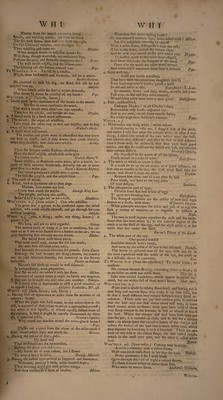
![Rh.xtus from the hearth a burning brand Seleitts, and whirling waves ; ’till from his hand The fire took flame, then dafh’d it from the right On fair Charaxus’ temples, near the fight Then whijiling paft: came on. Dry dm. When winged deaths in whijiling arrows fly. Wilt thou, though wounded, yet undaunted flay. Perform thy part, and (hare the dangerous day r Prior. The wild winds whijile, and the billows roar, The fplitting raft the furious tempett tore. Pope. To Whistle, v. a. To call by a whittle. Whiftle them backwards and forwards, ’till he is weary. South's Sermons. He chanced to mifs his dog: we flood ftill ’till he had wbmd\him up. Addijon. W hen Ample pride for flatt’ry makes demands, May dunce by dunce be wbijlled off my hands ! Pope. Whittle, n. f [hpiprle, Saxon.] 1. Sound made by the modulation of the breath in the mouth. My fire in caves conflrains the wind, Can with a breath their clam’rous rage appeafe; They fear his whijile, and forfake the leas. Dryden. 2. A found made by a fmall wind inftrument. 3. The mouth ; the organ of whittling. Let’s drink the other cup to wet our ivhijlles, and fo fing away all fad thoughts. JValton s Angler. 4. A fmall wind inftrument. The matters and pilots were fo attonilhed that they knew not how to direcft; and if they knew, they could fearcely, when they diredted, hear their own whijile. Sidney. Behold, Upon the hempen tackle fhipboys climbing; Hear the fhrill whijile, which doth order give To founds confus’d. Shirkef. Henry V. Small ivhijlley orfhepherds oaten pipes, give a found, be- caufe of their extreme flendernels, whereby the air is more pent than in a wider pipe. Bacon's Natural Hijiory. Her infant grandame’s whiftle next it grew. The bells fhe gingl’d, and the whijile blew. Pope. 5. The noife of winds. 6. A call, fuch as fportfmen ufe to their dogs. Madam, here comes my lord. —I have been worth the whijile. Shakefp. King Lear. The knight, purfuing this epiftle. Believ’d, he’d brought her te his ivhijlle. Hudibras. Whi's tler. n.f. [from whiftle.] One who whittles. The prize was a guinea to be conferred upon the ableft whi/iler, who could whiftle cleareft, and go through his tune without laughing. Addifon. Whit. n.f. [pitvc, a thing; apiht, any thing, Saxon.] A point; a jot. We love, and are no whit regarded. Sidney. The motive caufe of doing it is not in ourfelves, but car- rieth us as if the wind fhould drive a feather in the air ; we no whit furthering that whereby we are driven. Hooker. Her facred book with blood ywrit, That none could read, except fhe did him teach; She unto him difclofed every whit, And heavenly documents thereout did preach. Fairy Jfueen. Although the lord became the king’s tenant, his country was no whit reformed thereby, but remained in the former barbarifm. Davies on Ireland. Nature’s full bleflings would be well difpens’d In unfuperfluous, even proportion. And fhe no whit encumber’d with her flore. Milton. In account of ancient times it ought to fatisfy any enquirer, if they can be brought any whit near one another. Tillotjon. It is every whit as honourable to affift a good minifter, as to oppofe a bad one. Addifon s Foseholder, Ny. 48. White, adj. [hprc, Saxon ; wit, Dutch-] 1. Having luch an appearance as arifes from the mixture of all colours ; fnowy. When the paper was held nearer to any colour than to the reft, it appeared of that colour to which it approached neareft ; but wnen it was equally, or almoft equally diffant from all the colours, fo that it might be equally illuminated by them all, it appeared white. Newton's Opticks. Why round our coaches crowd the wh/'^-glov’d beaus ? Pope. Ulyfles cut a piece from the chine of the wbite-tooxh\\ boar, round which there was much fat. Broome. 2. Having the colour of fear; pale. My hand will That multitudinous lea incarnadine, Making the green one red.- —My hands are of your colour, but I fhame To wear a heart fo white. Shakefp Macbeth. 3. Having the colour appropriated to happinefs and innocence. Welcome, pure-ey’d faith, white-handed hope ; Thou hovering angel girt with golden wings, And thou unblemifh’d form of chaftity. Milton. W H I Wert thou that fweet-fmili’hg youth ? Or that crown’d matron, fage,& w^-robed truth ? Milton. Let this aufpicious morning be exprcft With a white ftone, diftinguifh’d from the reft • White as thy fame, and as thy honour clear, And let new joys attend on thy new-added year. Dryden. To feaftful mirth be this white hour affign’d. And fweet difcourfe, the banquet of the mind. F'obe Peace o’er the world her olive-wand extend. And white-rob'd innocence from heav’n defcend. Pope. 4. Grey with age. I call you fervile minifters, That have with two pernicious daughters join’d. Your high-engender’d battles ’gaiuft a head So old and white as this. “ Shakefpeare's K. Lear. So minutes, hours, and days, weeks, months and years Paft over, to the end they were created, Would bring white hairs unto a quiet grave. Shakefpeare. 5. Pure; unblemifhed. Unhappy Dryden ! in all Charles’s days, Rofcommon only boafts unfpotted lays : And in our own, excufe fome courtly ftains, No whiter page than Addifon’s remains. Pope. White, n.f. 1. Whitenefs ; any thing white ; white colour. A friend coming to vifit me, I flopp’d him at the door, and before I told him what the colours were, or what I was doing, I afked him which of the two whites were the beft, and wherein they differed ? and after he had at that diftance view’d them well, he anfwer’d, that they were both o-ood whites, and that he could not fay which was beft, nor wherein their colours differ'd. Newton's Opticks. My Nanfhall be the queen of all the fairies, Finely attired in a robe of white. Shakefpeare 2. The mark at which an arrow is fliot. It a mark be let up for an archer at a great diftance, let him aim as exactly as he can, the leaft wind Ihall take his arrow, and divert it from the white. Dryden. Remove him then, and all your plots fly fure Point blank, and level to the very white Of your defigns. Southern. 3. The albugineous part of eggs. I’ll fetch fome flax and whites of estgs T apply to s bleeding face. Shakefpeare. The ftrongeft repellents are the whites of new-laid egas beaten to a froth, with alum. TFifeman's Surgery. What principle manages the white and yolk of an egg into fuch a variety of textures, as is requiiite to faftuon a Chii? . . Boyle. The two in moft regions reprefent the yolk and the mem¬ brane that lies next above it; fo the exterior region of the earth is as the fhell of the egg, and the abyfs under it as the white that lies under the fhell. Burnet’s Theory of the Earth. 4. The white part of the eye. Our general himfelf San&ifies himfelf with’s hands, And turns up the zvhite o’ th’ eye to his difcourfe. Shakefp. The horny or pellucid coat of the eye, doth not lie ^in the fame fuperficies with the white of the eye, but rifeth up as a hillock, above its convexity. Ray. To White, v. a. [Irom the adjedtive.] To make white; to dealbate. His raiment became fhining, exceeding white as know ; fo as no fuller on earth can white them. Mar. ix. 3. Like unto whited fepulchres, which appear beautiful out¬ ward, but are within full of dead men’s bones. Matt, xxiii. Whitele'ad. n.f. White lead is made by taking fheet-lead, and having cut it into long and narrow flips, they make it up into rolls, but fo that a fmall diftance may remain between every fpiral re¬ volution. Thefe rolls are put into earthen pots, fo ordered that the lead may not link down above half way, or fome fmall matter more in them: thefe pots have each of them very fliarp vinegar in the bottom, fo full as almoft to touch the lead. When the vinegar and lead have both been put into the pot, it is covered up clofe, and fo left for a certain time ; in which fpace the corrofive fumes of the vinegar will reduce the furface of the lead into a more white coal^ which they feparate by knocking it with a hammer. There are two forts of this fold at the colour fhops, the one called cerufe, which is the moft pure part, and the other is called white lead. Quincy. Wh/tely. adj. [from white.] Coming near to white.*^ A whitey wanton, with a velvet brow, With two pitch-balls ftuck in her face for eyes. Shakefp. Now, governor, I fee I mutt: blulli Quite through this vail of night a whitely fhame, I o think I could defigti to make thofe free, Who were by nature Haves. Southern’s Oroonoko. „ White-](https://iiif.wellcomecollection.org/image/b30451541_0002_1124.jp2/full/800%2C/0/default.jpg)