Volume 2
A dictionary of the English language: in which the words are deduced from their originals, and illustrated in their different significations by examples from the best writers. To which are prefixed, a history of the language, and an English grammar / by Samuel Johnson.
- Samuel Johnson
- Date:
- 1755
Licence: Public Domain Mark
Credit: A dictionary of the English language: in which the words are deduced from their originals, and illustrated in their different significations by examples from the best writers. To which are prefixed, a history of the language, and an English grammar / by Samuel Johnson. Source: Wellcome Collection.
1125/1176
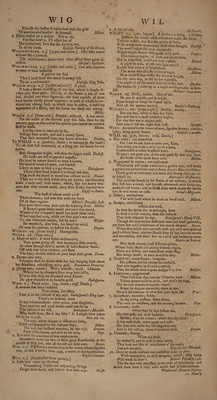
![WHO Tell who loves who ; what favours feme partake. And who is jilted. Dryden. We are ftill as much at a lofs, who civil power belongs to. Locke . 2. As who Jhould fay, elliptically for as one who floould fay. Hope throws a generous contempt upon ill ufage, and looks like a handfome defiance of a misfortune : as who Jhould Jay, you are fomewhat troublefome now, but 1 fhall conquer you. Collier againfl Defpair. 3. Whofe is the genitive of which, as well as of who, and is ap¬ plied to things. Whofe foever fins ye remit, they are remitted ; and ivhofe foever fins ye retain, they are retained. John xx. 23. The queftion whofe folution I require. Is what the fex of women mod defire. Dryden. Is there any other dodlrine, whofe followers are punifhed ? Add. 4. It has fometimes a disjunctive fenfe. There thou tell’ft of kings, and who afpire ; Who fall, who rife, who triumphs, who do moan. Daniel. Whoever .pronoun, [who and mr.] Any one, without limi¬ tation or exception. Whoever doth to temperance apply His ftedfall life, and all his actions frame, Truft me, fhall find no greater enemy. Than ftubborn perturbation to the fame. Fairy ffueen. I think myfelf beholden, whoever (hews me my miftakes. Loc, Whoe'er thou art, that fortune brings to keep The rights of Neptune, monarch of the deep ; Thee firft it fits, O ftranger, to prepare The due libation, and the folemn prayer. Pope. Whoever is really brave, has always this comfort when he is opprefs’d, that he knows himfelf to be fuperior to thofe who injure him, by forgiving it. Pope. Whole, adj. {palg, Saxon; heal, Dutch.] I. All; total; containing all. Burn the whole ram upon the altar. Ex.xxix. 18. All the whole army flood agaz’d at him. ' Shakefpeare. Fierce extremes. Contiguous might diftemper the whole frame. Milton. 2; Uninjured; unimpaired. Anmiifh is come upon me, becaufe my life is yet w'hole in me. 2 ^a’ ** 9’ 3. Well of any hurt or ficknefs. When they had done circumcifing all the people, they abode in the camp, till they were whole. J°f v. 8. Whole, n.f. The totality ; no part omitted ; the complex of all the parts. , . Fear God, and keep his commandments, for this is the whole of man. Ecclefiafles. Begin with fenfe, of ev’ry art the foul; Parts anfwering parts, fhall flide into a whole. Pope. It contained the whole of religion amongft the antients; and made philofophy more agreeable. Broome. There is a metaphyfical whole, when the effence of a thing is faid to confift of two parts, the genus and the difference, i. e. the general and the fpecial nature, which, being joined together, make up a definition. Watts s Logick. Wholesale, n.f. [whole and fale.] Sale in the lump, not in feparate fmall parcels. ' Thefe are ivholefale chapmen to Satan, that do not truck and barter one crime for another, but take the whole lrercl- Government of the Tongue. This coft me at the wholefale merchant’s a hundred drachma’s; I make two hundred by felling it in retail. Addifon. Some from vanity, or envy, defpife a valuable book, and throw contempt upon it by wholefale. Watts. W hoYesome. adj. [heelfam, Dutch; heylfam, Teutonick; both from Jjael, Saxon, health.] 1. Sound. Contrary to unfound in doctrine. They fuffer us to famifh, repeal daily any wholefome a£l eftablifhed againfl the rich, and provide more piercing ftatutes to chain up the poor. Sbakefp. Coriolanus. ’Tis no lefs To govern juflly, make your empire flourifh. With wholejome laws, in riches, peace, and plenty ; Than, by the expence of wealth and blood, to make New acquifitions. Denham's Sophy. So the dodtrine contain’d be but wholefome and edifying, a want of exadtnefs in fpeaking may be overlook'd. Atterhury. 2. Contributing to health. Night not now, as ere man fell, Wholfome and cool and mild ; but with black air Accompany’d, with damps and dreadful gloom. Milton. Befides the wholefome luxury which that place abounds with, a kitchen garden is a more pleafant fight than the fineft orangery. , Addifon. She held it wholeforner by muen, To reft a little on the couch. Prior. 3. Preferving; falutary. Obfolete. ..... The Lord helpeth his anointed, and will hear him from his holy heaven; even with the wholefome ilrcngth of his right hand. Pfalm xx. 6. 8 WHO 4. Kindly; pleafing. A burlefque ufe. . I cannot make you a wholefome anfwer ; my wit’s dff* eafech Shakefp. Hamlet-. To wail friends loft, Is not by much fo wholefome, profitable; As to rejoice at friends but newly found. Shakefpeare. Wholesomely, adv. [from wholefome.] Salubrioufly; falu- tiferoufly. Who'lesomrness. n.f. [from wholefome.'] 1. Quality of conducing to health ; falubrity. We made a ftandard of the healthfulnefs of the air, from the proportion of acute and epidemical difeafes, and of the wholefornenefs of the food from that of the chionical. Gtaunt. At Tonon they fhewed us a great fountain of water, that is in great efteem for its wholejomenefs; weighing two ounces in a pound lefs than the fame meafure of the lake water. Add. 2. Salutarinefs-; conducivenefs to good. Who'lly. adv. [from whole.] 1. Completely; perfectly. The thruft was fo ftrong, that he could not fo wholy beat it away, but that it met with his thigh, through which it ran, Sidney, b. n. Nor wholly loft we fo deferv’d a prey; For ftorms repenting part of it reftor’d* Dtrydert. Thus equal deaths are dealt with equal chance ; By turns they quit their ground, by turns advance : Victors, and vanquifh’d in the various field, Nor wholly overcome, nor wholy yield. Dryden. This ftory was written before Boccace; but its author being wholly loft, Chaucer is now become an original. Dryden. They employ’d themfelves wholly in domeftick life ; and provided a woman could keep her houfe in order, fhe never troubled herfelf about regulating the commonwealth. Addifon. 2. Totally ; in all the parts or kinds. Metals are wholly fubterrany. ^ Bacon. Whom, the accufative of who, fingular and plural. T here be men in the world, whom you had rather have your Ion be with five hundred pounds, than fome other with five thoufands. Locke on Education. WhomsoeLer. pron. [who andfoever.] Any without exception* With whomfoever thou findeft thy goods, let him not j[ve# Gen. xxxi. 32. Nature has bellowed mines on feveral parts; DUt their riches are only for the induftrious and frugal. Whomfoever elfe they vifit, ’tis with the diligent and fober only they ft ay. Locke. Whoo'bub. n.f. Hubbub. See Hubbub. In this time of lethargy, I pick’d and cut mod of their feftival purfes : and had not the old man come in with a whoobub againfl: his daughter, and fear’d my choughs from the chaff, I had not left a purfe in the whole army. Shakefp. WHOOP, n.f. [See hoop.] 1. A fhout of purfuit. Let them breathe a-while, and then Cry whoop, and fet them on again. Hudibras. A fox crofting the road, drew off a confiderable detachment, who clapp’d fpurs to their horfes, and purfued him with whoops and hallows. Addifon. 2. [Upupa, Latin.] A bird. Di£l. To WHOOP,/t/. «. [from the noun.] To fnout with malig¬ nity. Treafon and murder ever kept together, As two yoke devils fworn to either’s purpofe : Working fo grofly in a nat’ral caufe, That admiration did not whoop at them. Shakefpeare. To Whoop, v. a. To infult with ftiouts. While he trufts me, ’twere fo bafe a part To fawn, and yet betray ; I fhou’d be hifs’d And whoop'd in hell for that ingratitude. Dryden. WHORE, n.f. [hop, Saxon ; hoere, Dutch.] 1. A woman who converfes unlawfully with men; a fornica- trefs; an adultrefs ; a ftrumpet. To put out the word whore, thou doft me wo, Throughout my book ; troth, put out woman too. B. jfohnf 2. A proftitute; a woman who receives men for money. Orontes Conveys his wealth to Tiber’s hungry fhores, And fattens Italy with foreign whores. Dryden. We weary’d fhould lie down in death : This cheat of life would take no more ; If you thought fame but empty breath ; Your Phyllis but a perjur’d whore. Prior. To Whore, v.n. [from the noun.] To converfe unlawfully with the other fex. ’Tis a noble general’s prudent part, To cherifh valour, and reward defert; Let him be daub’d with lace, live high, and whore ; Sometimes be loufy, but be never poor. Dryden, To Who're. v. a. To corrupt with regard to chaftity. Who'redom. n.f. [from whore.] Fornication. Some let go whoredom as an indifferent matter, which yet ftrive for an holy-day, as for their life. Hail. 30 Q. Nor](https://iiif.wellcomecollection.org/image/b30451541_0002_1126.jp2/full/800%2C/0/default.jpg)