Volume 2
A dictionary of the English language: in which the words are deduced from their originals, and illustrated in their different significations by examples from the best writers. To which are prefixed, a history of the language, and an English grammar / by Samuel Johnson.
- Samuel Johnson
- Date:
- 1755
Licence: Public Domain Mark
Credit: A dictionary of the English language: in which the words are deduced from their originals, and illustrated in their different significations by examples from the best writers. To which are prefixed, a history of the language, and an English grammar / by Samuel Johnson. Source: Wellcome Collection.
1129/1176
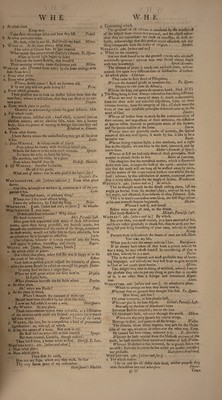
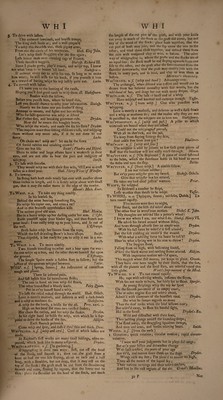
![li. Meerly imaginary. As univerfal as thefe appear to be, an effectual remedy might be applied : I am not at prefcnt upon a wild fpeculative pro- W'e£t, but fuch a one as may be eafily put in execution. Swift. ild, n. f. [from the adje&ive.] A defart; a tradt unculti¬ vated and uninhabited. We Lmetimes Who dwell this wild, conflrain’d by Want come forth To town or village nigh. Milton’s Paradife Regained. This gentle knight Forfook his eafy couch at early day* And to the wood and wilds purfu’d his way. Dryden* Then Libya firft, of all her moiflure drain'd* Became a barren wafte, a wild of fand. Addifon. Is there a nation in the wilds of Afric, Amidft the barren rocks and burning fands That does not tremble at the Roman name ? Addifon. You rais’d thefe hallow’d walls; the defart fmil’d, And paradife was open’d in the wild. Pope. Wild Bafil. n.f. [acinus, Lat.] A plant. * It hath leaves like thofe of the lefTer bafil; the cup of the flower is oblong and furrowed; the flowers are produced in bunches on the top of little footftalks, which arife from be¬ tween the footftalk of the leaf and the ftalk of the plants in which it differs from ferpyllum. Miller. Wild Cucumber, n.f. [elaterium, Latin ] A plant. The branches are fomewhat like thofe of the cucumber, but have no tendrils;, the fruit is prickly, and when ripe burfts with great elafticity, and abounds with fetid juice. Miller. Wild Olive, n.f. [eleagnus, Latin, from an olive, and ecyvor vitex ;] This plant hath leaves like thofe of the chafte tree, and a fruit like an olive. Miller. Wildse'rvice. n. f [cratagus, Lat.] A plant. The leaves are Angle ; the flower confifls of five leaves, which expand in form of a rofe. The fruit is fmall, and fhaped like a pear, in which are many hard feeds. Miller. To Wi'lder. v. a. [from wild.] To loofe or puzzle in an unknown or pathlefs trail. The little courtiers, who ne’er come to know The depth of fadtions, as in mazes go, Where intereffs meet, and crofs fo oft, that they With too much care are wilder'd in the way. Dryden. Oh thou ! who free’ft me from my doubtful ffate. Long loft and wilder'd in the maze of fate, Be prefent ftill. Pope. Wi' lderness. n.f. [from wild.] j. A defert; a trait of folitude and favagertefs. He travell’d through wide wafteful ground. That nought but defert wildernefs fhew’d all around. F. §>u. When as the land fhe faw no more appear, But a wild wildernefs of waters deep. Then ’gan fhe greatly to lament and weep. Spenfer. O my poor kingdom, flick with civil blows ! When that my care could not with-hold thy riots, What wilt thou do when riot is thy care ? O, thou wilt be a wildernefs again. Peopled with wolves, thy old inhabitants. But who can always on the billows lie ? The wat’ry wildernefs yields no fupply. All thofe animals have been obliged to change their woods and wildernejjes for lodgings in cities. Arbuth. id Pope. 2. The ftate of being wild or diforderly. Not in ufe. The paths and bow’rs, doubt not, but our joint hands Will keep from wildernefs with eafe. Milton. Wi'ldfirb. n.f [wild and fire.] A compofition of inflam¬ mable materials, eafy to take fire, and hard to be extin- guifhed. When thou rann’ft up Gadfhill in the night to catch my horfe, I did think thou had’ft been an ignis fatuus, or a ball of wildfire. Shakefpeare. Though brimftone, pitch, wildfire, burn equally, and are hard to quench, yet they make no fuch firy wind as gun¬ powder. Bacon s Nsit. FUJI. Yet fhall it in his boiling ftomach turn To bitter poifon, and like wildfire burn ; He fhall caft up the wealth by him devour’d. Sandys. No matter in the world fo proper to write with as wildfire, as no characters can be more legible than thofe which are read by their own light. Addifi Guard. In flames, like Semele’s, be brought to bed. While opening hell fpouts wildfire at your head. Pope. Wildgo osechase. n. f. A purfuit of fomething as unlikely to be caught as the wildgoofe. If our wits run th e wi/dgoofechace, I have done; for thou haft more of the wildgoofe in one of thy wits, than I have in my whole five. Shakefpeare. Let a man confider the time, money, and vexation, that this wildgoofechace has coft him, and then fay what have I gotten to anfwer all this expence, but loofe, giddy frolick ? s L'EJlrange. Wi'lding. n.f [wildelinghe, Dut.] A wild four apple. Shakefpeare. Waller. Ten ruddy wildings in the wood I found, ’ And flood on tip-toes, reaching from the ground. Dryd. The red ftreak, of all cyder fruit, hath obtained the pre¬ ference, being but a kind of wilding, never pleafing to the palate. Mortimer* The wilding's fibres are contriv’d To draw th’ earth’s pureft fpirit, and refill Its feculence. Phillips» Wi'ldly. adv. [from wild.] 1. Without cultivation. That which grows wildly of itfelf, is worth nothing. More. 2. With diforder ; with perturbation or diffraction. Put your difcourfe into fome frame, and ftart not fo wildly from my affair* Shakefpear* Mrs. Page, at the door, fweating, blowing, and looking wildly, would needs fpeak with you. Shakefpeare. Young mothers wildly flare with fear oppreft, And ftrain their helplefs infants to their breafl. Dryden. His fever being come to a height, he grew delirious, and talked very wildly. Female Quixote. 3. Without attention ; without judgment. As th’unthought accident is guilty Of what we ivildly do, fo we profefs Ourfelves to be the flaves of chance, and flie3 Of every wind that blows. Shakefpeare. 4. Irregularly. She, wildly wanton, wears by night away The fign of all our labours done by day. Dryden. Wi'ldness. n. f. [from wild.] 1. Rudenefs ; diforder like that of uncultivated ground. The heath, which was the third part of our plot, I wifli to be framed, as much as may be, to a natural ivildnefs. Bac. 2. Inordinate vivacity ; irregularity of manners. This fame ftarved juftice hath done nothing but prated to me of the wildnefs of his youth, and the feats he hath done about Turnbal -ftreet; and every third word a lie. Shakefp. He is giv’11 To fports, to wildnefs, and much company. Shakefpeare. 3. Savagenefs; brutality* He came in like a wild man ; but fuch a wildnefs as (hewed his eye-fight had tamed him, full of withered leaves; which though they fell not, ftill threatened falling. Sidney. Vainly thou tell’ft me, what the woman’s care Shall in the wildnefs of the wood prepare. Prior. 4. Uncultivated ftate* Their wildnefs lofe, and quitting nature’s part, Obey the rules and difcipline of art. Dryden. 5. Deviation from a fettled courfe ; irregularity. A delirium is but a fhort wildnefs of the imagination ; and a fettled irregularity of fancy is diftradtion and madnefs. JVatts's Log. 6. Alienation of mind. Ophelia, I wifh That your good beauties be the happy caufe Of Hamlet’s wildnefs ; fo fhall I hope your virtues May bring him to his wonted way again. Shakefp. Wile. n.f. [pile, Saxon; wiel, Iflandick.] A deceit; a fraud ; a trick ; a ftratagem ; a practice artful, fly, and infi- dious. Their leader by his wiles had much obtain’d, And done much mifchief on the Englifh ftate. Daniel. My fentence is for open war ; of wiles More unexpert, I boaft not; them let thofe Contrive who need. Milton. Life effay’d the fureft wile. Gilding itfelf with Laura’s fmile. Rofcommon. So Sforza, curs’d with a too fertile brain, Loft by his wiles the pow’r his wit did gain. Dryd. The heart of man is fo full of wiles, artifices, and deceit, that there is no gueffing at what he is from his fpeeches. Addifon's Guardian. Wifdom’s above fufpedting wiles. The queen of learning gravely fmiles. Swift. W'ilful. adj. [will and full.] 1. Stubborn; contumacious; perverfe ; inflexible. 2. Done or fuffered by defign. Sthenobcea herfelf did choak With wilful cord, for wanting of her will. Fairy Jhteen. Thou to me Art all things under heav’n, all places thou, Who for my wilful crime art banifh’d hence. Milton. The filent Arranger flood amaz’d to fee Contempt of wealth, and wilful poverty. Dryden. Wi'lfully. adv. [from wilful.] I. Obftinately ; ftubbornly. The mother, who being determinately, lead I fhould fay of a great lady wilfully, bent to marry her to Demagoras, tried all ways which a witty and hard-hearted mother could devife. . Sidney. Evil could fhe conceal her fire, and wilfully perfevered fhe in it. Sidney. 30 R Religion.](https://iiif.wellcomecollection.org/image/b30451541_0002_1130.jp2/full/800%2C/0/default.jpg)