Volume 2
A dictionary of the English language: in which the words are deduced from their originals, and illustrated in their different significations by examples from the best writers. To which are prefixed, a history of the language, and an English grammar / by Samuel Johnson.
- Samuel Johnson
- Date:
- 1755
Licence: Public Domain Mark
Credit: A dictionary of the English language: in which the words are deduced from their originals, and illustrated in their different significations by examples from the best writers. To which are prefixed, a history of the language, and an English grammar / by Samuel Johnson. Source: Wellcome Collection.
1131/1176
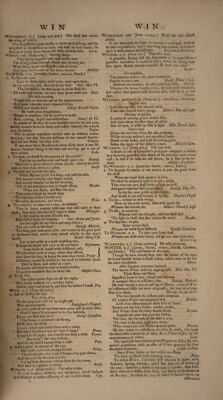
![i. Pleafed ; defirous. 3. Favourable; well difpofed to any thing. As many as were willing hearted brought bracelets and ear-rings. Ex. xxxv. 22. 4. Ready ; complying.. Religion hath force to qualify all forts of men, to make governors the apter to rule with confcience, inferiors for con¬ fidence fake the willinger to obey; Hooker. We’ve willing dames enough. Shakefpeare. He ftoop’d with weary wings and willing feet. Milt. 5. Chofen. They’re held with his melodious harmony. In willing chains, and fweet captivity. Milton. 6. Spontaneous. Forbear, if thou haft pity, Thefe groans proceed not from a fenfelefs plant, No fpouts of blood run willing from a tree. Dry den. 7. Confenting. How can hearts not free ferve willing. Milton. Wi'llingly. adv. [from will.] 1. W ith one’s own confent; without diflike ; without relu&ance. That prefervation of peace and unity amongft Chriftian churches fhould be by all good means procured, we join moft willingly and gladly with them. Hooker. I dare not make myfelf fo guilty. To give up willingly that noble title Your mafter wed me to. Shakefpeare. This ranfbm, if my whole inheritance May compafs, it (hall willingly be paid. Milton. 2. By one’s own defire. The condition of that people is not fo much to be envied as fome would willingly reprefent it. Addifon. '•Willingness, n.f. [from willing.] Confent; freedom from reluctance; ready compliance. We praife the things we hear with much more willingnefs, than thofe we fee ; becaufe we envy the prefent, and reve¬ rence the paft ; thinking ourfelves inftrudted by the one, and overlaid by the other. Ben. Johnfon. It is not doing good after that fame wonderful manner, that Chrift’s example obligeth us unto, but to a like ivillingnefs and readinefs to do good as far as our power reacheth. Calamy. Force never yet a generous mind did gain ; We yield on parley ; but are ftorm’d in vain ; Conftraint, in all things, makes the pleafure lefs. Sweet is the love which comes with willingnefs. Dryden. Willow, n.f. [pelie, Saxon, falix, Lat. gwilou, Welfh.J A tree worn by forlorn lovers. It hath amentaceous flowers confifting of feveral ftamina, which are colle&ed into a fpike but are barren. The em- bryoes are produced upon different trees from the male flowers, and afterwards become a fruit or hulk, fhaped like a cone, opening in two parts, and containing downy feeds. Mil. I offered him my company to a willow tree, to make him a garland, as being forfaken, to bind him up a rod, as being worthy to be whipt. Shakefp. In fuch a night Stood Dido with a willow in her hand Upon the wild fea banks. Shakefp. Tell him, in hope he’ll prove a widower fhortly, I wear the willow garland for his fake. Shakefpeare. When heaven’s burning eye the Helds invades. To marfhes he reforts, obfeur’d with reeds, And hoary willows, which the moifture feeds. Sandy. AfHiCied Ifrael fhall fit weeping down, Their harps upon the neighb’ring willows hung. Nor joyous hymn encouraging their tongue. Prior. Wi'llowish. adj. [willom.] Refembling the colour of willow. Make his body with greenifh coloured crewel, or willowijh colour. Walton. Wi'llowwort. n.f. A plant. The flower confifts of feveral leaves, produced from the inclofures of the flower-cup, placed circularly, and expanded like arofe ; from the centre of the flower-cup rifes the pointal, which becomes a fruit of two cells, full of fmall feeds, wrapped up in the flower-cup. Miller. Wl'LY. adj. [from wile.] Cunning; fly; full of ftratagem; fraudulent. They are fo cautelous and wily headed, efpecially being men of fmall praCtice in law matters, that you would wonder whence they borrow fuch fubtilities and ftiifts. Spenfcr. In the wily fnake Whatever flights, none would fufpicions mark As from his wit, and native fubtilty Proceeding. Milton s Pat. Lofl. Since this lalfc, wily, doubling difpofition of,mind, is fo intolerably mifehievous to fociety, God isfometimes pleafed, in mere compaffion to men, to give them warning of it, by fettins>- fome odd mark upon fuch Cains. South’j Seim. My wily nurfe by long experience found, And fir ft difeover’d to my foul its wound; ’Tis love faid fhe Dryden. Wi'mble. n. f. [wimpel, old Dutch, from wcmelen, to bore.] An inftrument with which holes are bored. At hdrveft-home, trembling to approach The little barrel, which he fears to broach : He ’fays the wimble, often draws it back, And deals to thirfty fervants but a fmack. Dryd As when a fhipwright ftands his workmen o'er* Who plye the wimble fome huge beam to bore ; Urg’d on all hands it nimbly fpins about, The grain deep-piercing till it fcoops it out. Pope. The trepan is like a wimble, ufed by joiners. Sharp. Wi'mble. adj. Active; nimble; fliifting to and fro. Such feems to be the meaning here. He was fo wimble and fo wight. From bough to bough he leaped light. And oft the pumies latched: Therewith afraid I ran away j But he that earft feem’d but to play, A (haft in earneft fnatched. Spenfer. Wi'mple. n. f [guimple, Fr. J A hood ; a veil. It is printed in Spenfer perhaps by miftake wimble. So fair and frefh, as faireft flower in May, For {he had laid her mournful ftole afide. And widow-like fad wimble thrown away. Fairy The Lord will take away the changeable fuits of apparel, and the wimples, and the crifping-pins. Ifrael ii. 22. To Wimble, v. a. To draw down as a hood or veil. The fame did hide. Under a veil that ivimbled was full low. Fairy Win. Whether initial or final in the names of men, may either denote a mafeuline temper, from pin, which fignifies in Saxon, war, ftrength, tAc. or elfe the general love and efteem he hath among the people ; from the Saxon pine, i. e. dear, beloved. In the name of places it implies a battle fought there. Gibf To Win. v. a. [Pret. wan and won; part. paf. won, pinna, Saxon ; winnen, Dutch.] 1. To gain by conqueft. The town of Gaza where the enemy lay encamped, was not fo ftrong but it might be won. Knoxes. His whole defeent, who thus fhall Canaan win. Milton. Follow chearful to the trembling town ; Prefs but an entrance, and prefume it won. Dryden. 2. To gain the vidory in a conteft. Loyalty is {till the fame Whether it win or lofe the game : True as the dial to the fun, Altho’ it be not fhin’d upon. Hudihras, b. iff. I five years at Tarentum wan The queftorfhip, and then our love began. Denham. Thy well breath’d horfe Impels the flying car and wins the courfe. Drrd. 3. To gain fomething withheld. * Refolv’d to win, he meditates the way, By force to ravifh, or by fraud betray. Pope. 4. To obtain. Thy virtue wan me 5 with virtue preferve me; Doft thou love me ? Keep me then (till worthy to be beloved. Sidney. When you fee my fon, tell him, that his fword can never win the honour that he lofes. Shakefpeare. Devililh Macbeth By many of thefe trains hath fought to win me. Shak. 5. To gain by play. He had given a difagreeable vote in parliament, for which reafon not a man would have fo much correfpondence with him as to win his money. Addifon. 6. To gain by perfuafion. They win great numbers to receive With joy the tidings brought from heav’n. Milton. 7. To gain by courtfhip. She’s beautiful; and therefore to be woo’d ; She is a woman, therefore to be won. Shakefp. That flood witnefs’d his inconftant flame, When thus he fwore, and won the yielding dame. Gay. To Win. v. n. 1. To gain the vidory. Nor is it ought but juft, That he who in debate of truth hath wort. Should win in arms. Miltort. 2. To gain influence or favour. You exprefs yourfelf very defirous to wirt upon the judg¬ ment of your mafter, and not upon his affections only. Bacon. You have a lbftnefs and beneficence winning on the hearts of others. Drydert. Thy words like mufick every breaft controul; Steal thro’ the air, and win upon the foul. Pope. 3. To gain ground. The rabble will in time win upon power. Shakefp. 4. To be conqueror or gainer at play. Charles I will play no more to night; My mind’s not on’t, you are too hard for me. — Sir, I did never win of you before. —But little, Charles; Nor fhall not when my fancy’s on my play* Shak. To](https://iiif.wellcomecollection.org/image/b30451541_0002_1132.jp2/full/800%2C/0/default.jpg)