Volume 2
A dictionary of the English language: in which the words are deduced from their originals, and illustrated in their different significations by examples from the best writers. To which are prefixed, a history of the language, and an English grammar / by Samuel Johnson.
- Samuel Johnson
- Date:
- 1755
Licence: Public Domain Mark
Credit: A dictionary of the English language: in which the words are deduced from their originals, and illustrated in their different significations by examples from the best writers. To which are prefixed, a history of the language, and an English grammar / by Samuel Johnson. Source: Wellcome Collection.
1132/1176
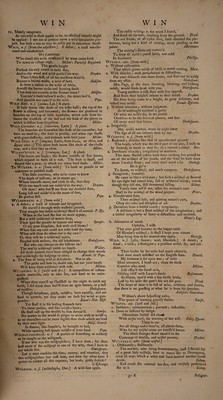
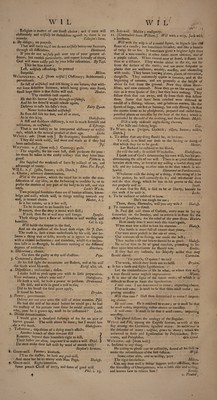
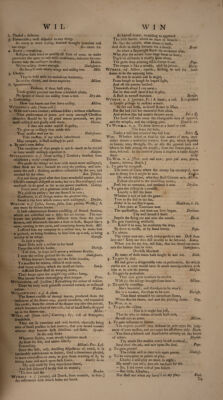
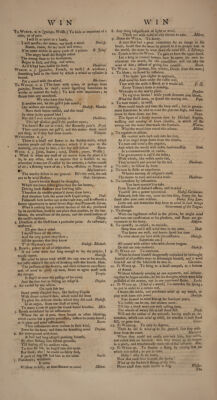
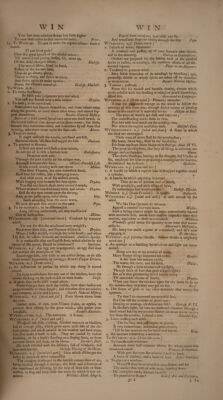
![To Wince, v. n. [gwingo, Welfh,] To kick as impatient of a rider, or of pain. I will fit as quiet as a lamb, t will notftir, nor wince, nor fpeak a word. Shakefp. Room, room, for my horfe will wince, If he came within fo many yards of a prince. B. johnf. The angry beaft did ftraight refent The wrong done to his fundament, Began to kick, and fling, and wince, As if h’had been befide his fenfe. Hudibras. Winch, n. f. [guineber, French, to twift.] A wind lace j fomething held in the hand by which a wheel or cylinder is turned. Put a winch with the wheel. Men timer. To Winch, v. a. [The fame with wince, or perhaps from guineber, French, to twijlwinch fignifying fometimes to writhe or contort the body.] To kick with impatience ; to fhrink from any uneafinefs. We who have free fouls, It touches not, let the gall’d jade winch ; Our withers are unwrung. Shakefp. Hamlet. Have thefe bones rattled, and this head So often in thy quarrel bled ! Nor did I ever winch or grudge it. Hudibras. This laft allufion gaul’d the panther more ; Yet feem’d fhe not to winch, tho’ fhrewdly pain’d. Dr yd. Their confciences are gall’d, and this makes them winch and fling, as if they had fome mettle. Tillotfon. Wi'ncopipe. «. J. There is a fmall red flower in the ftubble-fields, which country people call the wincopipe; which if it open in the morning, you may be fure, a fair day will follow. Bacon. Wind. n. j. [pinb,. Saxon; wind, Dutch; gwynt, Welfh.] 1. Wind is when any tra& of air moves from the place it is in, to any other, with an impetus that is fenfible to us, wherefore it was not ill called by the antients, a fwifter courfe of air ; a flowing wave of air; a flux, effufion, or ftream of •§ir. Mufchenbrcek. The worthy fellow is our general. He’s the rock, the oak not to be wind fhaken. Shak. Coriolanus. Love’s heralds fhould be thoughts, Which ten times fafter glides than the fun beams. Driving back fhadows over low’ring hills. Therefore do nimble-pinion’d doves draw love; And therefore hath the wind-fwift Cupid wings. Shak. Falmouth lieth farther out in the trade way, and fo ofFereth a fooner opportunity to wzW-driven fhips than Plymouth. Carew. Wind is nothing but a violent motion of the air, produced by its rarefadtion, more in one place than another, by the fun- beams, the attractions of the moon, and the combinations of the earth’s motions. Cheyne. 2. Direction of the blaft from a particular point. As eaftward ; weft ward. I’ll give thee a wind. I myfelf have all the other, And the very points they blow ; All the quarters that they know T’ th’ ftfipman’s card. Shakefp. Macbeth. 3. Breath ; power or act of refpiration. If my wind were but long enough to fay my prayers, I would repent. Shakefp. His wind he never took whilft the cup was at his mouth, but juftly obferv’d the rule of drinking with One breath. Hake. The perfume of the flowers, and their virtues to cure fhort- nefs of wind in purfy old men, feems to agree moft with the orange. _ ‘Temple. It ftop’d at once the paflage of his wind, And the free foul to flitting air refign’d. Dryden. 4. Air caufed by any action. On each fide her Stood pretty dimpled boys, like finding Cupids With divers colour’d fans, whofe wind did feem To glow the delicate cheeks which they did cool. Shakefp. In an organ, from one blaft of wind. To many a row of pipes the found-board breathes. Milt. 5. Breath modulated by an inftrument. Where the air is pent, there breath or other blowing, which carries but a gentle percuflion, fuffices to create found ; as in pipes and wind inftruments. Bacon. Their inftruments were various in their kind. Some for the bow, and fome for breathing wind. Dryden. 6. Air impregnated with feent. A hare had long efcap’d purfuing hounds, By often fhifting into diftant grounds, Till finding all his artifices vain. To fave his life, he leap’d into the main. But there, alas! he could no fafety find, A pack of dog-fifh had him in the wind. Swift. 7. Flatulence; windinefs. It turns Wifdom to folly, as nourifhment to wind. Milton. 8. Any thing infignificant or light as wind. Think not with wind of airy threats to awe. Milton. 9. DoWn the Wind. To decay. A man that had a great veneration for an image in his houfe, found that the more he prayed to it to profper him in the world, the more he went down the wind ftill. L’EJlrange. 10. To take or have the Wind. To gain or have the upper-hand. Let a king in council beware how he opens his own in¬ clinations too much, for elfe counfellors will but take the wind of him; inftead of giving free counfel. Bacon. To Wind. v. a. [pinban, Sax. tuinden, Dutch, from the noun.] 1. To blow; to found by inflation. The fquire ’gan nigher to approach, And wind his horn under the caftle wall, That with the noife it fhook as it would fall. F. §>. Every Triton’s horn is winding. Welcome to the wat’ry plain. Dryden. Ye vig’rous fwains ! while youth ferments your blood. Wind the fhrill horn, or fpread the waving net. Pope. 2. To turn round ; to twift. Nero could touch and time the harp well ; but in govern¬ ment fometimes he ufed to wind the pins too high, and fome¬ times let them down too low. Bacon. The figure of a fturdy woman done by Michael Angelo, wafhing and winding of linen cloaths, in which a6t (he wrings out the water that made the fountain. Wotton. Wind the wood-bine round this arbour. Milton. 3. To regulate in adlion. He vaulted with fuch eafe into his feat. As if an angel dropt down from the clouds, To turn and wind a firy pegafus. And witch the world with noble horfemanfhip. Shak. In a commonwealth or realm. The government is call’d the helm; With which, like veflels under fail. They’re turn’d and winded by the tail. Hudibras. 4. To nofe ; to follow by feent. 5. To turn by fhifts or expedients. Whence turning of religion’s made The means to turn and wind a trade. Hudibras. 6. To introduce by infinuation. You have contriv’d to take From Rome all feafon’d offices, and to wind Yourfelf into a power tyrannical. Shakef. Coriolanus. Edmund, feek him out, wind me into him, frame the bu- finefs after your own wifdom. Shakef. King Lear. Little arts and dexterities they have to wind in fuch things into difeourfe. Government of the Tongue. 7. To change. Were our legiflature veiled in the prince, he might wind and turn our conftitution at his pleafure, and fhape our go¬ vernment to his fancy. Addijon. 8. To entwift; to enfold; to encircle. Sleep thou and I will wind thee in my arms. Shak. You know me well, and herein fpend but time To wind about my love with circumftance. Shakefp. Sometime am I All wound with adders who with cloven tongues Do hifs me into madnefs. Shakefp. 9. To Wind out. To extricate. When he found himfelf dangeroufly embarked he bethought himfelf of all poffible ways to difentangle himfelf, and to wind himfelf out of the labyrinth he was in. Clarendon. 10. To Wind up. To bring to a fmall compafs, as a bottom of thread. Without folemnly winding up one argument, and intimat¬ ing that he began another, he lets his thoughts,which were fully poflefled of the matter, run in one cpntinued ftrain. Locke. 11. To Wind up. [Ufed of a watch] To convolve the fpring; to put in order to a certain end. I frown the while, and perchance wind up my watch, or play with fome rich jewel. Shakefp. Fate feemed to wind him up for fourfeore years. Yet frefhly ran he on, ten winters more : Till like a clock worn out with calling time, The wheels of weary life at laft flood ftill. Dryd. Will not the author of the univerfe, having made an au¬ tomaton, which can wind up itfelf, fee whether it hath flood ftill, or gone true. Grew. 12. To Wind up. To raife by degrees. Thefe he did fo wind up to his purpofe that they with¬ drew from the court. Hayward. When they could not coolly convince him, they railed, and called him an heretick: thus they wound up his temper to a pitch, and treacheroufly made ufe of that infirmity. Ater. 13. To Wind up. To ftraiten a firing by turning that on which it is rolled ; to put in tune. Hylas ! why fit we mute. Now that each bird faluteth the fpring l Wind up the flacken’d firings of thy lute, Never canft thou want matter to fing. IFaller. The](https://iiif.wellcomecollection.org/image/b30451541_0002_1133.jp2/full/800%2C/0/default.jpg)