Volume 2
A dictionary of the English language: in which the words are deduced from their originals, and illustrated in their different significations by examples from the best writers. To which are prefixed, a history of the language, and an English grammar / by Samuel Johnson.
- Samuel Johnson
- Date:
- 1755
Licence: Public Domain Mark
Credit: A dictionary of the English language: in which the words are deduced from their originals, and illustrated in their different significations by examples from the best writers. To which are prefixed, a history of the language, and an English grammar / by Samuel Johnson. Source: Wellcome Collection.
1135/1176
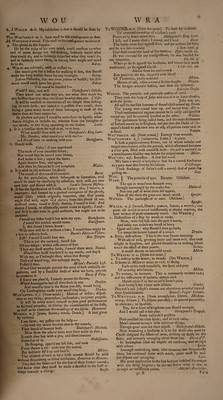
![WIN Wi'ngshell. n.f. \wing and Jhelt.] The fhell that covers the wing of infers. The long-fhelled goat-chafFer is above an inch long, and the wing/hells of themfelves an inch, and half an inch broad ; fo deep as to come down below the belly on both Tides. Grew. Wi'ngy. adj. [from wing.] Having wings. They fpring together out, and fwiftly bear The flying youth through clouds and yielding air; With w'tngy fpeed out-ftrip the eaftern wind. And leave the breezes of the morn behind. Addi/on. To WINK. v. n. [ptncean, Saxon ; wincken, Dutch.] 1. To fhut the eyes. Let’s fee thine eyes ; wink now, now open them : In my opinion, yet, thou fee’ll: not well. Sbak. Hen. VI. They’re fairies ; he that fpeaks to them lhall die: I’ll wink and couch; no man their fports mull: eye. Sbak. His falfe cunning Taught him to face me out of his acquaintance. And grew a twenty years removed thing. While one would wink. Shake/ Twelfth Night. He with great imagination. Proper to madmen, led his pow’rs to death, And, winkingy leap’d into deftruCtion. Shake/. H. IV. In defpite of all this, he runs foolifhly into his fin and ruin, merely bccaufe he winks hard, and rulhes violently like a horfe into the battle. Taylcfr. The Scripture reprefents wicked men as without under- ftanding; not that they are deftitute of the natural faculty: they are not blind, but they wink. _ Tillotjbn. If any about them Ihould make them think there is any dif¬ ference between being in the dark and winking, get it out of their minds. Locke. 2. To hint, or direCt by the motion of the eyelids. You faw my mailer wink and laugh upon you. Shake/p. Send him a fpoon when he wants a knife : wink at the foot¬ man to leave him without a plate. Swift. 3. To dole and exclude the light. Whije Hermes pip’d and fung, and told his tale, The keeper’s winking eyes began to fail. And drowfy Humber on the lids to creep, ’Till all the watchman was at length alleep. Dryden. When you fhoot, and Ihut one eye. You cannot think he would deny To lend the t’other friendly aid, . Or zvinky as coward, and afraid. Prior. jl. To connive ; to feem not to fee; to tolerate. They be better content with one that will wink at their faults, than with him that will reprove them. Whitgifte. I, for winking at your difcords too. Have loft a brace of kinfmen. Shak. Romeo and/uliet. Let not night fee my black and deep defires ; The eye wink at the hand ! Shake/p. Macbeth. The king gave him great gifts, and winked at the great fpoil of Bofworth-field, which came almoft wholly to this man’s hands. Bacon’s Henry VII. Let us not write at a Loofe rambling rate. In hope the world will wink at all our faults. Ro/common. Some faults of courfe with childhood end ; 1 We therefore wink at wags, when they offend, > And fpare the boy, in hopes the man may mend. Dryden. J Obftinacy cannot be winked at, but muft be fubdued, Locke. Cato is ftern, and awful as a god : He knows not how to wink at human frailty, Or pardon weaknefs that he never felt. Addi/on s Cato. 5. To be dim. The fullen tyrant flept not all the night. But, lonely walking by a winking light, _ Sobb’d, wept and groan’d, and beat his wither d bread. Dry. Wink, n. f. [from the verb.] 1. Ad of clofing the eye. You doing thus. To the perpetual vaink for ay might put This ancient moral. Shake/peare’s Tempefl. At every wink of an eye Tome new grace will be born. Shak. Since I receiv’d command to do this bufinefs, I have not flept one wink. Shake/. Cymbeline. The beams fo reverend and ftrong, Do’ft thou not think I could eclipfe and cloud them with a wink, But that I would not lofe her fight fo long ? _ Donne. It raged fo all night, that I could not fleep a wink. Tempk. Not write ! but then I think; And for my foul I cannot fleep a wink. Pope. 2. A hint given by motion of the eye. Her wink each bold attempt forbids. Sidney. ■ The ftockjobber thus from ’Change-a’ley goes down, And tips you the freeman a wink; Let me have but your vote to ferve for the town, And here is a guinea to drink. _ Swift. Wi'nker. n.f [from wink.'] One who winks. A let of nodders, winkers, and whilperers, whole blihnels is to ft; angle all others offspring of wit in thcii birth. 1 ope. W I N Wi'nkincly. adv. [from winking.'] With the eye alntoft clofed. If one beholdeth the light, he vieweth it winkingly, as tbofe do that are purblind ; but it any thing that is black, he looketh upon it with a broad and full eye. Peacbam on Draiving. Wi'nner .n.f [from win.] One who wins. A gamefter, having loft all, borroweth of his next fellow- gamefter fomewhat to maintain play; wnich he letting unto him again, fhortly thereby winneth all from the winner. Spenfer. . Go together, You precious winners all; your exultation Partake to every one. Shakef. Wintei’s Tale. Belhrew the winners ; for they play’d me falfe. Shakefp. Whether the winner laughs or no, the lofer will complain; and rather than quarrel with his own (kill, will do it at the dice. Temple. Winning, participial adj. [from win ] Attractive; charming. Yet lefs fair, Lefs winning foft, lefs amiably mild, Than that finooth wat’ry image. Milton’s Par a di/e Lcjl. On her, as queen, A pomp of winning graces waited ftill; And from about her fhot darts of delire Into all eyes, to wifli her ftill in fight. Milt. Par ad. LoR. Cato’s foul Shines out in every thing fhe aCts or fpeaks. While Winning mildnefs and attractive fmiles Dwell in her looks, and with becoming grace Soften the rigour of her father’s virtues. Addi/on’s Cato. Wi'nning. n.f. [from win.] Thefumwon. A fimile in one of Congreve’s prologues compares a writer to a buttering gamefter, that ftakes all his winnings upon every call:; fo that if he lofes the laft throw, he is lure t,o be un¬ done. Addi/on’s Freeholder. To Wi'nnow. v. a. [pm&puan, Saxon; evanno, Latin.] 1. To feparate by means of the wind; to part the grain from the chaff. Were our royal faith martyrs in love, We fhall be winnovS d with fo tough a wind. That even our corn fhall feem as light as chaff, And good from bad find no partition. Shake/p. Hen. IV. In the fun your golden grain difplay. And thrafh it out and winnow it by day. Dryden’s Virgil. 2. To fan ; to beat as with wings. Now on the polar winds, then with quick fan Winnows the buxom air. Milton’s Paradi/e Loft. 3. To fift; to examine. Winnow well this thought, and you fhall find ’Tis light as chaff that flies before the wind. Dryden. 4. To feparate; to part. Bitter torture fhall Winnow the truth from falfhood. Shake/p. Cymbeline. To Wi'nnow. v. n. To part corn from chaff. Winnow not with every wind, and go not into every way. Ecclus v. 9. Winnower, n / [from winnow.] He who winnows. Wl'NTER. n.f. [pineeji, Saxon; winter, Danifh, German, and Dutch.] The cold feafon of the year. Though he were already ftept into the winter of his age, he found himfelf warm in thofe defires, which were in his fon far more excufeable. Sidney. After Summer evermore fucceeds The barren Winter with his nipping cold. Shak. Hen. VI. Thofe flaws and ftarts Irnpoftors brow to fear, would well become A woman’s ftory at a Winter’s fire. Shake/p. Macbeth. He hath bought a pair of call: lips of Diana : a nun of Win¬ ter’s. fifterhood kiffes not more religioufly ; the very ice of cha- ftity is in them. Shake/p. As you like it. The two beneath the diftant poles complain Of endlefs Winter and perpetual rain. Dryden. Lieft thou afleep beneath thofe hills of fnow ? Stretch out thy lazy limbs; awake, awake. And Winter from thy furry mantle fhnke. Dryden. Suppole our poet was your foe before. Yet now, the bus’nefs of the field is o’er, ’Tis time to let your civil wars alone, When troops are into Winter-quartets gone. Dryden. He that makes no reflexions on what he reads, only loads his mind with arhapfody of tales, fit in Winter-nights for the entertainment of others. Locke. The republick have fent to prince Eugene to defire the em¬ peror’s protection, with an offer of Winter-quarters for four thoufand Germans. Addi/on on Italy. Stern Winter fmiles on that aufpicious clime, The fields are florid with unfading prime. Pope. To define Winter, 1 confider firft wherein it agrees with Summer, Spring, Autumn, and I find they are all feafons of the year; therefore a feafon of the year is a genus: then I ob- ferve wherein it differs from thefe, and that is in thelhortncfs of the days; therefore this may be called its fpecial nature, or difference;](https://iiif.wellcomecollection.org/image/b30451541_0002_1136.jp2/full/800%2C/0/default.jpg)