Volume 2
A dictionary of the English language: in which the words are deduced from their originals, and illustrated in their different significations by examples from the best writers. To which are prefixed, a history of the language, and an English grammar / by Samuel Johnson.
- Samuel Johnson
- Date:
- 1755
Licence: Public Domain Mark
Credit: A dictionary of the English language: in which the words are deduced from their originals, and illustrated in their different significations by examples from the best writers. To which are prefixed, a history of the language, and an English grammar / by Samuel Johnson. Source: Wellcome Collection.
1136/1176
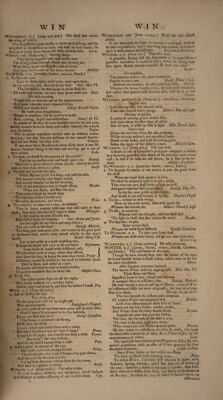
![difference : then, hy joining thefe together, I make a defini¬ tion. Winter is that fcafon of the year wherein the days are fhorteft. JVatts's Logick. To Wi'nter. v. n. [from the noun. ] To pafs the Winter. 1 he fowls fhall fummer upon them, and all the beafts of the earth {hall winter upon them. If. xviii. 6. Becaufe the haven was not commodious to winter in, the more part advifed to depart. Acts xxvii. 12. I o Wi'nter. v. a. To feed or manage in the Winter. ■The cattle generally fold for {laughter within, or exporta¬ tion abroad, had never been handled or wintered at hand- mcat. Temple. Young lean cattle may by their growth pay for their win¬ tering, and fo be ready to fat next Summer. Mortimer Wi nter is often ufed in compofition. The king fat in the winter-houfe, and there was a fire burning before him. Jer. xxxvj. 22< If in November and December they fallow, ’tis called a winter-fallowing. Mortimer. Shred it very fmall with thyme, fweet margarome, and a little winter-favoury. IVa It on s Angler. W i'nterbeaten. adj. [Winter and beat.] Harraffed by fevere weather. 1 Pie compareth Ins careful cafe to the fad feafon of the year, to the frofty ground, to the frozen trees, and to his own win- terbeaten flocke. Spenfer. Wi'ntercherry. ,n. f. [alkekenge.] A plant. The fruit is about the bignefs of a cherry, and inclofed in the cup of the flower, which fwells over it in form of a bladder. Miller. Wi'nter citron, n.f. A fort of Pear, which fee. Wi'ntergreen. n.f [pyrola, Latin.] A plant. It hath a rofe-fhaped flower, confifting of feveral leaves, which are placed circularly; out of whofe cup arifes the . pointal, ending in a probofeis, which afterwards turns to a roundifti fruit, which is channelled, generally umbellated, and confifting of five cells, which are commonly full of-fmall feeds. Miller. Wi'nterly. adj. [IVinter and like.] Such as is fuitable to Winter; of a wintry kind. If’t be Summer news, omile to’t before; if winterly, thou need’ll: UlU keep that count nance ftill. Shakefp. Cynibeline. WINTR.Y. adj. [from IVinter.] Brumal; hyemal. ^ He faw the Trojan fleet difpers’d, diftrefs’d , By ff°rmy winds, and wintry heav’n opprefs’d. Dryden. Wi ny. adj. [from wine.] Having the tafte or qualities of wine. ^Set cucumbers here and there among mufkmelons, and fee wnether the melons will not be more winy, and better tafted. Bacon’s Natural Hiftory. To WIPE. v. a. [pipan, Saxon.] 1. To cleanfe by rubbing with fomething foft. Such a handkerchief, I’m fure it was your wife’s, did I to-day See Caffio wipe his beard with. Shak. Othello. She a gentle tear let fall . Worn either eye, and wip’d them with her hair. Milton. • Then with her veft the wound fbe wipes and dries. Denh. 2. To take away by terfion. Calumniate ftoutly; for though we wipe away with never fo much care the dirt thrown at us, there will be left fome fulliage behind. Decay of Piety. 3. To ftrike off gently. Let me wipe off this honourable dew. That filverly doth progrefs on thy cheeks. Shakefpeare. Some natural tears they dropp’d, but wip’d them foon. Milton’s Paradij'e Loft. A young man, having fuffered many tortures, efcaped with life, and told his fellow Chriftians, that the pain of them had been rendered tolerable by the prefence of an angel, who ftood by him and wiped off the tears and fweat. AddiJ'on. 4- To clear away. Macduff, this noble paffion. Child of integrity, hath from my foul JVip d the black fcruples; reconcil’d my thoughts To thy good truth and honour. Shake/ Macbeth. S' I o cheat; to defraud. The next bordering lords commonly incroach one upon another, as one is ftronger, or lie ftill in wait to %vipe them °“tT0/7.their lands. Spenfer on Ireland. 6. lo Wipe out. To efface. I I*‘s ^ot’ that theyobjedl againft your houfe, .mall be wip’d out in the next parliament. Shak. Hen. VI. As thou lov’ft me, Camillo, wipe not cut the reft of thy fervices by leaving mc now. Shakefp. Winter’s Tale. Take one in whorn decrepid old age has blotted out the memory of his paft knowledge, and clearly wiped out the ideas .us mind was formci.y ftored with, and flopped up all the paf- fages fdr new ones to enter; or if there be fome of the inlets yet left open, the impreffions made are fcarce per- ■ecived- Locke. W I S Wipe. n. f [from the verb.] 1. An a£l of clcanfing. 2. A blow; a ftroke; a jeer; a gybe; a farcafm. 1 o ltatefmen would you give a wipe, You print it in Italick type: When letters are in vulgar ftiapes, Tis ten to one the wit efcapes \ But when in capitals expreft A^ffd dUHeft rCader fm°akS th>e jeft* So*/?.- WVper. n.f [from wipe.] An iuftrument or pMon'by which any thing is wiped. J The maids and their makes. At dancing and wakes. Had their napkins and pofies. And the wipers for their nofes. r WIRE. n.f. [virer, French, to draw round. Skinner 1 Metal drawn into {lender threads. Tane was the damfel; and without remorfe The king condemn’d her, guiltlefs, to the fire: Her vail and mantle pluckt they off by force. And bound her tender arms in twifted wire. Fairfax Thou {halt be whipt with wire, and ftew’d in brine,7 * Smarting in ling’ring pickle. _ Shakefp. Ant. and Cleopatra. The foldier, that man of iron. Whom ribs of horror all environ. That’s ftrong with wire inftead of veins. In whofe embraces you’re in chains. Beaumont and Fletcher. And the cherubick hoft, in thoufand quires. Touch their immortal harps of golden wires. Milton. Some roll a mighty ftone, fome laid along. And, bound with burning wires, on fpokes of wheels are rj- xxr , _ Dryden s Ain. 10 VV1 redraw, v. a. [wire and draw.] !• To fpin into wire. 2. To draw out into length. . A fluid moving through a flexible canal, when fmall, by its fri£hon will naturally lengthen, and wiredraw the fides of the canal, according to the direction of its axis. Arbuthnot. 3. Bo draw by art or violence. I have been wrongfully accufed, and my fenfe wiredrawn into blafphemy. Dryden. VVi redrawer, n.f. [wire and draw.] One who fpins wire. Thofe who have need of unmixed filver, as gilders and wiredrawers, muft, befides an equal weight of filver mixed with other metals, give an overplus to reward the refiner’s Ikill. Locke. To Wis. v. a. pret. and part. paff. wifi, [wiffen, German; wyfen, Dutch.] To know. Obfolete. Thus proud and fierce, unto the hearts he ftept Of them poor fouls ; and cutting reafon’s reins. Made them his own before they had it wifi. Sidney. There be fools alive, I wis. Silver d o er; and fo was this. Shakefpeare. This book, advifedly read and diligently followed but one year at home, would do a young gentleman more good, I wi,s, than three yeais travel abroad. Afchani s Schoolmajler. When Mammon faw his purpofe mift. Him to entrap un wares, another’s way he wifi. Fa. fjueen. Marry with a king, A hatchelor, a handfome ftrippling too, I wis your grandam had a worfer match. Shakefp. R. III. When for more worlds the Macedonian cry’d. He wift not I hetys in her lap did hide Another yet, a world referv’d for you, To make more great than that he did fubdue. - Waller. Wi'sdom. n.J, [piptiom„Saxon; wiifdom, Danifli.] Sapience; the power of judging rightly. That which moveth God to work is goodnefs, and that which ordereth his work is wifddm, and that which peifeeleth his work is power. ’ Hooker. ’Tis much he dares. And to that dauntiefs temper of his mind. He hath a wifdom that doth guide his valour To act in fafety. Shakefp. Macbeth. IVifdom and fortune combating together, If that the former dare but what it can, No chance may {hake it. Shakef. Ant. and Cleopatra. As from fenfes reafon’s work doth fpring. So many reafons underftanding gain. And many underftandings knowledge bring. And by much knowledge wifdom we obtain. Davies. Wifdom is that which makes men judge what are the beft: ends, and what the beft means to attain them, and gives a man advantage of counfel and dire&ion. Temple. As fcience is properly that knowledge which relateth to the effences of things, fo wifdom to their operations. Grew s Co^m. WISE. adj. [pip, Saxon ; wiis, Dutch and Danilb.J I. Sapient; judging rightly, particularly of matters of life; having practical knowledge. I would have you wife unto that which is good, and fimpl* concerning evil. Rom. Xvi. 19.](https://iiif.wellcomecollection.org/image/b30451541_0002_1137.jp2/full/800%2C/0/default.jpg)