Volume 2
A dictionary of the English language: in which the words are deduced from their originals, and illustrated in their different significations by examples from the best writers. To which are prefixed, a history of the language, and an English grammar / by Samuel Johnson.
- Samuel Johnson
- Date:
- 1755
Licence: Public Domain Mark
Credit: A dictionary of the English language: in which the words are deduced from their originals, and illustrated in their different significations by examples from the best writers. To which are prefixed, a history of the language, and an English grammar / by Samuel Johnson. Source: Wellcome Collection.
1139/1176
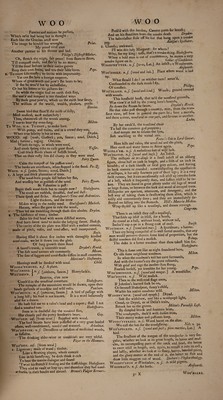
![11. Noting confidence ; as I trufl you with all my fecrets \ or, I trujl all my fecrets with you. 12. In partnerftiip. Though Jove himfelf no lefs content would be, To part his throne, and (hare his heaven with thee. Pope. 13. Noting connection. Pity your own, or pity our eftate, Nor twift our fortunes with your linking fate. Dryden. 14. Immediately after. With that (lie told me, that, though fhe fpake of her father Cremes, (lie would hide no truth from me. Sidney, b. ii. With that, he crawled out of his neft, Forth creeping on his caitiff hands and thighs. Fairy Queen. In falling, both an equal fortune try’d ; Wou’d fortune for my fall fo well provide ! With this he pointed to his face, and (how’d His hands, and all his habit fmear’d with blood. Dryden. With that, the God his darling phantom calls, And from his falt’ringlips this meffage falls. Garth. 15. Amongft. Jafper Duke of Bedford, whom the king ufed to employ with the firft in his wars, was then Tick. Bacon. Tragedy was originally with the antients, a piece of reli¬ gious worfhip. Rymer’s Tragedies of'lajl Age. Immortal powers the term of confcience know. But intereft is her name with men below. Dryden. 16. Upon. Such arguments had invincible force with thofe Pagan phi- lofophers, who became Chriftians. Addifon. 17. In content. Noting parity of (fate. See ! where on earth the flow’ry glories lie : IVith her they flourifh’d, and with her they die. Pope. 18. With in compofition fignifies opposition, or privation. WVthal. adv. [with and all.] 1. Along with the reft 5 likewife 3 at the fame time. Yet it muft be ivithal confidered, that the greateft part of the world are they which be fartheft from perfection. Hooker. How well fupply’d with noble counfcllors ? How modeft in exception, and withal How terrible in conftant refolution ? Shakefp. Hen. V. The one contains my picture, prince 3 If you chufe that, then I am yours zvithal. Shakefpeare. This that prince did not tranfmit as a power, to make con- queft, but as a retinue for his fon, and withal to enable him to recover fome part of Ulfter. Davies s It eland. God, when he gave me ftrength, to (hew withal How (light the gift was, hung it in my hair. Milton. Chrift had not only an infinite power to work miracles, but alfo an equal v/ifdom to know the juft force and meafure of every argument, to perfuade, and withal to look through and through all the dark corners of the foul of man, and to difeern what prevails upon them, and what does not. South. I cannot, cannot bear 3 ’tis paft 3 ’tis done : Perifh this impious, this detefted fon ! Perifh his fire, and perifh I withal, And let the houfe’s heir, and the hop’d kingdom fall. Dryd. 2. It is fometimes ufed by writers where we now ufe with. Time brings means to furnifh him withal 3 Let him but wait th’ occafions as they fall. Daniel. It is to know what God loves and delights in, and is nleafed withal, and would have us do in order to our happi- nefs. ' f , Tillotjon. We owe to chriftianity the difeovery of the molt per- feft rule of life, that ever the world was acquainted withal. v Ti Hot fon. To Withdra'w. v. a. [with and draw 3 from pf5, or prdep, Saxon, againjl, and draw.] 1. To take back 3 to deprive of. It is not poffible they fhould obferve the one, who from the other withdraw unneceflarily obedience. Hooker, b. v. Impcffible it is that God fhould withdraw his prefence from any thing, becaufe the very fubftance of God is infinite. “ Hooker. 2. To call away 3 to make to retire. Nauiicaa is withdrawn, and a whole nation introduced, for a more general praife of Ulyffes. Broome. To Withdraw, v.n. To retire 3 to retreat. She from her hufband foft withdrew. Milton. At this excefs of courage all amaz’d. The foremoft of his foes a-while withdraw : With fuch refpeCf in enter’d Rome they gaz’d, Who on high chairs the godlike fathers law. Dryden. Duumvir has pafs’d the noon of life 3 but cannot withdraw from entertainments, which are pardonable only before that ftage of our being. Tatler, N° 54. Withdra'wingroom. n.f [withdraiv znd room.] Room be¬ hind another room for retirement.' For an ordinary gentleman, a hall, a great parlour, with a with dr aw in groom, with a kitchen, butteries, and other con¬ veniences, is fufficient. M01 timer s Hujbandry. W/the. n.f. 1. A willow twig. An Irifh rebel put up a petition, that he might be hanged in a with, and not a halter, becaufe it had been fo ufed with former rebels. . Bacon. 2. A band, properly a band of twigs ; [pttSe fignifies a band.] Thefe cords and wythes will hold men’s confidences, when force attends and twifts them. K. Charles. Birch is of ufe for ox-yoaks, hoops, ferews, wythes for faggots. Mortimer's Hujbandry. To Wi'ther. v.n. [^eprSejiob, Saxon, dry, faded.] 1. To fade 5 to grow faplefs 3 to dry up. That which is of God we defend, to the uttermoft of that ability which he hath given: that which is otherwile, let it wither even in the root from whence it hath fprung. Hooker. When I have pluck’d thy rofe, I cannot give it vital growth again 5 It needs muft wither. Shakefp. Othello. It (hall wither in all the leaves of her fpring. Ezek. xvii. 9. The foul may fooner leave off to fubfift, than to love 3 and like the vine, it withers and dies, if it has nothing to em¬ brace South s Sermons. 2. To wafte, or pine away. Are there fo many left of your own family, that you fhould defire wholly to reduce it, by luftering the laft branch of it to wither away before its time. Temple. 3. To lofe, or want animal moifture. Vain men, how vanifhing a blifswe crave, Now warm in love, now withering in the grave. Dryden. To WITHER, v. a. 1. To make to fade. The fun is no fooner rifen with a burning heat, but it wi- thereth the grafs, and the flower thereof falleth. Ja. i. 11. 2. To make to (hrink, decay, or wrinkle, for want of animal moifture. Aire cannot wither her, nor cuftom ftale her infinite va¬ riety. Shakefpeare's Ant. and Cleopatra. Look how I am bewitch’d ; behold, mine arm Is, like a blafted fapling, withered up. Shakefpeare. What are thefe, So wither'd, and lb wild in their attire. That look not like th’ inhabitants o’ th’ earth. And yet are on’t ? Shakefpeare's Macbeth. Thy youth, thy ftrength, thy beauty, which will change To wither'd, weak, and grey. Milton. In Spain our fprings, like old men’s children be. Decay’d and wither'd, from their infancy : No kindly (howers fall on our barren earth. To hatch the feafons in a timely birth. Dryden. Wi'theredness. n.f [from withered.] The date of being withered 3 marcidity. Water them as loon as fet, ’till they have recovered their witherednefs. Mortimer s Hujbandry. Wi'therband. n.f A piece of iron, which is laid under a faddle, about four fingers above the horfe’s withers, to keep the two pieces of wood tight, that form the bow. Farrier's Di£i. Wi'thers. n.f. Is the joining of the fhoulder-bones at the bottom of the neck and mane, towards the upper part of the fhoulder. Farrier's Diet. Let the gall’d beaft wince 3 We are unwrung in the withers. Shakefpeare. Rather than let your mafter take long journies, contrive that the faddle may pinch the bead in his withers. Swift. Wi'therrung. n.f. IVitherrung fometimes is caufed by a bite of a horfe, or by a faddle being unfit, efpecially when the bows are too wide 5 for when they are fo, they bruife the flefh againft the fpines of the fecond and third vertebrae of the back, which forms that prominence that rifes above their fhoulders. Farrier's Di£t. To Withhold, v.a. [with and hold.] Withheld, or with- holden, pret. and part. I. To reftrain 3 to keep from action 3 to hold back. That hand, which as no kind of imminent danger could caufe at firft to zvithhold itfelf, fo neither have any practices, fo many, fo bloody, following fince, been ever able to make weary. Hooker, b. iv. Sith mine he is, or free or bound ; Withhold, O fovereign prince, your hafty hand From knitting league with him. Spenfer. The prince Would fain have come with me to meet your grace 5 And by his mother was perforce withheld. Shakefpeare. Be careful to withhold Your talons from the wretched and the bold: Tempt not the brave and needy to defpair 5 For though your violence ftiould leave them bare Of gold and filver, fwords and darts remain. Dryden. Volition is an adf of the mind, knowingly exerting that do¬ minion it takes itfelf to have over any part of man, by em¬ ploying it in, or withholding it from any particular a£lion. Locke. 2. To](https://iiif.wellcomecollection.org/image/b30451541_0002_1140.jp2/full/800%2C/0/default.jpg)