Volume 2
A dictionary of the English language: in which the words are deduced from their originals, and illustrated in their different significations by examples from the best writers. To which are prefixed, a history of the language, and an English grammar / by Samuel Johnson.
- Samuel Johnson
- Date:
- 1755
Licence: Public Domain Mark
Credit: A dictionary of the English language: in which the words are deduced from their originals, and illustrated in their different significations by examples from the best writers. To which are prefixed, a history of the language, and an English grammar / by Samuel Johnson. Source: Wellcome Collection.
1143/1176
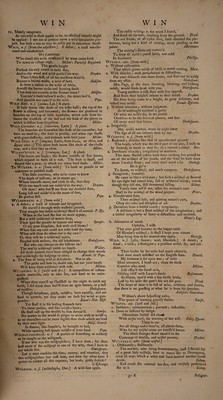
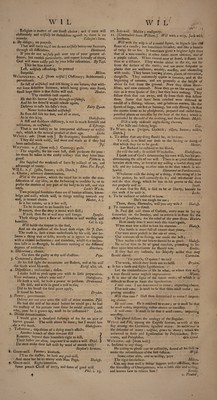
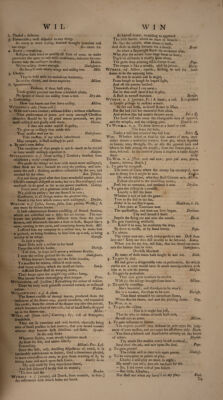
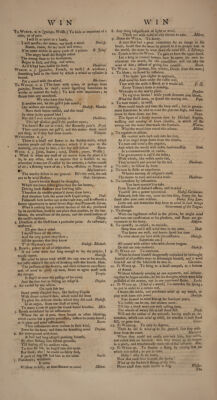
![A pretence of kindnefs is the univerfal ftale to all hafe pro¬ jects : all wolfijh defigns walk under (beeps cloathing. Gov. V on. Wolfsbane. n.f. [wolf and bane.] A poifonous plant; aconite. It hath circumfcribed roundifh divided leaves; the flower confifts of four leaves, fliaped like a monkey’s hood : each of thefe flowers are fucceedtd by three or more pods which con¬ tain feveral rough feeds: the moft part of thefe fpecies are dead¬ ly poifon Mliler. If': If. bane is an early flower. Mortimer's Hujbanary. Wo'lfsmilk. n.f An herb. Ainfwsrtb. Wo'lvish adj. [tiom wolves, of wolf', wolfijh is more proper.! Refembling a wolf. Vv hy in this wo'vjh gown do I ftand here, To beg of Hob and Dick. Shakefp. C arid anus. My people are grown half wild, they would not worry one another fo in that wovijh belluine manner elfe. Howe l. 1 here is a bale woluijh principle within that is gratified with another s mifery. South's Sermons. WO'MAN. [pipman, pimman, Saxon ; whence we yet pro¬ nounce women in the plural, wirmnen, Skinner.] 1. The female of the human race That man who hath a tongue is no man, If with his tongue he cannot win a woman. Shakfpeare. Thou dotard, thou art woman-tir’d, unroofted By thy dame Parlet here. Shah Jpe are's Winter sFale. Women are fott, mild, pitiful and flexible; Thou ftern, obdurate, flinty, rough, remorf lefs. Shakefp. And Abimelech took men-fervants and w men fervants. Gen. O woman, lovely woman, nature form’d thee To temper man : we had been brutes without thee. Otway. Ceneus a woman once and once a man; But ending in the fex fhe firft began D>yd n's /En. Wonun are made as they themfelves would choofe, Too pioud to alk, too humble to refufe. Garth. Women in their nature are much more gay and joyous than men ; whether it be that their blood is more refined, their fibres more delicate, and their animal fpirits more light; vi¬ vacity is the gift of women, gravity that of men. Addifon. 2. A female attendant on a perfon of rank. I could not perfonally deliver to her What you commanded me ; but by her zuoman 1 fent your melfage. Shakfpeare's Henry VIII. ToWc/man v. a. [from the noun.] To make pliant like a woman. I’ve felt fuch quirks of joy and grief, That the firft face of neither on the ftart Can woman me unto’t. Shakefpeare. Wo maned, adj. [from woman.] Accompanied; united with a woman. I do attend here on the general, ' And think it no addition nor my wifli, To have him fee me woman d. Shakefpeare's Othello. Womanha'ter. n.f. [woman and hater.'] One that has an averfion from the female fex. How could it come into your mind, To pitch on me of all mankind, Againft the fex to write a fatyr ; And brand me for awem.tnbater. Swift. Wo'manhood ln-f [from woman.] The character and col- Wo'manhead. J leeftive qualities of a woman. Obfolete. Ne in her fpeech, ne in her haviour, Was Iigh nefs feen, or loofer vanity, But gracious womanhood and gravity Fairy Sfueen. There dwells fweet love and conftant chaftity, Unfpotted faith, and comely womanhood. Regard of honour, and mild modefty. Spenfer. ’Tis prefent death I beg; and one thing,more. That womanhood denies my tongue to tell: O keep me from their worfe than killing luft. Shakefpeare: When my grave is broke up again, Some fecond gueft to entertain ; For graves have learn’d that wornanhead To be to more than one a bed. Donne. Wo'manish adj. [from woman.] Suitable to a woman. Neither doubt you, becaufe I wear a woman’s apparel, I will be the more omanifh ; fince I allure you there is nothing I defire more than fully to prove myfelf a man. Sidney. Zelmane making a woman Jh habit to be the armour of her boldnefs, giving up her life to the lips of Philoclea, humbly be- fought her to keep her fpeech a while within the paradife of her mind. Sidney. A voice notfoft, weak, piping, and womanifh, but audible, ftrong, and matlike. Afham. She then to him thefe wnmanijh words ’gan fay, For love of me, leave ofF. Fairy fhceen. Our fathers minds are dead, . And we are govern’d with our mothers fpirits; Our yoke and fuft’rance fhew us womanijh. Shakefpeare. 1 do not think he fears death; He never was fo womanijh. Shakefpeare. During his banifhment, he was fo foftened and dejeded, as he wrote nothing but a few womanijh epiftles. Bacon. In a fad look or zvomanijk complaint. Denham. t melt to womamjh tears, and if I flay, I find my love my courage will betray. ' Drydcn. The godlike hero, in his bread Diflain’d, or was alham’d to (how So weak, fo womanijh a woe. Drydcn< To Womani'se. v. a. [from woman.] To emafculate; to effeminate ; to foften. Proper, but not ufed This effeminate love of a woman doth womanize a man. Sid. WomanKI'nd. n f [woman and kind ] The female fex ; the race of women. Mufidorus had over bitterly glanced againd the reputation * of womankind. Sidney. So eafy is t’appeafe the ftormy wind Of malice, in the calm of pleafant womankind. Fairy fjhieen. Becaufe thou doat’d on womankind, admiring Their fhape, their colour, and attra&ive grace. None are, thou think’ft, hut taken with luch toys. Milton. Each inconvenience makes their virtue cold ; But womankind in ills is ever bold. Dr,den s juvenal. Juba might make the prouded of our fex, Any of womankind, but Marcia, happy. Addijon's Cato. She advanc’d, that womankind Would by her model form their mind. Swift. Wo'manly. adj. [from woman.] i. Becoming a woman ; fuiting a woman; feminine ; not maf* culine. I’m in this earthly world, where to do harm Is often laudable; to do good fometime Accounted dangerous folly: why then, alas ! Do I put up that womanly defence, To fay I’d done . oJiarm. Shakefpeare. She brings your froward wives As prifoners, to her womanly perfuafion. Shakefpeare. All will fpy in thy face A blufhing womanly difeovering grace Donne. Rage choaks my words ; ’tis womanly to Weep. D yden. Let him be taught to put off7 all thofe tender airs, affedled fmiles, and all the enchanting woman y behaviour that has made him the objeft of his own admiration. Arbuthnot and Pope. 2. Notchildifh; notgirlifh. Young perfons, under a womanly age, are often troubled with fome of 'he fame (ymptoms. Ar'rithnot onDiet. W o'm a nly. adv. [from woman.] In the manner of a woman ; effeminately. WOMB. n.f. [wamba, Goth, ramb, Sax. weemb, Iflandick.] 1. The place of the faetus in the mother. When yet he was bat tender bodied, and the only fon of my womb. Shakefpeare’s Coriolanus. New-born children bring not many ideas into the world, ba¬ ting fome faint ideas of hunger and thirft which they may have felt in the womb. Locke. Conceiving, as fhe flept, her fruitful womb Swell’d with the founder of immortal Rome. Addifon. 2. The place whence any thing is produced. The earth was form'd, but in the womb as yet Of waters, embryon immature involv’d. Appear’d not. Milton. The womb of earth the genial feed receives. Dryden. To Womb. v. a. [from the noun ] To inclofe; to breed in fecret. Not for all the fun fees, or The clofe earth wombs, will I break my oath To this my fair belov’d. Shakefpeare's Winter's Pale. W o'M BY. adj. [from womb.] Capacious. He’ll call you to fo hot an anfwer for it, That caves and w:mby vaultages of France Shall chide your trefpafs, and return your mock, In fecond accent to his ordnance. Shakefp. Henry V. Wo'men. Plural of woman. Thus it fhall befal Him who to worth in women over-trufts. Milton, Won. The preterite and participle paflive of vain. All thefe the Parthian, From the luxurious kings of Antioch wen. Milton. Againft myfelf I viftorious have won, And by my fatal abfence am undone. Drydcn. My mother is won over to my fide, but dares not mention me to my father, for fear of provoking him. Addifon's Spettat. ToWon. v. n. [puman, Saxon; wonen, German.] Todwell; to live; to have abode. Not in ufe. Him fortuned To come where vile Arcafia does wonn. Fairy fjhteen. Out of the ground uprofe As from his lair, the wild beaft where he wons In foreft wild. Milt Ms Paradife Lojl. A people near the northern pole thattcm\ Whom Ireland fent from loughes and forefts hore. Fairf Won. n.f. [fram the verb.] Dwelling; habitation. Obfolete. What fecret place, quoth he, can fafely hold So huge a mafs, and hid from heaven’s eye; Or where haft thou thy won, that fo much gold Thou tan’ft preferve from wrong and robbery. Fairy fjfeen. T©](https://iiif.wellcomecollection.org/image/b30451541_0002_1144.jp2/full/800%2C/0/default.jpg)