Volume 2
A dictionary of the English language: in which the words are deduced from their originals, and illustrated in their different significations by examples from the best writers. To which are prefixed, a history of the language, and an English grammar / by Samuel Johnson.
- Samuel Johnson
- Date:
- 1755
Licence: Public Domain Mark
Credit: A dictionary of the English language: in which the words are deduced from their originals, and illustrated in their different significations by examples from the best writers. To which are prefixed, a history of the language, and an English grammar / by Samuel Johnson. Source: Wellcome Collection.
1144/1176
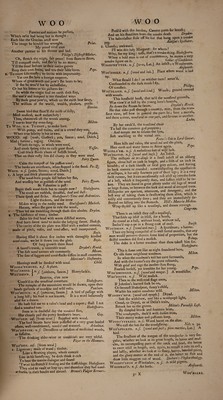
![To \\ O'NDER, v. n. [punopian, Saxon; wonder, Dutch.] lo be flruck with admiration ; to be plcafed or furprifed i'o as to beaftonifhed. 1 he want ot thefe magazines of victuals I have oftentimes complained of in England, and wondered at in other countiies. Spenfer's Ireland. His deadly wound was healed : and all the world wondered after the beat!. Rev. xiii. 3. No wonder to us, who have converfed with too many ft range unparallel’d addons, now to wonder at any thing ; wonder is from furprife, and furprife ceafes upon experience. South's Sermons. King Turnus wonder'd at the fight renew’d. Dryden. Who can wonder that all the fciences have been fo over¬ charged with infignificant and doubtful expreffions, capable to make the mod quick-fighted very little the more knowing. Locke. I could not fufficiently wonder at the intrepidity of thefe di¬ minutive mortals, who durft venture to mount and walk upon my body. Swift. Wo'nder. n.f. [punbop, Saxon; wonder, Dutch.] 1. Admiration; aftonifhment; amazement; furprife caufed by fomething unulual or unexpected. What is he, whole griefs Eear fuch an emphafis? whofe phrafe or forrow Conjure the wand’ring ftars, and makes them ftand Like zcwAV-wounded hearers. Sbakefpeare's Hamlet. Wonder Caufeth aftonifhment, or an immoveable pofture of the body ; for in zuonder the fpirits fly not as in fear, but only fettle. Bacon's Natural Hijlory. 2. Caufe of wonder; a ftrange thing; fomething more or great¬ er than can be expeCted. 7 he Cornifh wonder-gatherer defcribeth the fame. Carew. Great effects come of induftry in civil bufinefs; and to try things oft, and never to give over, doth wonders. Bacon. Lo, a wonder ftrange ! Ol every beaft, and bird, and infeCt fmall Came {'evens, and pairs. Milton's Paradfe Loft. What woman will you find, / I hough of this age the zuonder and the fame. On whom his leifure will vouchfafe an eye Of fond defire ? Milton's Paradfe Regained, No zuonder fleep from careful lovers flies. To bathe himfelf in Sachariffa’s eyes; As fair Aftrea once from earth to heav’n. By ftrife and loud impiety was driven. Waller. Drawn for your prince, that fword could wonders do : The better caufe makes mine thefharper now. Waller, 3. Any thing mentioned with wonder. There Babylon the wonder of all tongues. Milton. Ample fouls among mankind have arrived at that prodigi¬ ous extent of knowledge which renders them the wonder and glory of the nation where they live. Watts. Wo'nderful. adj. [wonder full] Admirable; ftrange; aftonifhing. I uttered that which I underftood not, things too wonderful for me which I knew not. Job xlii. 3. Strange Hath been the caufe, and wonderful to hear. Milton. All this is very wonderful, Shakefpeare multiplies miracle up¬ on miracle to bring about the fame event in the play, which chance with more propriety performs in the novel. Shak. lllujl. Wo'nderful. adv. To a wonderful degree. Improperly ufed. The houfe which I am about to build fhall be wonderful great. 2 Chron. ii. 9. Wonderfully, adv. [from wonderful.'] In a wonderful manner ; to a wonderful degree. He was much made on by the pope, who knowing him¬ felf to be unprofitable to the Chriftian world, was wonderfully glad to hear that there were fuch echoes of him founding in remote parts. Bacon's Henry VII. There is fomething wonderfully divine in the airs of this picture. • Addfon's Italy. Wonderment, n.f. [from wonder.] Aftonifhment; amaze¬ ment. Not in ufe, except in low language. When my pen would write her titles true, It ravifh’d is with fancy’s wonderment. Spenfer. I hofe things which I here fet down, do naturally take the fenfe, and not refpeCt petty wonderments. Bacon. The neighbours made a wonderment of it, and afked him what he meant. L'Ejlrange. Wo'nderstruck. adj. [wonder and frike.] Amazed. Afcanius, wonderjlruck to fee 1 hat image of his filial piety. Dryden s Mneid, Wo'ndrous. adj. [This is contracted from wonder on;, of won¬ der. J 1. Admirable; marvellous; ftrange; furprifing. I he credit ot whofe virtue reft: with thee ; Wondrous indeed, if caufe of fuch efteCts. Milton. In fuch charities fhe pafs’d the day ; ’Twas wond'rous how file found an hour to pray. Dryden. Refearches into the fprings ot natural bodies, and their mo- tions, ftrould awaken us to admire the wondrous wifdom of our Creator in all the works of nature. Watts 2. [Wondrous is barbaroufly ufed for an adverb. 1 In a ftrange degree. & b rom that part where Mofes rememberetb the plants, be^ot- t.®IJ th® fons of good men upon the daughters of the wicked; did they Ileal thole wondrous great a&s of their ancient kin^s and powerful giants. Raleido . T-° th’ allurement is not hard To minds refolv d, forewarn’d and well-prepar’d ; But wond'rous difficult, when once befet To druggie through the ftraits, and break th’ involving net. rr . , Dryden. You are fo beautiful, So wondrous fair, you juftify rebellion. Dryden, Sylphs, yet mindful of their ancient race, ; ’ ^ Are, as when women, wond'rous fond of p’lace. P0pe. Wo'ndrously. adv. [from wondrous.] To a ftrange degree* My lord led vjondroufy to difeontent. Shakenenr? This made Proferpina Jt Make to them the greater fpeed. For fear that they too much fhould bleed, Which wondroujly her troubled. Drayton. Such doClrines in the pidgeon houfe were taught: You need not afk how wondroufy they wrought. Dryden. Of injur’d fame, and mighty wrongs receiv’d, Cloe complains, and wondroujly s aggriev'd. Granville. To Wont. \v. n. [Preterite and participle mw/; punum. To be Wont. 5 Saxon; gewoonen, Dutch.] To be accuftom- ed ; to ufe ; to be ufed. A yearly folemn feaft {he wont to make The day that firft doth lead the year around. Fdvy gheen. Through power of that, his cunning thieveries He wonts to work, that none the fame efpies. Hubberd. Jafon the Theffalian was wont to fay, that fome tilings muft be done unjuftly, that many things may be done juftiy. 1-) Cl C( fl • * I this night have dream’d; If dream’d, not as I oft am wont, of thee. But of offence and trouble. Milton's Paradfe Lojl. The eagle’s fate and mine are one, Which on the {haft that made him die Efpy’d a feather of his own, Wherewith he wont to foar fo high. Waller A mother was wont always to indulge her daughters, when any of them defired fquirrels or birds, but then they muff keep them well. ' Lcchf Another fort of fophifm is wont to be called an imperfeCt enumeration or falfe induction, when from a few experiments men infer general theorems. Watts's Logick. WONT. n.f. [from the verb ] Cuftom; habit; ufe. Out of ufe. Paffing their time according to their wont, they waited for the coming of Phaiantus. Sidney. Things natural in that regard forget their ordinary natural went, that which is heavy mounting fometime upwards of its own accord. _ Hooker. ’Tis not his wont to be the hindmoft man, Whate’er occafion keeps him from us now. Shakefpeare. They are by fudden alarm or watchword to be called out to their military motions under fky or covert, according to the feafon, as was the Roman wont. Milton. Wont. A contraction of will not. Wo'nted. part. adj. [from the verb.] Acciiffomed; ufed; ufual. Her champion flout, to aid his friend. Again his wonted weapon proved. Fairy fjicen. So pray’d they, innocent, and to their thoughts Firm peace recover’d foon and wonted calm. Milton. The pond-frog would fain have gotten the other frog over ; but file was wonted to the place, and would not remove. L'Eji. Who have no houfe, fit round where once it was. And with full eyes each wonted room require; Haunting the yet warm allies of the place, As murther’d men walk where they did expire. Dryden. Wo'ntedness. n.f. [from wonted.] State of being accuftom- ed to. Not in ufe. Did I fee any thing more of Chrift in thofe that pretend to other modes of government, I might fufpcCt mv judgment biaffed with prejudice or wontednefs of opinion. King Charles. Wo/nti.ess. adj. [from zuont.] Unaccuftomed ; unufual. Whither, love, wilt thou now carry me ? What wontlefs fury do’ft thou now infpire Into my feeble bread, when full of thee f Sp-nfr. To Woo. v. a [apogou, courted, Saxon.] To court; to fue to for love. We cannot fight for love, as men may do; We ftiould be woo'd, and were not made to wso.Shax'jpeare,^ Some lav in dead mens fkulls; and in thofe holes Where eyes did once inhabit, there were crept, As ’twere in fcorn of eyes, reflecting gems; That woo'd to the ftimv bottom of the deep. And mock’d the dead bones that lay lcatterki by. Shabeffewe. Eancic](https://iiif.wellcomecollection.org/image/b30451541_0002_1145.jp2/full/800%2C/0/default.jpg)