Volume 2
A dictionary of the English language: in which the words are deduced from their originals, and illustrated in their different significations by examples from the best writers. To which are prefixed, a history of the language, and an English grammar / by Samuel Johnson.
- Samuel Johnson
- Date:
- 1755
Licence: Public Domain Mark
Credit: A dictionary of the English language: in which the words are deduced from their originals, and illustrated in their different significations by examples from the best writers. To which are prefixed, a history of the language, and an English grammar / by Samuel Johnson. Source: Wellcome Collection.
1145/1176
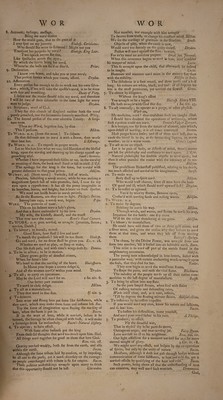
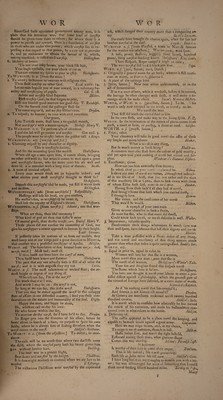
![Fancies and notions he purfues* XVhich ne’er had being but in thought : Each like the Grecian artift woos The image he himfelf has wrought. Prior. My proud rival woos Another partner to his throne and bed. Philips’s Dijlrejl 'Mother. Oh, ftretch thy reign, fair peace! from fhore to (hore, Till conqueft ceafe, and flav’ry be no more; Till the freed Indians in their native groves Reap their own fruits, and woo their fable loves. Pope. 2. To court folicitoufly; to invite with importunity. Yet can Ihe love a foreign emperor, Whom of great worth and pow’r {he hears to be; If fhe be woo’d but by ambaffador, Or but his letters or his pictures fee : So while the virgin foul on earth doth flay. She woo'd and tempted is ten thoufand ways By thefe great pow’rs, which on the earth bear Cway, The wifdom of the world, wealth, pleafure, praife. Davies. Sweet bird that fhun’ft the noife of folly, Moft mufical, raoft melancholy ! Thee, chauntrefs oft the woods among, I woo to hear thy even-fong. Milton. To Woo. v. n. To court; to make love. With pomp, and trains, and in a crowd they woo, When true felicity is but in two. Dryden. WOOD. adj. [wods, Gothick; pob, Saxon; woed, Dutch.] Mad ; furious; raging. Obfolete. Winds do rage, as winds were woody And caufe fpring tides to raife great flood. Puffer. Coal-black fteeds yborn of hellifh brood, That on their rufty bits did champ as they were wood. Fairy Queen. Calm the tempeft of his paflion wood; The banks are overflown, when flopped is the flood. Fa. Q. Wood. «. f. [pube, Saxon; woudy Dutch.] i. A large and thick plantation of trees. The wood-born people fall before her flat, And worlhip her as goddefs of the wood. Fairy Queen. St. Valentine is paft: Begin thefe wood-birds but to couple now ? Shakefpeare. The woods are ruthlefs, dreadful, deaf and dull: There fpeak and ftrike. Shakefpeare's Pitas and Andronicus. Light thickens, and the crow Makes wing to the rooky wood. Shakefpeare's Macbeth. Hecate, when {he gave to rule the woods, Then led me trembling through thofe dire abodes. Dryden. i. The fubftance of trees; timber. Balm his foul head with warm diftilled waters, And burn fweet wood to make the lodging fweet. Shakefp. The cavity of the tin plate was filled with a melted cement, made of pitch, rofin, and itW-alhes, well incorporated. Boyle. Having filled it about five inches with throughly kindled wood-coals, we let it down into the glafs. Boyle. Of long growth there flood A laurel’s trunk, a venerable wood. Dryden's Mneid. The foft wood turners ufe commonly. Moxon. The fize of faggots and wood-ft.acks differs in moft countries. Mortimer’s Hujbandry. Herrings muft be fmoked with wood. Child. Wooda'nemone. n.f A plant. Woo'd bind. 7 n. r r„ubbint>, Saxon.] Honeyfuckle. Wo6'dbine. 5 J u Beatrice, e’en now Couch’d in the woodbind coverture. Shakefpeare. The nymphs of the mountains would be drawn, upon their heads garlands of woodbine and wild rofes. Peacham. Woo'dcock. n.f. [pobucoc, Saxon.] A bird of paffage with a long bill; his food is not known. It is a word ludicroufly ufed for a dunce. He hath bid me to a calve’s head and a capon ; {hall I not find a woodcock too. Shakefpeare. Soon as in doubtful day the woodcock flies, Her cleanly pail the pretty houfewife bears. Gay. Woo'ded. adj. [from wood.] Supplied with wood. The lord Strutts have been poffeffed of a very great landed eftate, well-conditioned, wooded and watered. Arbuthnot. Wooddr ink. n.f Deco&ion or infufion of medicinal woods, as faffafras. The drinking elder-wine or wooddrinks are very ufeful. Flayer on the Humours. Woo'den. adj. [from wood.] i. Ligneous ; made of wood ; timber. Like a ftrutting player, whofe conceit Lies in his hamftring, he doth think it rich To hear the wooden dialogue and found ’Twixt his ftretch’d footing and the fcaffoldage. Shakefpeare They ufed to vault or leap up; and therefore they had wood on horfes in their houfes and abroad. Brown's Vulgar Errours WOO Prefs’d with the burden, Caeneus pants for breath; And on his {houlders bears the wooden death. Drydeni The haberdafher ftole off his hat that hung upon a wooden pCg_ Addifon's Spectator* 2. Clumfy; awkward. I’ll win this lady Margaret: for whom ? Why, for my king i tulh, that’s a wooden thing. Shakefpeare. When a bold man is out of countenance, he makes a very wooden figure on it. A . Collier of Confidence. Woodfre'tter. n.f. [tereSy Lat.] An infe& ; a Woodworm. J Amfworth„ Woo'dhole. n.f. [wood and hole.] Place where wood is laid up. , ,, What {hould I do ? or whither turn r amaz d, Confounded to the dark recefs I fly, Of woodhole. x , , Phllt^\ Woo'dland. n.f. [wood and land.] Woods; ground covered with woods. , This houlhold beaft, that us’d the woodland grounds. Was view’d at firft by the young hero’s hounds* As down the ftream he fwam. Dryden's/t.ncid. He that rides poft through a country, may, from the tran- fient view, tell how in general the parts lie; here a morals, and there a river, wood’and in one part, and favanas in another. Locke 6 By her awak’d, the woodland choir To hail the common god prepares ; i And tempts me to refume the lyre. Soft warbling to the vernal airs. Fenton’s Ode to Lord Gower. Here hills and vales, the woodland and the plain, Here earth and water feems to ftrive again. Pope. Woodla'rk. n.f A melodious fort ot wild lark. Woo'dlouse. n.f [wood and loufe.] An Infedt. The millepes or woodloufe is a fmall infedl of an oblong fio-ure, about half an inch in length, and a fifth of an inch in breadth; of a dark blueifh or livid grey colour, and having its back convex or rounded : notwithftanding the appellation of millepes, it has only fourteen pair of fhort legs ; it is a very fwift runner, but it can occafionally roll itfelf up into the form of a ball, which it frequently does, and fuffers itfelf to be ta¬ ken. They are found in great plenty under old logs of wood or large ftones, or between the bark and wood of decayed trees. Millepedes are aperient, attenuant, and detergent; and the beft way of taking them is fwallowing them alive, which is eafily and conveniently done; and they are immediately de- ftroyed on falling into the ftomach. Hill's Materia Medica. Wrap thyfelf up like a woodloufe, and dream revenge. Congreve» There is an infetft they call a woodloufy That folds up itfelf in itfelf, for a houfe. As round as a ball, without head, without tail. Inclos’d eap-a-pe in a ftrong coat of mail. Swift. Woodman, n.f [wooda.n& man.] A fportfman; a hunter. Their cry being compofed of fo well forted mouths, that any man would perceive therein fome kind of proportion, but the {kilful woodmen did find a mufick. t Sidney. The duke is a better woodman than thou takeft him for. Shakefpeare< This is fome one like us night foundered here, Or elfe fome neighbour woodman. Milton. So when the woodman s toil her cave furrounds, And with the hunter’s cry the grove refounds. With grief and rage the mother-lion flung, Fearlefs herfelf, yet trembles for her young. Pope. Woo'dmonger. n.f. [woodand monger.] A woodfeller. Woo'dnote. n.f Wild mufick. Then to the well-trod ftage anon, If Johnfon’s learned fock be on, Or fweeteft Shakefpear, fancy’s child, Warble his native ivoodnotes wild. Miltort. Woodny'mph. [wood and nymph.] Dryad. Soft fhe withdrew, and like a wiodnymph light, Oread, or Dryad, or of Delia’s train, Betook her to the groves. Milton's Paradife Lojl* By dimpled brook and fountain brim, The woodnymphsy deck’d with daifies trim* Their merry wakes and paftimes keep. Milton. Woodo'ffering. n. f. Wood burnt on the altar* We caft the lots for the woodoffering. _ _ Neb. x. 34- Woo,dpecker. n.f [wood and peck ; picas martins? Lat.] A bird. , , r The ftru&ure of the tongue of the woodpecker is very lin¬ gular, whether we look at its great length, its bones and mu f- cles, its incompaffing parts of the neck and head, the better to exert itfelf in length, and, again, to retraft it into its cell; and laftly, whether we look at its {harp, horny, bearded point, and the gluey matter at the end of it, the better to flab and draw little maggots out of wood. Derham’s Phyf co-theology. Woodpi'geon or Woodculver. n.f A wild pigeon. W oodroo'f. n.f. An herb. Amfworth. 3° X W Oc/dS ARE-](https://iiif.wellcomecollection.org/image/b30451541_0002_1146.jp2/full/800%2C/0/default.jpg)