Volume 2
A dictionary of the English language: in which the words are deduced from their originals, and illustrated in their different significations by examples from the best writers. To which are prefixed, a history of the language, and an English grammar / by Samuel Johnson.
- Samuel Johnson
- Date:
- 1755
Licence: Public Domain Mark
Credit: A dictionary of the English language: in which the words are deduced from their originals, and illustrated in their different significations by examples from the best writers. To which are prefixed, a history of the language, and an English grammar / by Samuel Johnson. Source: Wellcome Collection.
1151/1176
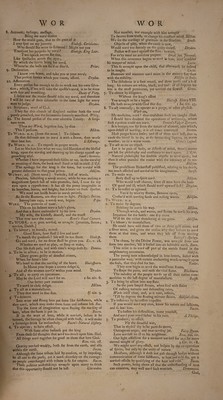
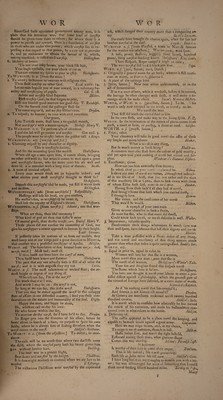
![Since God hath appointed government among men, it is plain that his intention was, that fome kind of worjhip ihould be given from fome to others ; for where there is a power to punifh and reward, there is a foundation of wojhip in thofe who are under that power ; which worjhip lies in ex- preffing a due regard to that power, by a care not to provoke it, and an endeavour to obtain the favour of it, which, among mankind, is called civil worjhip. Stillingfleet. 6. Idolatry of lovers. ’ I is not your inky brows, your black filk hair, Your bugle eyeballs, nor your cheek of ere m 1 hat can entame my fpirits to your w rjhip. Shakefpeare. To Worship, v. a. [from the noun. ] 1. Xo adore; to honour or venerate with religious rites. Thou (halt worjhip no other God. Exod. xxxiv. 14. Let no man beguile you of your reward, in a voluntary hu¬ mility and worjhipping of angels. Col. ii. 18. Adore and worjhip God Supreme. 'Milton. Firft worjhip God ; he that forgets to pray. Bids not himfelf good-morrow nor good-day. T. Randolph. On the fmooth rind the paflenger fhall fee Thy name engrav’d, and wo Jhip Helen’s tree. Dryden. 2. To refpedt; to honour; to treat with civil reverence. Our grave. Like Turkifh mute, fhall have a tonguelefs mouth. Not worfhipp'd with a waxen epitaph. Shakejp. Henry V. To Wo' rship. v. n. To perform afls of adoration. I and the lad will go yonder and worjhip Gen. xxii. 5. The people went to worjhip before the golden calf. 1 Kings. Wo'rshipful. adj. [worjhip and full] 1. Claiming refpedi by any character or dignity. This is worjhipful fociety, And fits the mounting fpirit like myfelf. Shakefpeare. When old age comes upon him, it comes alone, bringing no other evil with it; but when it comes to wait upon a great and worjhipful finner, who for many years has ate well and done ill, it is attended with a long train of rheums. South. 2. A term of ironical refpedl. Every man would think me an hypocrite indeed ; and what excites your moft worjhipful thought to think fo ? Shakefpeare. Sttppofe this worjhipful idol be made, yet ftill it wants fenfe and motion. Stillingfeet. Wo'rshipfully-. adv. [from zuorjhipful.] Refpe£tfully. Haftings will lofe his head, ere give confent, His mailer’s fon, as wirjbipfully he terms it. Shall lofe the royalty of England’s throne. Shakefpeare. Wo'rshipper. n.f [from worjhip.'] Adorer; one that wor- fhips. What art thou, thou idol ceremony ? What kind of god art thou that fuffer’ll more Of mortal griefs, than do thy worJhi;pers. Shakef. Henry V. Thofe places did not confine the immenfity of God, nor give his worjhippers a nearer approach to heaven by their height. South's Sermons. If pofterity takes its notions of us from our medals, they mull fancy onq of our kings paid a great devotion to Minerva, that another was a profeffed worjhipper of Apollo. Adiifcn. Worst, adj. The fuperlative of bad, formed from worfe : badt worfe, worjl.] Moft bad; moft ill. If thou hadft not been born the worf of men, Thou hadft been knave and flatterer. Shakefpeare. The pain that any one adually feels is ftill of all other the wo'Jl; and it is with anguilh they cry out. Locke. Worst, n f. The moft calamitous or wicked ftate; the ut- moft height or degree of any thing ill. Who is’t can fay, I’m at the worjl? I’m worfe than e’er I was, And worfe I may be yet: the worf is not, So long as we can fay, this is the worjl. Shakefpeare. That you may be armed againft the worf in this unhappy ftate of affairs in our diftreffed country, 1 fend you thefe con- fkJerations on the nature and immortality of the foul. Digby. Happy the man, and happy he alone, He, who’can call to-day his own: He who fecure within can fay, To morrow do thy wofy for I have liv’d to day. Dryden. Sir Roger gets into the frontiers of his eftate, before he beats about in fearch of a hare, on purpofe to fpare his own fields, where he is always fure of finding diverfion when the worjl comes to the worf. Addifoh s Spectator. To Worst, v. a. [from the adje&ive.] To defeat; to over¬ throw. The cafe will be no worfe than where two duellifts enter the field, where the worjl ed party hath his (word given - him gain without further hurt. Suckling. The bear was in a greater fright, Beat down and wo fed by the knight. Hudibras. It is downright madnefs to contend where we are fure to be werfed. L'Efrange. The vi&orious Fhiliftines were worfed by the captivated ark, which foraged their country more than a conquering ar*- my. So .tvs Sermons. She could have brought the chariot again, when fhe faw her brother worjled in the duel. Dryde ’ Ded l. s. Wo'rsted n. f. [from Worfed, a town in Norfolk famous for the woolen manufacture, j Woolen yarn; Wool fpun. A bafe, proud, (hallow, beggarly three fuited, hundred pound, filthy worfed-^. ocking knave. Shakefpeare , King Lear. There Ridpath, Roper cudgel d might ye view; The very worjl,d ftill look’d black and blue. Pope. Wort, n.f [pijvc, Saxon; wortt Dutch.] 1. Originally a general name for an herb; whence it ftill conti¬ nues in many, as liverwort^ fpleenwort. 2. A plant of the cabbage kind. 3. [pyjvc, S^xon.J New beer either unfermented, or in the a<5t of fermentation. If in tt.e wort of beer, while it worketh, before it be tunned, the burrage be often changed with frefh, it will make a fo- vereign drink for mela choly. Paeon’s Natural Hiflory. Worth, or Wurth, v. n. [peojfSan, Saxon.] To be. T his word is only now retained in wo worthy or wurth; wo be. Wo worth the man That firft did teach the cur fed lleel to bite In his own flefh, and make way to the living fp’rit. F. f. Wor th. In the termination of the names of places comes from pojvb, a court or farm, or pojrSig, a ftreet or road. Gibfon. WORTH, n.f. [peoj-rS, Saxon.] I. Price; value. Your clemency will take in good worth the offer of thefe my fimple and mean labours Hooker. What is wo> th in any thing. But fo much money as ’twill bring ? Hudibras. A common marcaiite fhall have the colour of gold exactly ; and yet upon trial yield nothing of worth but vitriol and ful- phur. Woodward's Natural Hifory. 2. Excellence ; virtue. How can you him unworthy then decree ; In whofe chief pa t your woru- -apianted be. Sidney. Is there any man of worth and virtue, although not inftruct- ed in the fchool of hrift, that hau nut rather end the days of this tranfitory life as Cyrus, than to link down with them of whom Elihu hath Paid, memento mo> i.ntur. Hooker. Having from thefe fuck’d all they had of worth, And brought home that faith which you carried forth, I throughly love. Donne. Her virtue, and the confcience of her worth That wou’d be woo’d. Milton, A nymph of your own train Gives us your charadler in fuch a drain, As none but fhe, who in that court did dwell, Could know fuch worth, or wo> th deferibe fo well. Waller. 3. Importance; valuable quality. Peradventure thole things whereupon fo much time was then well fpent, have fithence that loft their dignity and wo: th. Hooker. Take a man poffeffed with a ftrong defire of any thing, and the worth and excellency of that thing appears much greater than when that defire is quite extinguifhed. South's Ser. Worth, adj. 1. Equal in price to, equal in value to. Women will love her that fhe is a woman, More worth than any man : .men that fhe is The rareft of all women. Shakef eare’s Winter’s Taid Your Ion and daughter found this trefpafs worth The fhame which here it fuffers. Shakefpeare. You have not thought it worth your labour to enter a pro- feffed diffent againft a philofophy, which the greateft part of the virtuofi of Europe have deferted, as a mere maze of words. G anvii.es Seeptick. As if ’tis nothing worth that lies conceal’d ; And fcience is not fcience till reveal’d? Dryden. At Geneva are merchants reckoned worth twenty hundred thoufand crowns. Addifohs Italy. It is worth while to confider how admirably he has turned the courfe of his narration, and made his hufbandman con¬ cerned even in what relates to the battle. Addijon. 2. Deferving of. The caftle appeared to be a place worth the keeping and capable to be made fecure againft a good army. Clarendon. Here we may reign fecure, and, in my choice, To reign is worth ambition, though in hell. Milton. Hafte hither Eve, and worth thy fight behold, Eaftward among thofe trees, what glorious fhape Comes this way moving. ' Mi.ton's Paradife Loft. W hatfoever Is worthy of their love is worth their an <gor. Denham. This is life indeed ; life north preferring; Such life as Juba never felt till now Addifohs Cato. I have long had it in my thoughts to trouble you with a let¬ ter ; but was difeouraged for want of fomething that I could think worth fending fifteen hundred miles. Berkley to Pep.<• Many 3](https://iiif.wellcomecollection.org/image/b30451541_0002_1152.jp2/full/800%2C/0/default.jpg)